Podcast Archives
Prior to Risky Conversations, previous iterations of Jamie Lee’s podcast were hosted elsewhere; those early episodes have been preserved here in an archive for public access. If you want to subscribe to Jamie Lee’s current podcast, you can do that by visiting the Risky Conversations homepage.

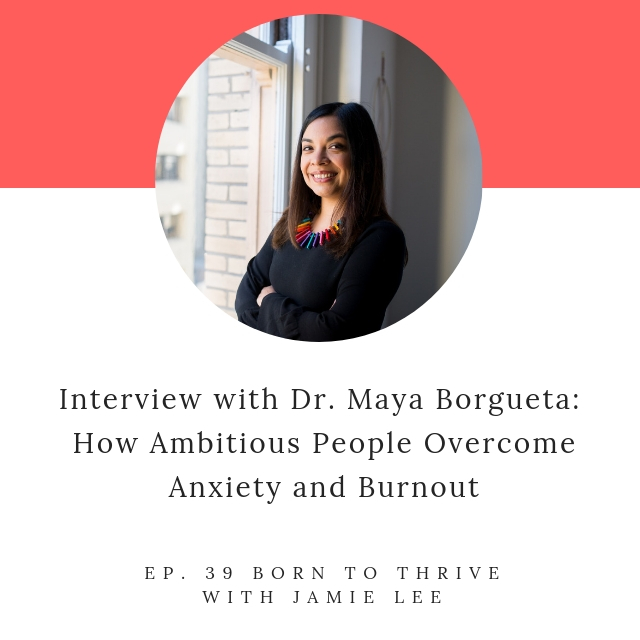
Interview with Dr. Maya Borgueta: How Ambitious People Overcome Anxiety and Burnout
Though I believe we are all born to thrive, I know there are days when that truth can feel like a lie, because of anxiety.
We experience anxiety more acutely when we most need our courage to brave a high-stakes conversation like negotiation.
In this valuable conversation with Dr. Maya Borgueta, a clinical psychologist and founder of Stella Nova Psychology, we explored:
- Why it's important to be prepared to know your worth at any time during job interview process
- What purpose anxiety serves
- Why it's not an emotion you need to avoid or push away
- How to manage your anxiety level in a simple, yet powerful way
- What self-compassion has to do with managing our anxiety
- How to recognize burnout
- Steps to take to address burnout
Learn more about Dr. Maya Borgueta on www.stellanovawomen.com
Though I believe we are all born to thrive, I know there are days when that truth can feel like a lie, because of anxiety.
We experience anxiety more acutely when we most need our courage to brave a high-stakes conversation like negotiation.
In this valuable conversation with Dr. Maya Borgueta, a clinical psychologist and founder of Stella Nova Psychology, we explored:
- Why it's important to be prepared to know your worth at any time during job interview process
- What purpose anxiety serves
- Why it's not an emotion you need to avoid or push away
- How to manage your anxiety level in a simple, yet powerful way
- What self-compassion has to do with managing our anxiety
- How to recognize burnout
- Steps to take to address burnout
Learn more about Dr. Maya Borgueta on www.stellanovawomen.com
Full Episode Transcript
Hello! Welcome to Episode 39 of Born to Thrive with Jamie Lee. I’m your host and coach, Jamie Lee.
Usually, I start each podcast episode with a really chipper, “I believe we are all born to thrive!”
I do. I really do.
But I also recognize there are days when that can feel like a lie.
There are days when I wake up filled with a lot of anxiety, self-doubt, guilt, shame, and it doesn’t really feel like I am born to thrive. It feels more like I am born to crawl back to bed.
Ever have one of those days?
I think we all do. I think it’s the human condition. But if I’m wrong, please let me know. And if you never have days like that, I would love to hear about your life! Email me, jamie@jamieleecoach.com.
I think we have days like that and I think that’s only human because our brains are hard-wired to seek out comfort and pleasure and safety. There’s a part of our brain that has never evolved from when we lived in caves and had to seek safety and comfort as if our life depended on it. As if our survival depended on it.
And so, yeah, there are days when it can feel like our brains are working against us, not for us. And I think that’s why mental health is so, so important. And on that topic, I have a very special guest.
My guest is Dr. Maya Borgueta. She is a clinical psychologist and founder of Stella Nova Psychology, a therapy group in downtown San Francisco that specializes in supporting professional women in their careers and in their personal lives.
Her practice focuses on supporting women in their 20s through 40s who work in tech, business and other industries, and the practice also strives to serve the needs of underrepresented groups like women of color. She has previously worked in a variety of settings, including university mental health, veterans’ affairs, rape crisis centers and, most recently, the health tech industry.
This conversation is going to be really useful for all of us who struggle with anxiety. I do. And I’m really interested and looking forward to learning about concrete ways we can help ourselves so that we can show up to brave uncomfortable conversations even when we have anxiety. We can do something to not let anxiety stop us from being courageous and taking the lead so that we can thrive.
So, without further ado, please enjoy this interview with Dr. Maya Borgueta.
Jamie: Hello! Dr. Maya?
Dr. Maya: Hi, Jamie! How are you?
Jamie: I’m doing great! Thanks so much for coming onto the podcast.
Dr. Maya: Thank you for inviting me. I’m glad to be here.
Jamie: Yeah! So, first thing, I’d love to hear about a negotiation in your life or career that had the biggest impact for you.
Dr. Maya: Sure. I was thinking about this recently, because a lot of my clients have been going through a salary negotiation process recently and I actually came to learning these salary negotiations, I think, a little bit late in the game. In my last job, actually. And previously, being a psychologist, I was in school for many years, I was applying for internships and practicum positions which just had a fixed salary. After that, I was working in universities where they had a fixed salary and you just kind of got set on the pay schedule and went up the ladder, kind of step by step, everybody was in the same position and then I transitioned to the private sector. I worked for a role at a mental health tech company, a startup.
So, my first salary negotiation happened at that last job and it happened really out of the blue. I didn’t know I was going into it. I was expecting to go through several steps before we got to the salary negotiation. I thought that I was going to interview and then I’d go home and if they wanted me, they’d call me and, you know, talk to me about salary then. And that’s not at all what happened.
So, I went in for the interview, and on that day I met with a bunch of people and last I met with the CEO of this tech startup and he basically said I had the job if I wanted it and asked what I wanted right then and I was not at all prepared to answer that question. So, I was winging it completely, which maybe was a good thing because I might have been a little anxious had I known I was going into a salary negotiation.
Jamie: So, he basically asked you to name your salary.
Maya: Exactly!
Jamie: Yeah. So, what did you say?
Maya: So, I dove in and I asked him...so, I’d been doing a little bit of contract work with the company before I was interviewing for this job and I asked him to match that hourly rate for my salary, which was a wild ask. It was way more than anything I could have possibly expected for the job. It would have made me probably one of the most high-paid people at the company. And he very quickly did the math in his head and told me that wasn’t gonna happen and he came back to me with, “Okay, well, what is your current salary at your job?” And at that time I was working at a university counseling center, so in college mental health, which is fun work but it is notoriously not paid well. So, he asked me what my current salary was and I answered truthfully, which was about $75,000 at that time and he said they were thinking of offering me something around that number.
Jamie: Quick question.
Maya: Yeah!
Jamie: Was this in California and how long ago was this?
Maya: It was in California and, let’s see, that was around 2015?
Jamie: Oh, okay.
Maya: Yeah, summer of 2015. So, I know that there’s laws now that you can’t ask that question.
Jamie: That’s right, that’s right.
Maya: Yes. But at that time, it was not off the table.
Jamie: Yeah.
May: Yeah, so maybe I started off with a mistake there. I was caught off guard. So he said, “Okay, well, that’s around what we’re looking to offer you.” And so I countered that by telling him, truthfully, that I was also looking at other employment in the private sector at the time. Even thought this job was, by far, my first choice, I was looking at other jobs at that time and I told him that I would be able to make closer to, you know, around $90,000 in other jobs that I was looking at, so that that $75,000 was not a good point of comparison for me as I was thinking about making financial decisions about my next job.
Jamie: Right, yeah. And then, where did you settle?
Maya: So, we settled on that. We settled on $90,000, which I was very happy about at the time. I actually did end up re-negotiating my salary about a year later. I learned that my salary was still below what was considered median for a psychologist in this area here. It can vary quite a bit around the country, as many jobs do, but it was below median, so I was able to re-negotiate that again.
Jamie: Great job! So, what did you take away from that experience? What was your lesson?
Maya: So, my lesson was that it is a valuable thing, always, to be prepared to know and discuss your financial worth confidently. Even though I wasn’t expecting to have that conversation that day, I think I could have set myself up for a better discussion. It ended up turning out well for me in the end but I think about it actually a lot like another concept that I discuss with my therapy clients a lot, which is setting boundaries. I tell them, you can’t set boundaries with other people until you have a clear idea of what you yourself need. And I think it’s similar with your salary. You can’t negotiate your salary without having a firm understanding going into it of what you need and what you can accept.
Jamie: I couldn’t agree more. I think how you negotiate one thing is how you negotiate other things in your life and, you know, salary negotiation is just an extreme example of setting those boundaries. Like you’re saying, “This is the work I will do for x amount of money,” right? Yeah. Great lesson and great story! Earlier this week, I gave a webinar about how to anchor and basically, you ended up anchoring at an extremely high place and your to-be employer set a new anchor and then you effectively broke the extremely low anchor by countering, saying, “I am also looking at other jobs and I’m looking to make $90,000,” so, well done! This is a great story and a great lesson to take away.
So, as a psychologist, I’d love to hear about how you approach and explain anxiety. You know, for me, anxiety is something that I deal with on a daily basis, and I think anxiety is something that comes up when everyone, like a lot of people, when they think about negotiating, there’s just anxiety there in the top of their mind. So, I’d love to hear, in your expert point of view, what we can do to manage it.
Maya: Sure, absolutely. So, anxiety, as you’ve already said, it’s a really common concern for people. It’s actually, I think, the number one issue that my clients in my practice come to talk to me about. And we don’t all experience anxiety disorders but virtually everybody experiences anxiety that comes up in certain situations. And experiencing anxiety says nothing, actually, about your ability or about your competence. The clients that I work with, in particular, are really high-functioning, intelligent women. They’re accomplished and ambitious professional people, so I just want to point that out to bust a little bit of the stigma around there.
Jamie: Yeah, and it can feel like the truth when your anxiety is saying things like oh, you can’t do it, blah blah blah.
Maya: Oh my goodness, yes!
Jamie: And I call my voice the Itty Bitty Shouldy Committee.
Maya: I love that, yes. That’s exactly true. And we tend to think of anxiety as an emotion, which it absolutely is, but it’s also a really complex series of physiological responses that we have in our bodies whenever we are anticipating something to be potentially threatening or potentially dangerous. And our body doesn’t really distinguish between threats like messing up an interview and being embarrassed or something that’s actually physically dangerous, like you’re getting mugged, right?
So, when we’re headed into a scary-feeling negotiation, we’re actually, in our bodies, experiencing a low-level or sometimes a full-blown fight or flight response. And actually, we now know that that fight or flight response that most people are familiar with is actually fight, flight or freeze. So, if you’ve ever experienced freezing up when you’re in a moment of anxiety, feeling like you can’t think or you can’t talk or your brain is just on pause…
Jamie: Or crawling back to bed.
Maya: Absolutely, absolutely. Yeah, so, in your body, when you’re anxious, what types of feelings do you usually have?
Jamie: When I’m feeling anxious, I feel nervous. I feel shame in advance.
Maya: Mmm, yeah, absolutely. That anticipation.
Jamie: Yeah, yeah. I have this anxiety around public speaking. Even though I do it all the time, the anxiety still comes up every single time. And I would say it’s that the heart is beating really fast, like you talked about, the flight or fight response. There’s a temptation to be like, “Uhhhh, I don’t know if I can do it,” you know?
Maya: Yeah, yeah, so your heart races, you get that, maybe, sometimes when I feel really anxious I feel a little bit short of breath. Especially when I’m talking, like I can’t really catch my breath. A lot of people feel it as stomach upset, so, you know, nausea or just cramps in your stomach or, you know, that butterfly feeling.
Jamie: That’s right.
Maya: It’s really, really common. And I like to point out, you’re saying you get a little bit of anxiety every time you go to speak. A little bit of anxiety is not necessarily a bad thing in and of itself. A little bit of anxiety can actually be helpful for performance. If we’re not at all anxious, maybe we don’t prepare as well, right? You know, a little bit of anxiety can make you go the extra mile as you’re getting ready. In the moment, it can improve your alertness and it can give you a boost of energy, too. So, a little bit of anxiety is not necessarily a bad thing. Too high anxiety in the moment can really be paralyzing and particularly if you’ve ever had a panic attack, that’s a really acute high level of anxiety. You really can’t function at all. So there’s a wide range of what anxiety can look like, right?
Jamie: Right.
Maya: So, when I’m working with a client, my goal, I always tell them at the beginning, to kind of set expectations around this and normalize that anxiety is an okay emotion to have. My goal is never to eliminate anxiety completely or make anxiety the enemy. It’s to turn the volume down so that your anxiety’s not up at a 10. You want your anxiety maybe to be at a 3 or even a 4. That’s a level that most of us can still function perfectly well at.
Jamie: Yeah, yeah, that’s a really interesting point. In an earlier episode, I was having a conversation with a career coach and she made the distinction between confidence and courage and I think there’s this kind of a myth about the very confident person who shows up with zero anxiety, zero fear but in reality there’s always gonna be a little bit of anxiety and, in fact, what I’m hearing is that it actually can serve a really great purpose in helping you to prepare, be alert, do your best.
Maya: Yeah. Anxiety is, like all of our emotions, actually, it’s an evolved response and it’s evolved in humans because it helps us. If you think about your health, if you had zero anxiety you probably wouldn’t do routine things like getting your pap smear or your physical. I’m out in California, so the example that always comes to mind is a little bit of anxiety is going to get you to build your earthquake kit so that you’re prepared, right?
Jamie: Yeah. What if you feel like you’re teetering on the edge of like 8 or 9 right before you engage in a high-stakes conversation like salary negotiation?
Maya: Yeah, absolutely. And I think salary negotiation is definitely one of those situations that can trigger that level of anxiety for a lot of people. So, in that moment, I think doing something to ground yourself can be really helpful. I really love, one thing that works for me and that I actually pull out as a tool when I’m finding my anxiety creeping up, anywhere from, I get a little nervous on planes when there’s turbulence, I do it when I’m on a turbulent airplane ride, I do it before I go to the dentist, and I do it before I get on stage or go up to do speaking as well. It’s something called box breathing. Have you heard of it before?
Jamie: Yes, I have heard of it before.
Maya: Yeah, so the idea behind it is that when you’re in a state of anxiety, your nervous system is really overactivated, so it’s a way to calm down your nervous system. And it’s really simple and the idea is just that you are taking some nice, slow breaths but you’re doing it in a really specific way. It’s called box breathing because you are going to inhale to a count of four, hold that breath for a count of four, exhale for a count of four, and hold the breath out for a count of four. And when I do it, I find that even doing that for like four or five cycles of breath can be enough to really, dramatically change how I’m feeling. It sounds simple and it is simple, actually, but it’s really effective and so I love having a tool like that for going into something that I know will be challenging.
Jamie: I read about it in Brene Brown’s book and I remember doing it, doing the box breathing as I was walking to work because the thought of going into work, into the office was creating anxiety for me, yeah.
Maya: Yeah, definitely, and that’s one of the nicest things about it is it’s a tool that you can literally do anytime, anywhere. I’ve done it during meetings before. Nobody has to know you’re doing this thing to manage your anxiety. It’s really kind of a stealth anxiety management tool.
Jamie: Yeah, and I love that it’s something that is so easy and it’s just breathing, but breathing in a very conscious and deep way, intentional way. Yeah, that’s very powerful.
Maya: Yeah, and I remember hearing Brene Brown actually talking about that. She learned about it from people in the military. They actually are trained, they don’t call it box breathing, they call it tactical breathing, but they do it as a way to center themselves, even in a combat situation. So, it’s used really everywhere from the military to yoga studios.
Jamie: Wow. And I know you recently gave a talk at Bullish Conference about self-compassion for ambitious people and I would love to hear from you, what is the connection there?
Maya: Sure, sure. So, I have become a little bit of an evangelist about self-compassion with the ambitious professional women that I work with and before I get into the anxiety connection, just to tell you a little bit about self-compassion and what it is and how I think about it: the reason that I ended up developing this talk which I’ve had the opportunity to give in a few different places at this point is that I was noticing this thread coming up again and again with my clients and also myself, for that matter, the tendency to be really hard on ourselves. And even really accomplished, competent, ambitious women were struggling with really impossibly standards for themselves, harsh self-criticism, stuff that we [audio drops] goes on with people in our lives that we care about.
So, to give an example of this, you could imagine watching your best friend just blow a presentation that she’s worked really hard on for the past week, for past six weeks. Everything’s gone wrong. She’s tripped up, she’s forgotten things, she’s given misinformation. Most of us, in that situation, we would really, deeply cringe for her, right? It would be painful to watch. But we’d also comfort her. We’d remind her that she’s still awesome, that she’ll get the next one. We might actually even also help her figure out what actions she needs to take to move forward, right? Maybe she needs more practice, maybe she needs to talk to a therapist about her performance anxiety that might be getting in the way, right? What we generally don’t do with our best friend who’s messed up in this way is we generally don’t call her a loser. We generally don’t tell her she’s never gonna amount to anything or that she’s worthless or that she’s nothing but an embarrassment.
Jamie: Ooh! Good one! Yes! You hit it on the head right there.
Maya: But the thing is that when the tables are turned, when it’s us that’s made the mistake, it’s exactly what we do. We tell ourselves we’re idiots, we’re losers, we’re stupid, we obsess over the situation and we can play it over and over again in our heads.
Jamie: Yep. Been there. Done that.
Maya: Yeah. I think it’s really relatable. When I did this talk for the first time in San Francisco, I was actually just like kind of putting it out there. I put some tickets up on EventBrite. I was like, I don’t know if people will come to this, but worth giving it a try. I was just starting to build my practice. It sold out in three days. I didn’t do any paid marketing, I just posted in a few Facebook groups. And it resonated so deeply because it’s something that I think is so, so very common.
So, basically, self-compassion is the practice of treating ourselves with the same care and kindness that we would treat somebody we loved. It doesn’t mean that we’re coddling but we are supporting and encouraging and offering empathy and kindness to ourselves. Even and especially when we’ve messed up.
Jamie: Yes. So powerful.
Maya: Yeah, so bringing it back to your original question about anxiety, what does this all have to do with anxiety? Well, one thing is that you can imagine that your self-critic can cause a ton of anxiety. It’s obviously anxiety-provoking to be hearing you’re not smart enough for this, you absolutely can’t mess this up, or everybody thinks you’re an idiot, right? Anybody would be anxious hearing somebody telling us that, whether it was somebody outside or ourselves telling us that same message. So, when we learn how to calm that inner critic and quiet that inner critic it can really be helpful for soothing our anxiety.
Jamie: And I think the first step is just recognize that this is the voice of the inner critic. It’s not me. We tend to over-identify with our own thoughts, so being able to make that distinction, oh that’s just the inner critic. That’s just the part of my brain that talks to me like that. Nothing’s actually gone wrong.
Maya: Yeah, exactly. You know, you were saying before about anxiety how when you’re in the middle of it it just feels true. It feels like all your anxious thoughts are true. I think we can have that same kind of distortion around our inner critic that because it’s being harsh, it’s the unblemished, objective truth and that if we think anything else, we’re just deluding ourselves. But really, having a negative bias on how we look at ourselves is just as harmful, if not more harmful, than having an overly positive filter.
Jamie: Yeah, and I love the self-compassionate way, because compassion just means to be with, right? And so it takes being able to recognize and acknowledge it, not push it away or reject it, but like, okay, I have these thoughts in my head. These are just thoughts. For that reason, I always advise my clients, what I do all the time is write down the stressful thoughts, the anxious thoughts, like you’re not gonna amount to anything, you didn’t do a good job, or whatever. You’re a loser.
Maya: Exactly! So, you know, if you were noticing that you were anxious, either, you know, some people are more tuned in with their body, it’s easier for them to kind of first recognize that they’re feeling anxious, because they notice that their heart’s racing and their palms are sweating and they’re feeling a little shaky. Other people are really heady and might notice that they’re really just ruminating on an anxious thought. Whatever your personal kind of red flags are that, ooh, this sounds like anxiety, this sounds like my self-critic, it’s a signal to yourself to check in and take a pause and see what you need in that moment. Self-compassion is figuring out what is good and helpful for you in the moment.
Jamie: Excellent. Yeah, so I have one more question about this.
Maya: Sure!
Jamie: So, I know that anxious people, anxious people who are very ambitious, we also tend to burn ourselves out because we listen to that inner critic that says you gotta do and do and do and do more.
Maya: Right.
Jamie: So, I’m curious to hear, what are some ways, some strategies that you advise your clients take to avoid burnout?
Maya: Yeah, so burnout is a really specific type of exhaustion. It’s one that we get, mental and physical exhaustion, when we’re under chronic stress and it seems to be a theme in our conversation today but we don’t always realize that we’re in the middle of it. So, the first step is to be able to recognize that that’s happening for you. It’s something for me, as a psychologist, that I’ve had to work at because I think, you know, those of us that are in caregiving types of professions can burnout and experience compassion fatigue at really high rates.
So, you know, signs that I look for to recognize when I’m burnt out is if I’m feeling tired all the time. Even when I’m getting enough sleep, I still have that bone-deep exhaustion. Another sign that can come up is feeling cynical or pessimistic or maybe even resentful about some kind of project that you really care about, something that you’re working on. If I find myself getting unusually annoyed at my clients, that’s a sign to me that I’m burnt out. And another one that is, I think, particularly relevant to those of us who identify as being ambitious, professional women is we can lose confidence in ourselves and also find it really hard to enjoy our success and kind of discounting that.
So, that’s step one. Recognizing that you’re in the middle of it. And the next step is figuring out what needs to change in the structure of your day-to-day life. A lot of people kind of jump from oh, I’m burned out, I need to take a vacation. And a vacation can be a wonderful first step, but just taking a vacation does not solve burnout. I think we’ve all had the experience of going on vacation and it is lovely and it’s heavenly for a week and you think, “Ugh, I’m gonna go back to work and I’m never gonna be stressed again. I’m just gonna imagine myself back on this beach.” And you get back to work and your emails have piled up and maybe your boss is still a jerk, or maybe there’s still too much work to get through in your work day and you’re there until 9PM. And nothing has changed and you’re right back to square one and maybe even more underwater now that you’re back from a vacation. So, take a vacation, I am not anti-vacation, but you need to think about what needs to change in a bigger way in your life.
Jamie: Oooh.
Maya: Yeah. Are you making space for your self-care basics? Do you have enough time for food? Are you getting routine medical care? Are you making time to get enough sleep to be fully rested? Not just enough to function, but to be rested. Are you exercising? Are you getting social time? All of those things are non-negotiables. And maybe we need to set boundaries in our life or delegate some of our responsibilities if we’re not able to make time for that.
Jamie: You’re giving me a lot to think about here.
Maya: Sure. What stands out for you?
Jamie: It’s thinking bigger. It’s not just about quick fixes but structurally, how are you designing your career? How are you operating in your life? I think those are the bigger questions that you’re helping to raise for me. Thank you!
Maya: Absolutely. And I think it can be helpful to think about what is your personal mission statement. Or what are your core values? What really matters to you in your life and are you getting to engage with that stuff in your normal day-to-day?
Jamie: Yeah.
Maya: If the answer is you’re not doing that much, then if you want to reduce your burnout, you also need to find a way to fit things you’re passionate about into your life. And it seems a little counterintuitive, right? Add something new in when you’re already burnt out? But those are the things that energize us. We need rest for energy but we also need kind of emotional energy that we get from doing things that are really meaningful.
Jamie: I think for me it’s the constant thinking about work.
Maya: Mmm-hmm. Yeah, yeah. I’m a psychologist but I’m also an entrepreneur and building a new business and I’m in the process of hiring employees and we’re getting ready to move into a new office and there’s always something new on the table and that has been something that’s a struggle. Putting work down at the end of the day.
Jamie: Yeah. It’s mental hygiene.
Maya: Exactly. We need to take care of our mental health as much as our physical health.
Jamie: I love that even those of us who work with people and help other people, like you and me, we still gotta do our own work.
Maya: Absolutely. You know, I think it can even be harder sometimes. One of the downsides to being a person who loves to help other people and who really gets joy out of being able to help people reach their goals is we can lose sight of our own and there has to be that balance. Because, you know the saying, you can’t pour from an empty cup.
Jamie: Exactly. This has been such a valuable conversation and I’m really getting a lot of insights for me. Thank you. Where can people go to learn more about you and the work that you do?
Maya: Absolutely. So, you can go to my private practice website, which is stellanovawomen.com and that is the website for my therapy practice in downtown San Francisco where I focus on serving the needs of professional women to care for their own mental and emotional health. And you can also follow us on Facebook and Instagram and Twitter @stellanovawomen.
Jamie: Okay! Dr. Maya, thanks again for your valuable time. I have some things to follow up now after this conversation and I look forward to hearing more about the wonderful work that you do at stellanovawomen.com.
Maya: Okay! Thank you so much, Jamie. It was really wonderful talking to you.
Jamie: Bye bye!
Maya: Bye bye!

Interview with Jay Fields: How to Use the Brain in Your Body to Overcome Anxiety and Building Confidence and Strength
Jay Fields is a somatic educator and therapeutic coach who teaches women how to regulate their nervous systems -- or "the brain the body" -- so they can manage anxiety and difficult emotions with empathy and connection.
In this impactful interview, Jay walks me through exactly what happens in our bodies, our brains, our nervous systems, and in our behavior when we encounter negative emotions like anxiety in the moment of a high-stakes conversation.
We explored:
- How to deal with anxiety in the moment of negotiating without freezing, fleeing or fighting
- How to manage negative emotions so they don't sabotage your outcomes
- What it means to have your own back and the power it gives you to name the "elephant" in a negotiation
- How to get better at setting boundaries and saying no with confidence and strength
Learn more about Jay here: jay-fields.com

Jay Fields is a somatic educator and therapeutic coach who teaches women how to regulate their nervous systems -- or "the brain the body" -- so they can manage anxiety and difficult emotions with empathy and connection.
In this impactful interview, Jay walks me through exactly what happens in our bodies, our brains, our nervous systems, and in our behavior when we encounter negative emotions like anxiety in the moment of a high-stakes conversation.
We explored:
- How to deal with anxiety in the moment of negotiating without freezing, fleeing or fighting
- How to manage negative emotions so they don't sabotage your outcomes
- What it means to have your own back and the power it gives you to name the "elephant" in a negotiation
- How to get better at setting boundaries and saying no with confidence and strength
Learn more about Jay here: jay-fields.com
Full Episode Transcript
Hello! Welcome to Episode 31 of Born to Thrive with Jamie Lee. I’m your host and coach, Jamie Lee.
My mission is to help ambitious people like you become bolder, braver, and better paid. I believe that negotiation skills are leadership skills and that good negotiators lead the conversation and that good leaders negotiate.
And today I have a really powerful conversation that I’m really happy to share with you. It’s an interview I did with Jay Fields, and in this interview, we talked about The Big F.
Yes.
Feelings.
We talked about the power of emotions. The impact emotions have on our bodies, our brains, on our nervous system and in our reactions or in our behaviors. I think it’s so important to acknowledge, to accept, and to manage emotions in order to become a better negotiator and in order to become a better leader.
And so, I hope you find this conversation useful and you use the tools that Jay shares with us, because I certainly have, and I have used them to do better in my public speaking, I’ve used them to improve my coaching, I’ve used these tools to improve my negotiation, and I’ve used these tools even at home to deal with conversations, sticky situations in my interpersonal relationships.
To learn more about me and my services, please visit jamieleecoach.com and I hope you enjoy this interview.
Jay Fields is a somatic educator, therapeutic coach, and author of the book Teaching People, Not Poses. Jay is unique in that she teaches women how to regulate their nervous systems and have empathy for themselves so that they can manage anxiety and difficult emotions and stay connected, engaged with the people and projects they work with.
So, without further ado, here’s the interview with Jay Fields.
Jamie: Hi, Jay!
Jay: Hey, Jamie.
Jamie: Thanks, again. I want to say. This is our second time trying this recording. Thanks for making the time.
Jay: Of course!
Jamie: And I’m really excited to talk to you about how to deal with the anxiety that arises in the moment of negotiation. Because I think that’s the really tough part. Preparing, coming up with a script, it’s not so hard, but actually dealing with that negative emotion in the face of pushback or the first sign of pushback.
And so, I want to ask you, what do you have in terms of strategies that you can advise our listeners, how to communicate with clarity and conviction that makes it easy for people to connect with the other side?
Jay: Right, yeah. I hear you. Even if you have the script it doesn’t necessarily make it easy. So, before I answer that question, let me put what I’m going to say into some context. So, anxiety and emotions, other emotions, are felt sensations that we have in our body that then our brain in our skull interprets, okay? And so, that means, for example, you get a tightness in your chest and you interpret that as I’m scared.
And what happens then is that, if you’re unaccustomed to being in tune with your body, and/or you’re not willing to have an emotion in the time that it’s coming up, such as in a negotiation, it will affect the nervous system. So, your nervous system is the brain in your body, right? And what usually happens is either there’s the fight/flight response that revs up the nervous system and you get that amped feeling in your body or there’s the freeze, or sometimes called collapse response, where your body just kind of flatlines, your energy flatlines, you numb out. And either way, it feels hard to gather your thoughts, it’s hard to say a sentence clearly, to make sense.
And so I bring that up because when we talking about managing anxiety or managing emotions, especially in the workplace, I think it’s really, really important to understand that on the first, primary level, it really is about managing sensation in the body. And that, I think, people can go oh, okay, maybe I could do that.
And so, the way to do that is...I mean, there’s multiple ways to do it. One of the ways that I feel is really great to do that is through practicing what’s called a felt resource, and a felt resource is something that is inside your body that you can go to to bring yourself back to your best self. And there’s three. One is grounding, one is centering, and one is orienting.
And I’ll unpack them a little bit, and as I do, I’m going to encourage you and your listeners to just get a sense, to go through it with me and see what happens.
Jamie: So, should I try it now? As you talk me through it?
Jay: Yeah! Because the felt resource, what I think is so great about them is, it isn’t something that you necessarily need to sit down, eyes closed, back straight, fifteen minutes, practice this. These are the sort of things that they’re best used in the moment and come back and come back and even if it’s three or four seconds, just see what happens, okay?
So, the first one is grounding, and that’s literally just putting your feet on the floor or imagining that you can feel the connection to the earth. You feel the 6,000 miles of earth underneath you, or if you’re sitting in a chair, you feel your butt in the chair, you feel your weight supported. And so, just notice, as you do that, as you feel your weight in your chair, or you feel a more intentional connection to the ground if something happens to your energy level or to your breath.
Jamie: Yeah, I feel like I kind of slowed down my breathing a little bit.
Jay: [Breathes out] Yeah, so there’s kind of like a [exhales].
Jamie: Yeah, like I’ve calmed down a bit.
Jay: Yeah, so that’s one. Another felt resource would be to center. And by centering, what I mean is to imagine you could gather all of your strength or all of your power into the center of you, wherever it is you experience that. So it might be your belly, it might be your heart, and this is one of the things that, when we have the fight/flight response, often what happens is it feels like our energy dissipates. It just kind of goes bleh in every direction.
So, I’d like you to see what it feels like to imagine that you could kind of pull yourself back to your center. Bring all your focus there and just see if that makes sense in the way of, does something happen on a sensational level in your body that lets you know it’s working?
Jamie: Yeah, well, I just notice I took some sugar and caffeine to power through the day and so I’m feeling the blood pumping through my veins right now.
Jay: Okay.
Jamie: And I have a question for you. So, what happens if you’re doing the centering exercise and you don’t like it? You don’t like what comes up.
Jay: Yeah. Exactly. Okay. So, let me come back to that and tell you the third felt resource before I forget, because I probably will, and then I’ll come back to that question, okay?
So, the third felt resource - there’s grounding, there’s centering - the third one is orienting. That one is looking around the space that you’re in and taking in the familiar objects, the colors, the textures. It’s kind of like the YOU ARE HERE sticker at a trailhead, you know? Where you’re just kind of looking around and reminding yourself, okay this is what’s happening, you’re expanding your awareness. Because the other thing that’s happening when your nervous system goes into fight or flight is we get tunnel vision. We get beady eyes, right? And all of a sudden all you can focus on is the thing that’s freaking you out. So, to just look around the room, and you don’t have to do it in a big way that makes you look like you’re crazy, but just to kind of take in okay, there’s the couch, there’s the desk, this is happening, I’m here.
So, back to your question. It’s a really, really great question. What happens if you check in with one of these felt resources, it brings you back into your body and what’s happening and you don’t like it?
Jamie: Yeah.
Jay: First off, you’re a human being. That’s what happens for most of us, which is part of why this is hard for people, is, for the most part, our internal experience, for many of us, isn’t comfortable. It isn’t welcoming. It can even be painful or full of anxiety and so part of what the felt resource is for is not just to bring you back, but to then also be a container for what’s happening, meaning you will experience discomfort, or you might experience discomfort, and if you do, it will not kill you. And, here’s the thing, because the nervous system responds to discomfort as a threat, it feels like it will kill you.
Jamie: Yeah.
Jay: It feels awful. Nobody likes it. And it won’t [kill you]. And so, what if you don’t like the experience? Well, one, acknowledging this is the experience I’m having, I don’t like it, and it won’t kill me.
Jamie: You know, can I add to that?
Jay: Please.
Jamie: Yeah, I love that it’s not gonna kill you, but it feels like it might. I think about my early career experiences and I’d think, “Oh, I can speak up and mention this,” or “I can speak up and ask for this,” and then immediately my mind goes to oh, but then they’ll think I’m blah blah blah, or they’ll push back and it’ll be so embarrassing and that future projection of how things might go wrong for me was so frightening!
Jay: Right, and you spin out, and I think what you just said is super important, Jamie, the future projection. Because that’s the thing about the felt resources, is they bring you into the present moment. And in the present moment you might be having a sensation that is uncomfortable, however, you are not in danger. In a physical sense, you’re not in danger.
But the other piece that’s really important, so you’ve got the felt resources, and then you have the other piece that I call having your own back. So, in order to have your own back, first is you need to be able to feel what’s happening in your body.
Jamie: Literally.
Jay: Literally! Like what’s happening? Do I have a heaviness in my stomach? Do I have a tightness in my chest? Are my hands sweaty? You know, do I feel like I’m just dissipating energetically and I’ve got no skin left anymore? Am I disappearing? You need to be able to feel those things first, but the second piece, and this is the most important piece, especially when it’s something you don’t like feeling, is meeting yourself with your presence.
So, that’s what the grounding, centering, orienting helps you to do. So, meeting yourself with your presence and then adding empathy and kindness. Meaning, the easiest way that I’ve found to do this, because this is really, really, really hard for most people, because most of us are used to meeting a sensation that’s uncomfortable with well, you shouldn’t feel that way! or buck up! or get your shit together! We kind of try to snap ourselves out of it.
Jamie: Yeah, you might go to your center and start thinking, oh, I need to some more ab exercises, which is a thought I did have.
Jay: Yeah, totally! That happens too, like oh, what’s happening here, right? So the adding empathy piece, so there’s the use the felt resource, get present with what’s happening in my body and then there’s the second piece of use that presence to essentially say to yourself, of course you feel that way.
So, you’re in the negotiation. You’re already anxious because you’re asking for something that’s a really big ask for you. The person that you’re speaking with goes, “Oh, really? Because I don’t think we can do that.” And they push back and all of a sudden the anxiety increases, the rev in your body increases, and if there is a part of you that can go, oh, this is happening, I don’t like that it’s happening, and of course it’s happening. Right? You affirm the thing that’s happening, and if we scan back out, this is what all good relationships are built upon, right, is empathy and understanding. Being able to say, “Oh, Jamie, as your friend, of course you feel that way, you know, I understand that.” If you came to me and said, “I’m super anxious right now,” I wouldn’t say, “Well, figure it out because this is high stakes, come on!”
Jamie: “Buck up!”
Jay: Exactly! I’d say, “Of course you feel that way, this is a big deal.”
Jamie: Yeah, or “I’ve never done it before.” or “You haven’t had so many opportunities to negotiate on behalf of yourself. You were always expected to negotiate on behalf of other people, so it feels foreign.” Yeah, and I love that you’re, I guess you’re talking about compassion for yourself, ultimately, yeah? Because it’s like having empathy for yourself as if you’re your own friend.
Jay: Yeah. Kindness! Like this novel idea that you could offer kindness to yourself.
Jamie: Yeah, I think it’s so powerful to be kind to yourself in a negotiation.
Jay: Mm-hmm.
Jamie: It probably is the last thing people think of. Oh, I need to have the right words and the power and the leverage, but yeah, what about kindness to yourself?
Jay: Yeah, and I want to acknowledge for a lot of us it’s really, really hard. It’s not how we were wired, especially in a high stakes situation, we were, a lot of us taught that the harder you are on yourself, the better you will be.
Jamie: Right, and there is the gendered stereotype that women are emotional, therefore they are not rational decision-makers, therefore they’re not good negotiators. And so, what you’re saying, sort of just subverts all of that. What you’re saying is acknowledging your emotions, allowing for emotions to come up and be present is actually a power, not a deficit.
So, I want to ask you a follow-up question about that, because I think a lot of us, even some of my clients tell me this, they think, oh, I just need to buck up! I just need to put emotion out of this and just power through! So they want to pretend that they don’t experience the anxiety, the fear, and the doubt. So, what’s the problem with that?
Jay: Okay, yeah, so you can do that. The problem is it disconnects you from yourself. There’s a way that you can’t be present to yourself, with what’s happening, and deny what’s happening. And when you do that, it means that you also can’t be present to the other person.
Jamie: Oh.
Jay: And it means that you can’t be present to your inner resources, like all the amazing stuff that you have on your resume that got you to this point where you’re negotiating for a higher salary. You don’t actually have access to those things if you are trying to deny your own experience in the moment. Does that make sense?
Jamie: Yeah, so when you deny yourself and you deny your own experience in the moment, you’re not present to yourself and therefore you’re also not present to the other side.
Jay: Exactly, and so it’s not about like, you have to tell the person I’m freaking out right now. Nor is that if you’re scared you need to curl up in a ball and manage that that way. It really does work to simply feel the feeling. Like, the sensation is I’m tight all over. I interpret that as I’m scared. And then just naming it and then on some level, even if it’s just like a hand on your heart or a hand on your leg, of course you feel that way and I’m here. Right? Being able to say to yourself, “And I’m here.”
Jamie: I’d love to add to that. I think it’s so powerful what you’re suggesting because our mutual friend and my mentor, Lisa Gates, she always talks about the power of naming the elephant in the room.
Jay: Right.
Jamie: And sometimes the elephant, you know, it’s not visible, it’s not something that we can perceive with our eyes, but it’s something we feel with our intuition. And so, being able to name that feeling, let’s say you’re negotiating with a bully and they’re implying some very nasty things but not making it explicit, right? So there’s an elephant in the room. You feel the feeling of having been, I guess, put down, right? And being able to tap into that feeling and naming that. Saying, “Hey, you know, I’m surprised you would say something like that and not realize that would really hurt my feelings.”
Jay: Right.
Jamie: That’s a kind of naming the elephant.
Jay: That’s so great. Naming the elephant, when it comes to it being your own experience is a way of really standing for yourself. Having your back.
Jamie: Right.
Jay: And that’s what the negotiation process is in the first place, right? This is just the second layer to that.
Jamie: Right, yeah. And it just deepens it and makes you more present. The more present you are, the better questions you can ask, the more information you can gather, and that way you gain more leverage.
Jay: Yeah, and the less your nervous system is hijacking your brain, the more you can have access to all your best qualities.
Jamie: Yeah, beautiful. It’s so true. So that you’re fully present. Yeah, so another follow-up question is, for a lot of my clients and this audience, we tend to defer to other people’s comfort for happiness. I am a recovering, extreme people pleaser.
Jay: Me too!
Jamie: Yeah, and we do this by overdoing, not setting boundaries, not asking for what you’re worth, not saying no when you don’t want to, saying yes instead of no. So, it seems that becoming more aware of your feelings would just make you vulnerable and disempowered and I think that’s a misconception, so I’d love to hear from you, why is that not true?
Jay: Yeah, it is a widely held misconception because we just don’t know a better way and so this has kind of been spread as this is true. So, to answer that, I’m going to also step back again and put it in context. So, every human being has three needs. They need to feel like they’re safe, they need to feel like they belong, and they need to feel like they matter. So safety, belonging and mattering. All of us need these. And we get these needs met, or don’t, through relationship with others. And how we got them met or didn’t, growing up greatly influences how we feel about ourselves and how we feel about the fact that we have feelings.
So, we’re relational beings, right? So, we get safety, belonging, mattering from other people, and that’s great, but it’s also really important to be able to give it to yourself. To be able to feel that you can offer yourself safety, belonging and mattering. Because, to the extent that you can’t offer that to yourself, that’s when, like you said, you try to either please others or control them, because that’s the opposite. You either please or control others. You don’t have any boundaries or you have too many and you keep people at bay. Or this is where addictive behaviors come in or where just self-criticism and self-hatred come in. So, why am I saying all of this in relation to your question? That is because when you acknowledge how you feel, when you can say the sensation is this, the emotion is this, of course I feel that way, that is a way of offering yourself a felt sense of I am safe, I belong and I matter.
Jamie: Wow!
Jay: Does that make sense? Literally, in your body, if you were to say to yourself, “Of course you’re scared, Jamie.” There’s a way that you’re there with yourself so you feel safe. You’re acknowledging and affirming how you feel, so you feel like you matter. And putting that together there’s this sense of I’m okay, I belong. Regardless of whether this bully or this not-bully who’s pushing back is giving me what I want in terms of feeling safe, belonging or mattering, I can do it for myself. And what happens is, when you get that for yourself, you don’t do all the weird, strategic behaviors that we do to try to get them from someone.
Jamie: Right. I just really love how profound and simple that was.
Jay: Yeah!
Jamie: Simply acknowledging yourself and that is the secret. Simply acknowledge how you feel in that moment and I guess what you’re saying is allow yourself to feel all the feels. Right?
Jay: Yeah, well, and in the moment, this is what makes, part of what makes this challenging. If you’re in the moment, you’re in the office with your boss and you’re negotiating, you can’t actually drop in and feel the feels entirely. But you can affirm them. You can affirm that they’re there and they’re real. And then it’s gonna still be in your system, right? And you walk out of the room and maybe you go into the bathroom and you get into a stall and you just kind of shake a little bit. Or you have a cry. Or you punch at the air. Whatever you need to do to start running the emotions through your body as opposed to just acknowledging that they’re there.
Jamie: I see. So, there is a process. It’s not just like, in the moment, split-second, saying oh, I feel these things. There you go, I’m done! You allow yourself to have the full process of the experience of the body sensations.
Jay: Yeah, and the thing is is it might be done in the moment, right? But if it’s an intense sensation, if it’s an intense experience, it’s gonna still be there when you leave the room. That’s why you leave the room and then you go back to your desk and you feel all jacked up and you can’t quite concentrate and you’re a little fidgety, right, is because all that energy, all that anxiety is still in your body. So, that’s an opportunity, maybe now that you’re not in the heat of the moment with someone there with you, you just, again, ground or center or one of them will work for you. For most people, one of them is easier than the others. So, pick the one that helps you to go, “I’m here in my body,” maybe a hand on your chest and just go, “I am anxious and of course I feel that way.” And just kind of let yourself feel it as a feeling, as emotion.
Jamie: Yeah.
Jay: But it all comes back to a relationship with yourself, really. That empathic and warm and kind and it isn’t, it’s something that’s felt, not cerebral.
Jamie: Got it. It’s literally a sensation in your body.
Jay: Yeah. It’s like, what if your best friend came and sat down next to you and put her hand on your leg and said, “Of course you feel that way.” You feel it. That’s what we’re trying to offer ourselves.
Jamie: Is there a way for people to cope with that resistance? We’ve been trained from such a young age to repress certain emotions, right? I’m Asian, so in the Asian culture there’s a lot of that emotion suppression, right? And also, we’re conditioned to say certain things in certain situations. All different ways of sort of pushing down your emotions and so, do you have a suggestion for people who are so accustomed to pushing down anger?
Jay: Yeah, oh my gosh, this is one of my favorite questions, I’m so happy you asked this! Because most of us in some form of resistance most of the time. Most of us have been conditioned culturally and in our family to believe that emotions are just not the greatest things ever and we should probably not have them.
So most of us are in resistance, and what I’ve found, the best way to work with that is first, acknowledge you’re there. So, typically, most of us at this point in our life know what we do to try and avoid feeling, right? We work long hours or we watch long hours of Netflix or we eat chocolate or we go grab a drink, or we do drugs. Most of us know what our thing is that we do to try and manage. And so, if you can catch yourself if one of those behaviors or you can catch yourself in that feeling of, “I feel nothing,” right? Where you go to look in your body and you go to see what you feel and you feel nothing. Or all you feel is just pure tightness everywhere. The way to work with that is to say to yourself, “I don’t want to feel this.” And what that does is it brings you back to being aligned with what’s true in your body’s experience, which is, in your body, you are currently in resistance. You are in fight, flight or shut-down. And if you can name, “No. NO. I don’t want to do this. I don’t want to go there, I don’t want to feel this.” You don’t even have to know what it is that you don’t want to feel. All you need to know is that your nervous system right now is telling you “No! I don’t want this.”
Jamie: So, acknowledge the resistance.
Jay: Acknowledge it! And what happens is one of two things: either you all of a sudden become aware of the thing you didn’t want to feel and you’re there with yourself feeling it, because it kind of sneaks up on you, right? Or you’re there feeling the no. But either way, you haven’t abandoned yourself, you haven’t left your resources. You can be angry and present. The same way that you can be resistant and present. And we’re just used to resistance looking like I’m not gonna be present.
Jamie: What might that look like? You’re angry and you’re present to it.
Jay: Good question. So, anger, typically in our bodies feels like heat. It feels like energy coursing through us. It feels like tightness, and so to be present to that is to acknowledge, I’m hot, my hands are gripping and I’ve got a lot of energy in me and I’m angry. And to allow that sensation to happen in your body. And you’re present with it.
So, I often talk with my clients about this in terms of, especially when it comes to anger, I talk about it in terms of wattage. If you think of yourself as a light bulb who’s typically a 60-watt light bulb and then somebody pokes the bear, and you get angry, and then all of a sudden, the sensations in your body feel like they’re 120 watts. And what we want to do is get out of there. That’s the nervous system response: fight, flight, freeze, this is too much wattage, I can’t handle this.
But you can actually, through using the felt resources and learning to be present with yourself, learn that wattage is just wattage. The same way that discomfort is just discomfort. It will not blow your circuitry. You can stand heat. You can stand tension. And then the interpretation of that is anger, and yes, you might have to acknowledge and feel the anger when you’re outside of this and outside of the situation, but in the situation, if you’re with a boss and they’ve said something that puts you down and you get fired up right away, you can be with the sensation of I’m fired up and not have it come out your mouth as something you wish you wouldn’t say.
Jamie: Yeah. That reminds me of something you said earlier about how we’re containers of emotion, so it’s kind of like taking yourself from inside that boiling pot into realizing, no, I’m the pot that holds this boiling water.
Jay: Right. And the big thing is is that none of this is about making the emotion go away, and I think so much of the new age or holistic kind of approaches to things is like you shouldn’t feel emotion or there’s negative emotions. And I don’t like to think of emotions as negative or positive, I like to think of them as uncomfortable or pleasant, right?
And you don’t have to get rid of the ones that are uncomfortable. You just use your presence, that felt sense of yourself, to help you regulate how much of that is in your awareness, versus how much of I’m grounded, I’m centered, I’m here in this space, I have resources, I belong here, I matter, I’m safe, right? The emotion doesn’t go away, but the other things, you just turn the volume up on them.
Jamie: Mmm, well this is really tremendous. I think this is very important because I do causal coaching and I help people deal with their mindsets and improve upon them and when you work with what’s in your mind, that always generates emotion and some of them are very uncomfortable, like doubt, anxiety fear. So, I think the felt resources that you shared with us and reminding ourselves that we are safe, that we do belong to ourselves and that we matter to ourselves, it’s so powerful. I think it changes everything.
Jay: It really, really does. I say that all the time.
Jamie: Yeah, thank you. So, where can our audience learn more about what you do and your services?
Jay: I have a website, and it is jay-fields.com and on there you can learn about the individual coaching I do and the trainings that I do at organizations and there’s a recorded guided meditation for the felt resources if you want to go back through them and there’s a bunch of writing and articles about different aspects of having your own back.
Jamie: Awesome, and Jay, I am a huge fan of your writing. I love the book Teaching People, Not Poses. I found it very relevant for me even though I don’t teach yoga, I teach negotiation. Being yourself is a great lesson to be reminded of. So, thank you so much for your time again and I will talk with you soon!
Jay: Great, thank you so much. I’m so grateful for this. Have a great day!
Jamie: Alright, you too.
Jay: Bye!