Podcast Archives
Prior to Risky Conversations, previous iterations of Jamie Lee’s podcast were hosted elsewhere; those early episodes have been preserved here in an archive for public access. If you want to subscribe to Jamie Lee’s current podcast, you can do that by visiting the Risky Conversations homepage.

How to Negotiate Budget Cuts and Unconscious Bias with Amy Auton-Smith
I met Amy Auton-Smith at Catalyst Conference in March 2019. She shared a salary negotiation story of how she successfully negotiated a win-win solution when the budget for her position was significantly reduced. I immediately knew I'd love to have her share both her negotiation story and the story of how she started her startup on the podcast.
Amy is a long-term champion of equality and diversity. As CEO of FairFrame, she's working to bring cutting-edge tech and diversity and inclusion research outcomes together to help mitigate the effects of unconscious bias at work. Amy is passionate about helping employers and leaders everywhere to ensure that everyone can achieve their true potential at work.
Check out Fairframe.io or on Crunchbase.

I met Amy Auton-Smith at Catalyst Conference in March 2019. She shared a salary negotiation story of how she successfully negotiated a win-win solution when the budget for her position was significantly reduced. I immediately knew I'd love to have her share both her negotiation story and the story of how she started her startup on the podcast.
Amy is a long-term champion of equality and diversity. As CEO of FairFrame, she's working to bring cutting-edge tech and diversity and inclusion research outcomes together to help mitigate the effects of unconscious bias at work. Amy is passionate about helping employers and leaders everywhere to ensure that everyone can achieve their true potential at work.
Check out Fairframe.io or on Crunchbase.
Full Episode Transcript
Hello! Welcome to Episode 61 of Born to Thrive with Jamie Lee. I am a leadership and negotiation coach and today I am really excited to share this interview with Amy Auton-Smith of FairFrame.io.
Amy is a long-term champion of equality and diversity and, as CEO of Fair Frame, she’s working to bring cutting-edge tech and diversity and inclusion research outcomes together to help mitigate the effects of unconscious bias at work.
Amy is passionate about helping employers and leaders everywhere to ensure that everyone can achieve their true potential at work.
I met Amy at the Catalyst Conference in New York City last month. She had a booth where she was showcasing her company, FairFrame.io and the technology is really cool and interesting and you’ll hear more about that in the interview.
But, while we were talking, when I shared with her that I’m a negotiation coach, she shared this amazing story of how she negotiated her salary, her working arrangement when she was still working as an attorney. She was offered a great job with great pay and then, right before she was about to say yes, the pay was significantly reduced.
And so then she came up with a solution to the problem that made both sides happy and she was happy with the outcome. So I thought it was a great story. I wanted you to hear it from her and also to learn more about the really cool work that women are doing, women entrepreneurs are doing, to help mitigate the effects of unconscious bias at work.
So, without further ado, here’s the interview with Amy Auton-Smith. Enjoy.
Jamie: Hello, Amy!
Amy: Hi, Jamie. Nice to speak to you.
Jamie: Thank you so much for coming on the podcast. Before we dive into the questions, I’d love for you to tell us more about FairFrame.io.
Amy: So, FairFrame.io is an early-stage startup based in New York which helps people to see the linguistics of unconscious bias, so how the way we express ourselves can indicate stereotyped ways of thinking. And then we also use our ability to surface unconscious bias and stereotype in writing to inform large-scale analytics for organizations. So we both help individuals to see, right there in the moment, how thinking processes can influence how we rate and appraise other people and we provide analytics for organizations on a large scale.
Jamie: Wow. This is really fascinating and I think people would find this kind of tool very useful and I know, for a lot of women, they encounter unconscious bias in the process of negotiating their careers and even their lives, you know. And so, I’m curious, for you, what has been the biggest negotiation that had the most impact on your life and career?
Amy: Well, just on the first part, we get such a positive response from women when they see what FairFrame does and how it really helps people to see where stereotyped thinking creeps into everyday interactions. We’ve had so many women, especially senior women leaders go “Oh, yeah, yeah. I’ve seen that before.”
I think for me one of the most notably interesting negotiations that I remember in relation to senior level positions was when I was applying for a leadership role and I’d been approached by the headhunter and I’d been given the specifications for the role, including the particular salary that was on offer, and I went through a very long selection process with multiple interviews including interviews with the chair of the company and the CEO and they indicated that they would like to make me a job offer but then the head of HR phoned me and, slightly apologetically, indicated that the salary for the role had changed and it had changed downwards quite dramatically.
So I inquired what was the reason for this and they said that the budget for the role had changed. So, at that point, I kind of was faced with a rather difficult situation because the role was one that I really wanted but the salary that was on offer was in no way attractive. So I took the information and said, “Okay, well, thank you very much. I’ll think about it,” and paused to reflect. My initial inclination was to say, “Okay, this is time wasting and they obviously don’t value the skills that I’m gonna bring to this role.” However, upon reflection, I thought, you know, maybe there is a budgetary element here and perhaps if I take them on face value, there might be an opening.
So I went back to them and I said “Well, the salary that you’re offering for the full-time role isn’t attractive but if you’d be interested in making the role part-time, I’m actually looking at starting some initiatives myself separately and I would be interested in a part-time role.” And I suggested that I work the equivalent of...the equivalent reduced number of hours to make the salary what they had originally suggested. And the head of HR took this away and very quickly came back and said that they’d love to proceed. So we turned what could have been, you know, quite a difficult situation to one where, in fact, in turned out better for me and I think for the organization as well.
Jamie: That’s wonderful! You know, this sort of thing happens more often than we’d like where you’re going for a position or an opportunity and the budget isn’t...and we’re like “Oh, this is great!” and then out of the blue somebody says “Oh, now we don’t have the budget.” So I really appreciate how you didn’t take it personally when the budget was cut. You didn’t make it mean something kind of negative about how they’re valuing you or undervaluing you and you were able to achieve a win-win situation where you got to take the job and have more time and get paid the appropriate amount of money. So, I’m curious, how did you go from there to starting FairFrame?
Amy: So I suppose perhaps my experience in that role did make me more attuned to actual variations in the workplace and, interestingly, for that particular workplace, my salary was quite helpful to them eventually when people did start querying the gender pay gap within the organization and, I suppose, fortunately for them, because they had me on this relatively high salary compared to a lot of other women in broadly similar roles in the organization, they were able to say that they were, you know, not applying a blanket differential in how they paid their people but there was the suggestion that this might be the case.
So I started to become quite interested in the dynamics of gender equality in leadership. And I have a long history of being involved in relation to gender equality generally, particularly, I started out with human rights for women and girls and then became a sort of amateur active workplace champion in the way that quite a lot of people do.
So, a few years ago, I started to look at changing from my career focus of being an organizational attorney. So I was chief legal officer in my last role and I was looking at ways to become more active and more agentic in relation to delivering change on gender equality. So, at the time, I started to look for academic courses in gender, classes that I could take at universities in the UK and, at the same time, my partner was offered the chance to move to New York.
And I always said no to this before because moving overseas and a UK-specific legal qualification don’t tend to hang together super well but I saw an opportunity, so the deal was we would move to New York and I would have a period of time in which I could study for a Master’s degree in a gender or gender-parallel field so I actually...we moved to New York about four years ago and I went to NYU to do a degree in general management but with the option, which I took, to take several classes in organizational diversity and that kind of iterated...I originally assumed that I would look for some kind of role where I could either work in an organization that helped to foster an environment of diversity and inclusion or perhaps to take a leadership role in relation to that.
And then being part of the NYU ecosystem gave me access to such an amazing entrepreneurial environment and it sparked the thought that perhaps I could become an entrepreneur and, at the same time, I was doing a project with a large, multinational organization in which I’d seen the lack of resources available to people who wanted to be more effective on identifying issues of bias and stereotype but there’s very few products available to help people. So, putting the two things together - the environment and also my desire to foster a more active role in relation to diversity and inclusion - led me to have the idea for FairFrame and to start down the process of becoming an entrepreneur.
Jamie: Excellent! You know, the way you describe it, it’s like one thing led to another, another, and then, you know, here you are. And I gotta ask, was it a smooth ride?
Amy: So...no. When I first moved to the US having quit my legal career, that was a pretty anxious time because the legal profession in the UK is a very defined career track, so I had one of those, nowadays, pretty unusual resumes where every position was an increasing level of responsibility, etc., etc. And I had reached a very senior level. So then to, you know, as my late night subconscious thought processes phrased it, “throw everything away” to move overseas and potentially start again from scratch was...it wasn’t easy and I did have a lot of nights when I lay awake wondering if I’d made a horrible mistake.
Jamie: Mmm. Yeah. I think a lot of the people who are listening would empathize because we want to create something new and audacious but there’s always that fear. And so what was the compelling vision for you to overcome, you know, those sleepless nights and doubt and all of that?
Amy: Well, fundamentally, I mean, I didn’t make this decision on a whim. So it was something that my partner and I looked at very carefully and we looked at whether it was affordable and doable and how it would fit into a long-term strategy and the risk was a pretty calculated one, to be honest. So, having the opportunity to come to the US and study at NYU is not something that is in itself a risky endeavor and there was always the possibility of returning to the UK and, you know, perhaps going back into the same career track, so I think the unconscious level of all the sort of evenings, late nights level of worry was not proportionate to the actual risk. And the risk that we were taking was one that we thought through and assessed and what it did do, of course, is open up way more doors than the one door that I’d closed by, you know, stepping away from my legal career to explore this opportunity.
Jamie: Mmm. Yeah, so kind of taking a step back and thinking about the landscape, what do you think is possible for women? You know, especially women like you who want to become bolder, braver, and better paid? You know, unconscious bias exists, right, so what can women do to overcome the barriers?
Amy: Yeah and I think that’s a really simple-sounding question which actually has a very complex societal framework around it. So, frankly, one of the only reasons why I can even contemplate being an entrepreneur is because I have a partner who is able to support our family and our family’s expenses. So, you know, I’m not single and in my twenties with, you know, a lifestyle that doesn’t carry a lot of inherent cost. I think that is an interesting part of the startup environments and the ecosystem, which is the extent to which the doors are not in fact open to all entrepreneurs.
And one of the things I’ve been thinking about is the extent to which support is available to entrepreneurs where...you know, working carries a cost. So, for example, if you have caring responsibilities and you need to travel or even be away from home for meetings, as soon as you have caring responsibilities, that isn’t a free activity. You have to pay someone to be there while you’re not and, for as long as entrepreneurs don’t have access to support in those early stages before businesses become revenue-generating and able to pay salaries, there is an extent to which the entrepreneurial ecosystem is gonna be a closed door. I think it will be very interesting for the VCs and the entrepreneurial support ecosystem to look at whether there is an interest in and whether there is an opportunity left on the table from entrepreneurs for whom working carries an actual cost.
I think, in terms of succeeding as a woman, being aware of the ways that unconscious bias and stereotype can play against you is probably good knowledge to have and then to be able to plot your route through despite the biases and the stereotype that might apply. So avoiding the kind of fix-the-woman approach, which tends to be quite prevalent in a lot of diversity and inclusion initiatives but also being aware that achieving an objective might require a more careful navigation than would be the case for, say, a man in a similar position.
Jamie: Mmm. So, what I’m gleaning from what you said is don’t assume that there is something wrong with you because you encounter an imperfect world.
Amy: No, absolutely. And I think the value that women entrepreneurs and entrepreneurs of color bring to the entrepreneurial ecosystem is dramatically undervalued at this point and despite the higher [indecipherable] in some circumstances, I think having that determination and also not taking it personally are good attributes to have.
And, fundamentally, there are a lot of ideas out there that are not being looked at by huge swathes of the startup ecosystem, so if you have a good idea and you have belief in yourself, push through some of the resistance that you might encounter because chances are that resistance is based upon the other person’s prior experience and expectation, which almost necessarily because of the low participation of women and people of color and other minority entrepreneurs in that ecosystem, their experience is likely not to include how you look at things and what you can bring to the table. So, obviously, pay attention to advice that you receive along the way but also maybe don’t always pay too much attention to it. Keep that self-belief.
Jamie: Yeah, I love that. So don’t just fold or give in immediately when you encounter pushback, right? Because it might have nothing to do with you. It’s all about what they’re thinking and believing based on their past experience. And so, you know, your first story really exemplified that really well. You encountered a potential obstacle and you’re like no, you know, maybe we can still work with this and you found a great work-around solution.
So, I’m kind of curious, you know, from using....from your work with FairFrame, do you have any suggestions, like communication strategies that you would recommend in terms of how to respond to, you know, language that is...or perspective or pushback that comes from an unconscious bias point of view.
Amy: Yeah, and that’s a really interesting questions because I would look at it from the point of view of why should the person on the receiving end be the one who has to recalibrate the behavior? And I would say the way we should be looking at this is not how can someone help someone else to understand that their own perspective and experiences might be different. Take that burden off the women and underrepresented people and actually ask those in positions of decision-making power to be more self-aware and conscious about people’s different lived experiences.
Having said that, if you are in an experience or a workplace where that level of sophistication in the levels above you or around you isn’t present...yeah, calling out behaviors can be helpful but also frequently can be tricky, so I think looking for the work-around and finding the allies, finding the supporters, finding the mentors is going to be key.
And I think, especially in the workplace, a lot of workplaces now are taking this a lot more seriously than has previously been the case so there might even be opportunities where, if the support is not available to you, actually there might be a door open somewhere for you to take a lead in saying, hey, we need this and it’s more than just me, there’s whole ways in which we as an organization can do better and see if those doors might open. But, yeah, fundamentally, it is a difficult paradigm to negotiate and there is a well-known backlash effect as well for raising things and raising things in certain ways and then that’s unfortunate.
Jamie: Well, let me ask you this: what would constitute, you know, communication that reflects unconscious bias? What’s something that gets flagged over and over again in your work with FairFrame?
Amy: So we, because we’re looking at the linguistics of bias, I’m connected in to quite a few people who are researching this at the moment and also starting to use some really interesting technology techniques to identify linguistic text for bias. So FairFrame combines a machine learning approach with also a social science-based approach. So we’ve gone through vast quantities of research to identify the linguistic tags of stereotype and bias that have previously been identified by researchers and what’s super exciting for us is people in the ecosystem that we’re interacting with have been really inspired to look at this as a source of study and obviously, this is happening elsewhere as well.
And we see...I got sent today, in fact, two pieces of research by someone that we’ve been talking to about the linguistics of bias and how, you know, the way that we think is reflected in the way we express ourselves. So classic examples would be, you know, think of the way things like the word “abrasive” and I mean this is a fairly well-known example which you would hope is still not being used but, you know, whenever we mention the word “abrasive,” senior women shake their head and say, ugh, I’ve seen this over and over again.
So changing from a description of “abrasive” to maybe “assertive” or “has direct communications skills” or “has a direct communication style” and asking managers to be aware that if you’re using this word and you’re using it for a women, that this is word that is dramatically more likely to be used for women and it carries a stereotype and a bias load, so rephrasing yourself and readjusting your thinking onto whether what you characterize as abrasive in this person in front of you might actually be just a very direct communication style when your personal expectation of them is that they are, maybe, warm and perhaps caring in how they present to other people but those attributes wouldn’t be expected uniformly across the peer group.
So just prompting that thought process: am I applying the same standards to this person in front of me as I would apply to others from a different group? And if the answer is maybe or no then it’s probably time to readjust your thinking and how you’re appraising this person in front of you.
Jamie: Yeah and I think when you say that, you really, you know, touch on both the opportunity and the challenge of addressing bias because it’s so deeply ingrained in how people think and somebody who says oh, that Cheryl is so shrill and abrasive…
Amy: Right.
Jamie: They’re just making an observation and not realize that they’re making a choice, an unconscious choice to see this person as problematic, not...rather than appreciating her directness. So, yeah, I appreciate that. Thank you. Well, you know, your work is so fascinating and I think it’s valuable. Where can people go to learn more about the work you do?
Amy: So, we’re still very early-stage and we haven’t launched a public-facing product yet so we’re working with some large organizations to refine and calibrate how we present this information to managers and also how we present the analytics in a dashboard format, so there’s www.fairframe.io, which is our company’s landing page, and then keep an eye out on LinkedIn, so I’m always happy to connect with people who want to see what’s going up on LinkedIn and I always post a selection of interesting snippets from the diversity and inclusion community, particularly ones related to linguistics and how we can be more effective and in the moment about the management of our own stereotypes and bias.
And I do want to be very clear about one thing right here, which is it can often come across as thought, when we talk about rating and appraising people in the workplace, we’re just talking about men rating women but one thing to be really clear about is stereotype and bias that focuses on gender attributes is something that is common to both men and women in the workplace.
So just to highlight, when I talk about a manager looking at a person in front of them, it’s not always the case that that manager is going to be a man. And these ways of thinking that we have are common across most human beings, so just to emphasize that there are ways in which all of us can become better at becoming more objective in our appraisal of others in the workplace.
And the key factor here, of course, is the ones who are less likely to benefit from stereotypes, positive or negative stereotypes, are women and groups that tend to be underrepresented as you move further up an organization. So everyone who’s in decision-making positions or positions of leadership, I would say it is a useful exercise to consider whether our own thought processes might be inadvertently blinding us to positive attributes in people in front of us.
And they’re a little discredited in some circles but there’s a really interesting little test you can do online called the Implicit Association Tests and these have been running for a very long time and they’re quite straightforward. What they do is ask people taking the test to correlate, for example, certain words with, for example, work or family. And the speed with which you can correlate, say, a feminine word or idea with family versus a feminine word or idea with work can indicate how easily your brain processes these and whether there’s a match or a mismatch in your unconscious processing. And I’ve taken these tests and it is really fascinating to just feel that slight hesitation sometimes when you’re trying to correlate something where your brain is saying, you know, men and career, women and family and then to try and switch round. And it was very interesting for me to take these tests because, despite my close engagement with diversity and inclusion, you know, it really brought home to me that my thought processes follow quite a stereotypical pattern until I self-correct.
Jamie: Mm-hmm.
Amy: To overlay that conscious level of processing information which is, of course, where that’s a decision-making and more objective decision-making arises.
Jamie: Yeah, I’ve taken the Harvard Implicit Bias test many years ago and I found out I was rather biased, more biased than I would like.
Amy: [laughs]
Jamie: And, you know, now that I work as a coach and I really help people shift their mindset, it’s all in the brain, right? The habits of your brain, the neural pathways that have been strengthened by practice. In other words, your just patterns of thinking over and over again and often these patterns are unconscious, it’s at the root of unconscious bias.
Amy: Definitely, yes.
Jamie: Yeah. It takes practice. It can be sometimes painful to realize that what you think to be true is not necessarily true. What we think is an observation and what we think is objective and when you say oh, that boss is terrible and these people hate me or this person has an agenda against me, you think you’re being objective but then you realize this is all opinions. Yeah, so…
Amy: It’s an incredibly huge...it’s an incredibly difficult for human beings to be genuinely objective and one of...Google has looked at this quite a lot and I was flicking through the Google re:Work suite of documentation and they highlight some research that shows the human brain has assessed by neuroscience researchers to process something like 11 million bits of information at any one time, of which we’re processing 40 consciously so, but sort of you know, 99.9996% unconscious in how we process the world around us.
And in the context of a busy workplace, particularly doing something that we feel we’ve got skills in and that we’ve been doing for many years, it’s exceptionally difficult to step out of those patterns of thinking, which is why I really hope that FairFrame will make a difference just in giving that in-the-moment prompt and that behavioral nudge, if you like, to apply a diversity thinking mindset rather than a pre-programmed thought process which is making those unconscious assumptions and decisions.
Jamie: Yeah. You’re doing really awesome work. Well, thank you so much Amy for your valuable time, your expertise and this great business that’s going to remind us more of our own unconscious thinking so that we can correct it and think more consciously and create better businesses and diversity in the world.
Amy: Jamie, it’s been a pleasure and thank you so much for your work in giving people voices and some interesting things to think about. It’s been great to meet you.
Jamie: Alright. Have a good one!
Amy: Thank you, and to you!

Two Simple Reminders That Improve Negotiation Outcomes: Dr. Julia Bear
According to research, women's monetary negotiation outcomes improved when they did two things before negotiating:
1. Recalling the last three times they were assertive
2. Imagining that they are negotiating for a friend.
In this episode, I interview one of the co-authors of this research, Julia Bear.
We explored this research, why what and how we think impact our negotiation results, and how we can apply research like this to improve our negotiation outcomes.
Julia Bear is an Associate Professor in the College of Business at Stony Brook University. Dr. Bear’s research focuses on the influence of gender on negotiation outcomes, as well as conflict management in organizations. In her research, she investigates what factors, both individual and situational, influence the gender gap typically seen in negotiation outcomes, and how an understanding of these factors can help to reduce this gender gap in both initiation of negotiation and negotiation performance.
Other resources mentioned include:
HBR article: 10 Myths about Negotiating Your First Salary
Book: Women Don't Ask

According to research, women's monetary negotiation outcomes improved when they did two things before negotiating:
1. Recalling the last three times they were assertive
2. Imagining that they are negotiating for a friend.
In this episode, I interview one of the co-authors of this research, Julia Bear.
We explored this research, why what and how we think impact our negotiation results, and how we can apply research like this to improve our negotiation outcomes.
Julia Bear is an Associate Professor in the College of Business at Stony Brook University. Dr. Bear’s research focuses on the influence of gender on negotiation outcomes, as well as conflict management in organizations. In her research, she investigates what factors, both individual and situational, influence the gender gap typically seen in negotiation outcomes, and how an understanding of these factors can help to reduce this gender gap in both initiation of negotiation and negotiation performance.
Link to the research: Negotiating Femininity
Other resources mentioned include:
HBR article: 10 Myths about Negotiating Your First Salary
Book: Women Don't Ask
Full Episode Transcript
Hello! Welcome to Episode 60 of Born to Thrive with Jamie Lee. I’m your host and coach - now a certified coach, thank you very much! - Jamie Lee.
And today, I have a really special episode for you. I have an interview with Dr. Julia Bear of Stony Brook University, who published fascinating research along with Dr. Linda Babcock - the famous Dr. Linda Babcock who co-wrote Women Don’t Ask. And Dr. Julia and Dr. Linda - all these doctors. I love it - they found that it helps women to recall two particular things before they negotiate. And when women recall these two particular things, it helps their negotiation outcomes, literally, in terms of monetary outcomes.
The first is that you recall the last three times you’ve been assertive and the second is that you imagine that you are negotiating for a friend. And I think this research is so fascinating, I think it’s so helpful because it gives us practical tools that we can implement in our negotiations.
This helps us because a lot of us have this limiting belief that women are not good negotiators and that holds us back from becoming bolder, braver, and better paid. We also have the limiting belief that, oh, I don’t really need to prepare mentally for negotiation, so I really love this research.
So, without further ado, here is the interview with Dr. Julia Bear of Stoneybrook University.
Jamie: Yeah, we have Dr. Julia Bear on the podcast. Welcome to the podcast!
Julia: Thank you!
Jamie: Do you prefer that I call you Dr. Bear?
Julia: You can just call me Julia, that’s fine.
Jamie: Okay. Alright, Julia. Well, for those who don’t you, you’re an associate professor in the College of Business at Stony Brook University and Julia’s research focuses on the influence of gender on negotiation outcomes as well as conflict management in organizations. In her research, she investigates what factors, both individual and situational, influence the gender gap typically seen in negotiation outcomes and how an understanding of these factors can help to reduce this gender gap in both initiation of negotiation and negotiation performance, which we’re all about because this podcast is about helping ambitious people become bolder, braver, and better paid.
So, Julia, I’d love to hear what sparked your interest in the topic of gender and negotiation in the first place?
Julia: Yes, well, you know I’ve always been fascinated by gender issues and gender differences. I just think it’s a fascinating phenomenon, generally. And when I arrived at Carnegie Mellon University to start my PhD in Organizational Behavior, there was a professor there named Linda Babcock who had just published a book which some of your listeners may even be familiar with called Women Don’t Ask.
Jamie: Yeah.
Julia: And so that literally had just come out and that was really, in many ways, the blossoming and the beginning of research on gender and negotiation and I just found it fascinating, this notion that negotiation, which is a very specific type of behavior and interaction, really serves as an underlying mechanism for so many of the gender gaps that we see, whether we think of gender gaps in salaries, career advancement, etc.
So once I got there and met her and she had just published the book and given my interest in gender, it was really just a natural progression from there to start really digging into this work on gender and negotiation, which, again, was really in the very initial phases at that point.
Jamie: I remember reading Women Don’t Ask in 2013 and it changed my life.
Julia: Mm-hmm. Yeah. It’s a wonderful book. I would encourage your listeners if they’re...well, obviously they’re interested in this topic if they’re listening to the podcast. It’s a very well done book and it also couples...Linda wrote the book, actually, with a journalist, so it’s nice in the sense that it covers research on gender but it’s also written in a very engaging manner. It also incorporates really interesting stories from women’s lives as well.
Jamie: Yeah and they wrote a follow-up, which is Ask for It.
Julia: Yeah, mm-hmm. And Ask for It’s very nice too. It’s more of a how-to book but full of really, really good tips, many of which I actually teach in my classes in terms of how to go about negotiating, particularly if you find it anxiety-provoking or uncomfortable, etc. So, yeah, that was a nice follow-up as well. Mm-hmm.
Jamie: Nice, nice. And I know you co-wrote this article: Negotiating Femininity: Gender-Relevant Primes Improve Women’s Economic Performance in Gender Role Incongruent Situations.
Julia: Quite a mouthful, yeah.
Jamie: And you wrote that with Linda Babcock.
Julia: Yes, that’s right. Since then, we’ve co-authored papers. Of course I’ve also written many on my own or with other co-authors. But yes, Linda and I co-authored that paper and that was published, I believe, in 2017, yeah.
Jamie: Yeah, so I will link the pdf of this article in the show notes. I’d love for you to give a bit of background about how you and Linda Babcock got the idea for doing this particular article.
Julia: Sure, so yes, there is some background to that article. So, when I started working in this area of gender negotiation, there were plenty of studies showing that if you look in sort of a very narrow landscape of negotiation, let’s say negotiating starting salary or negotiating price in a financial transaction, we tend to see that men, on average, tend to negotiate better outcomes than women.
And I want to be very clear here that all of this social science research is based on averages. I mean, of course there are plenty of women who love to negotiate; there are plenty of men who hate to negotiate, so gender can be a blunt variable, in a sense, to investigate. But on average, we do see men outperforming women
But I started to question the narrowness of the issues that we were investigating, right? And I started to say, if we think theoretically about gender, given men and women’s gender role, men are socialized and expected to be breadwinners, assertive. Women are typically socialized, expected to be communal, helpful, caring. I started to think, you know, maybe it’s no surprise that we see men outperforming women when negotiating over, you know, let’s say, financial issues or types of negotiation issues that map very well onto their gender role.
So, I started to investigate a variety of different issues, not just, let’s say, starting salary or price. But I tried to really test this notion that context should influence whether we see these gender differences. And, indeed, that’s what we found. So I published several papers showing that finding that, gender differences do depend on the context, the negotiation context.
And so I offer that as background to this particular paper because, once we had those findings, we then subsequently said okay, well if we know that there are certain contexts in which we don’t have gender differences, then how can we use that knowledge to actually help people to negotiate better and help women to negotiate better?
And thus the idea for that paper was born, in a sense, because we said, you know, is there some way where we can basically prime women psychologically to make the context feel like it’s a better fit? And that’s what we did in that paper. So, in other words, we said, okay, yes, there are a variety of contexts in which gender differences disappear and that’s all well and good but the fact is many people are negotiating things like salary or financial transactions. We know those are less of a good fit for women, so how can we perhaps psychologically prime them and make it a better fit?
So that’s sort of the background, this notion that there’s always this person-situation fit and for women, especially, competitive negotiations about money may be a poorer fit for women and we found that empirically in our older papers.
And so then that was the motivation for the 2017 paper was basically to say can we make - we called them gender-relevant primes. Because we said okay, wonderful, for women to make it fit better, we either need to remind them, sort of give them almost like a reminder, yes, you can be assertive, you can do this or try to make the situation fit their gender role better.
So that’s why we had two primes. We had one prime in which women recalled being assertive in the past right before negotiating and then we had one prime in which women actually imagined that they were gonna be negotiating for someone else. But both of those primes, the idea was to make the women’s fit with the negotiation situation better, so that it would improve their performance and indeed it did. That’s actually what we found.
Jamie: Cool! So that explains the title Gender-Relevant Primes.
Julia: Yeah. Mm-hmm.
Jamie: You know, helping women to see the negotiation as a better fit to how they see themselves.
Julia: Exactly. Exactly! So if you recall that you were assertive in the past, it’s kind of like, you know, a reminder that yes, the situation, this fits you, you’ve done this, so trying to make it fit that way. Or, again, the other prime we tested was okay, let’s reframe the situation psychologically. Imagine you’re doing it for a close friend. Advocating for other people has been shown empirically as a situation in which women negotiate just as well as men and so, by priming that way, it’s to sort of, you know, have women reframe the situation in a way that’s a better fit. Yeah.
Jamie: I really appreciate that in the title it says Negotiating Femininity, so it implies that femininity itself is negotiable. It’s a concept, really, and we can always reframe how we see our femininity so that we can see ourselves as a better fit to any situation, including a negotiation.
Julia: Mm-hmm, mm-hmm.
Jamie: Yeah. And I also appreciate the premise of the study and I’d love for you to tell us a bit more about that. And the premise is that what we think and how we think ahead of negotiating, particularly for money, impacts how we behave in the negotiation and, therefore, how we behave has an impact on our negotiating results.
Julia: Mm-hmm.
Jamie: And this fits perfectly to what I call the model, which is that even though circumstances are neutral, what we think about the circumstance is optional and what we think creates our feelings, therefore it creates our behavior, therefore it creates results.
So, tell us a little bit more about the behavioral impact that you observed. You discuss three different studies in this particular article so, tell us about the behavioral impact that you observed there.
Julia: Yeah, so basically, what we found is that across the three studies, when we compared women’s and men’s negotiation performance without the primes, men indeed outperformed women. Not a surprise. That’s what extent research has shown and, again, I just want to be clear on the effects, what we call the effect sizes in social science means sort of the magnitudes of the difference. It’s not huge, right? It’s not that men are incredible at negotiations and women are terrible but, on average, men were outperforming women.
But again, when we had women use one of the primes… so in the first study we studied the assertiveness prime and in the second study we tested the imagine it’s your close friend prime and then in the third study, we tested them both together and they actually worked equally well.
But, in any case, when women used these primes, in that case, their performance significantly improved in the negotiation and there was no gender difference. So, basically, men’s performance essentially stayed the same but women’s performance significantly improved and the gender difference was eliminated in negotiation performance.
Jamie: Yeah. And what I read from the article was the negotiation study participants had to do a mock negotiation where they were negotiating for the price of..was it an auto part? Engine?
Julia: Yes, yes. And we specifically chose that negotiation because in prior work - and that was the work I mentioned a few moments ago - in prior work, we have actually evaluated that particular negotiation and found that people generally rated this negotiation situation over the price of, actually, it’s the price of motorcycle headlights, people tended to evaluate this as a very masculine negotiation.
Jamie: Motorcycle headlights, yeah.
Julia: Yes. Well, it’s funny, is I have to tell you that negotiation exercise is widely used in negotiation training, which I actually find interesting and I wonder how that influences women in their training but that’s another issue. But in any case, yes, so we specifically chose that exercise to use in our study because we wanted to be sure that we were testing our primes in a situation, again, that was a poor fit for women. I mean that was the whole point of testing these primes, yeah.
Jamie: Yeah. So, my understanding of that prime was you were suggesting that women remember the last time they had to assert themselves and be forceful in defending…
Julia: Yes, exactly. Right. I believe it was recall three incidents, yes, and actually those characteristics that we chose, they actually are directly from an instrument called the Bem Sex Role Inventory and it’s directly from the measure of masculinity. So we actually chose those very intentionally from a theoretical perspective basically saying okay, let’s really test this notion that if we can, again, prime this masculinity for women, that will help mitigate the lack of fit and really help them improve their performance.
Jamie: Wow, fascinating! I didn’t know that there was a textbook about masculinity.
Julia: Oh, absolutely. There is very, very, very rich work on gender theory and this paper really was directly based off of that work. Yes.
Jamie: So it’s really theoretical. It doesn’t mean that, you know, men are this and women are that. It’s our concepts about gender.
Julia: Yeah, the concepts about gender that we tend to see in terms of the way boys and girls are socialized, the expectations for men and women’s behavior. And, again, it’s not that we’re saying all women are like this or all men are like that. Of course that would be sort of silly and simplistic but rather, from a big picture [indecipherable] perspective, we know that there are norms and expectations for behavior and we know that they differ for men and women. Yeah.
Jamie: Hmm. Okay. And I would like to just call out the distinction that it’s what we think about gender that impacts our behavior, so when we think that this is, you know, masculine behavior and because I am a woman I can’t behave that way, it hinders our willingness to participate in this sort of transactional conversation. That’s what I’m hearing. And so, I’m curious to know why do you think that recalling this perceived masculine behavior in the past had women improve their negotiation results in these mock negotiations?
Julia: You know, that’s a great question and I don’t have a good answer to that in the sense that we didn’t actually measure that. So, again, the question is what is the mechanism that’s explaining in the primes and we really didn’t get a good measure of that, so I can’t speak to that empirically so well.
You know, I do think, psychologically, it gives a sense, a greater sense, perhaps, of self-advocacy or a sense of feeling like, you know, yes, I’ve been in these situations before. I’ve done this. There’s also a great deal of research - and I see this in my research as well - that women do find negotiations much more aversive than men. They report much greater anxiety than men about negotiating, so it could also just be helpful in terms of quelling anxiety. It’s, you know, this is not a novel situation, so to speak, you know, reminding oneself I’ve done this before, I can do this again. You know, those are potential mechanisms. Yeah.
Jamie: Yeah, I’m gonna go out on a limb and guess that, when women recall being assertive and being forceful in their communication, they feel confidence from having remembered that they’ve done it before.
Julia: Mm-hmm, mm-hmm. Yeah, I think women have fewer opportunities as they grow up for social learning when it comes to negotiation, right? Social learning meaning learning through observing others’ behavior, similar others behavior. So I do think that having that reminder can be very helpful.
Jamie: Mmm, yeah. And that was one of the biggest takeaways for me from reading Women Don’t Ask about how men, young men, are often coached from an older male about how to play contact sports and that could be...and that sort of situation also plays out in negotiations because they get coached by other people and so I guess, long story short, when women are encouraged to recall the past behavior when they did defend and assert themselves, it’s kind of like you’re coaching yourself.
Julia: Mm-hmm. Yeah. I agree. I agree.
Jamie: Great! So, the second prime was that women were encouraged to prepare as if they’re preparing for this negotiation on behalf of a friend.
Julia: Mm-hmm.
Jamie: This is so fascinating and you call this gender-complementary, is that right?
Julia: That’s right. That’s right. It’s funny, it’s been a long time since I’ve looked at this paper, that’s right. So we called the assertive one that we were just talking about, we called it the supplementary prime, meaning it’s for supplementing and then this is the complementary, right, meaning that it’s trying to reinforce this notion that negotiation may in fact be complementary to aspects of women’s gender role.
Jamie: Yeah and so many of my clients and people that I’ve taught in workshops, they all have said...many and many of them say that they feel so comfortable negotiating on behalf of other people.
Julia: Mm-hmm. Yeah and this has definitely been shown empirically, that women in fact, when they negotiate for somebody else, they do significantly better than when they negotiate for themselves and they negotiate just as well as men do. And so this prime was really based off of those findings, right? It was saying okay, how can we harness, so to speak, the positive effects that we know happen for women when they negotiate for other people.
Jamie: Yeah. So what do you think was behind the psychological, you know, the underpinnings of that? When women negotiate as if they’re negotiating for a friend they actually get a better deal.
Julia: Yeah. I think, again, a really good question and we don’t have the data to speak to that. You know I think that it may...you know, there are two potential mechanisms. I think similar to the other prime, the supplementary prime or the assertiveness prime, I think, you know, it may serve as sort of a psychological....the word is escaping me right now...sort of a psychological cue to basically reframe the situation a more positive way, kind of break through that anxiety or discomfort, right? And, you know, make people realize that they can, in fact, mentally reframe the negotiation as a more positive situation in which they can feel free to be more assertive.
Jamie: Yeah, and what I notice as a coach is that a lot of people, including myself, we have difficulty seeing ourselves from the most objective perspective. We’re often our own harshest critics.
Julia: Yes, yes.
Jamie: And it’s hard for...it’s really easy to give praise to other people and extremely hard to accept praise for ourselves, especially if you are ambitious, overachieving. I think that that tendency kind of is congruent to, correlates to how driven you are because you think you drive yourself by not saying the kindest things to yourself instead of being as kind and loving to yourself. And so when you think about negotiating for a friend, as opposed to for you, I think it kind of switches on this more compassionate, even kinder aspect of ourselves and it’s very powerful because it actually improves the results.
Julia: Mm-hmm, mm-hmm. Yeah. Absolutely. It was interesting that, because, again, you know, we went into this paper with a very empirical perspective, of course, and it was interesting that both frames...both primes, excuse me, they did indeed work and if I remember the data correctly, I believe that they worked...I believe that the results were pretty comparable for both primes, which was also interesting in and of itself. They both sort of served as these cues for women to really reframe the situation and negotiate more assertively, yeah.
Jamie: And when you say that, do you mean that the results were comparable, meaning the impact on the actual…?
Julia: Yes, on the actual outcome, yes. I’d have to double check that but I believe, if memory serves, it wasn’t like oh, one prime worked so much better than the other. In fact they both worked pretty comparably, if memory serves.
Jamie: Well I’m of course not coming from an empirical perspective, I’m coming from a coaching perspective, but I love this. This is really fascinating and also it’s the kind of work that I do with my clients. I help them on an individual basis, you know, recall how they were confident and assertive for themselves and how...This is really great. I appreciate this.
So, if we may, I’d like to switch gears a bit and I want to ask you a personal question.
Julia: Sure! Mm-hmm.
Jamie: This is a question I ask everyone who comes on the podcast. What was a negotiation - and I want to tell you that I define negotiation simply as a conversation with the intention of reaching agreement where everyone has the right to say no, so a very broad definition of negotiation - what was a negotiation in your life or career that had the biggest impact on you? And I’d love to hear, you know, what had happened and what you learned.
Julia: Ummm….yeah, that’s a good question. So, there really is not one specific negotiation that stands out. I can say, on a personal level, that - and perhaps that’s why I was interested in this research - that I think it was really when I started working in this area that I, first of all, A) realized that things were negotiable and B) realized that I should start negotiating them, right?
So, I don’t think...so for me, negotiation is not particularly intuitive but I think that working in this area has made me more likely to negotiate and I have had several negotiations at work that I realized in retrospect had I not been working in this area, I might not have negotiated them or even considered the issues negotiable, so to speak, over, you know, a variety of issues.
Jamie: Could you give us an example?
Julia: You know, there’s not sort of a really specific example that comes to mind but certainly there were issues that came up when I was relocating from...I had been living in Israel and I was relocating to the US and there were just a variety of issues that came up in that relocation and starting a job here that, in the past, I think I would have just taken them as a given, you know, like oh well of course the moving expenses aren’t going to cover an actual relocation, right? Or well, of course there are health insurance issues moving from another country that I actually thought twice about and thought well, wait a second, why can’t...you know, this is an exceptional situation, why don’t I try negotiating some of these issues, right?
It is a different move than the organization is used to accommodating but why not ask for some...you know, clearly moving from a different country there are different needs. So, things like that that I think in the past I would have just not...it wouldn’t have even occurred to me to negotiate. Many issues I didn’t even consider were even negotiable. And today, I just very much view...actually I like your definition of negotiation, I agree. I also view it as a conversation that, ideally, people can find a win-win solution and reach an agreement but as you said I like that very much as well, everybody has a right to disagree, to say no and you know, you try, you make your best attempt and sometimes it works out and sometimes it doesn’t, you know?
But there’s no harm in asking, there’s no harm in trying and going in with a very collaborative and mindset of trying to solve a problem together. I think that’s a great conceptualization of negotiation.
Jamie: Thank you! And so, I’m curious, have you ever used one of these two primes yourself?
Julia: Yes, I have. I have definitely used some version of the assertiveness prime, absolutely. When I’m going into a new situation or a situation that I find intimidating for whatever reason, I’ve absolutely used that sort of reminder prime because I find it puts things in perspective. And sort of reminding myself, well, wait a second, you’ve done x, y, z, a, b, c, d, so, you know, you can do this, too.
You know the other thing I find really helpful as well to get better with using that prime is also just reframing the situation as learning experiences. So, rather than being sort of so nervous about something new or something daunting, reframing it as well, this is gonna be a learning experience. It’s something new I’m here to learn and yes, in fact, I’ve done a, b, c, d, e, f in my life and so we’ll just go in there and do it, you know, so that’s...I do find that helpful actually, yeah.
Jamie: Love it! So, three very actionable tips you’ve shared: First, before you engage in a negotiation, remind yourself of three times in the past where you did defend yourself, assert yourself, prove yourself. And two is you can also think about the situation as if you’re preparing for a very good friend. I’ve done a version of this, a variation of this, where I ask my client to think about how their best friend would describe them, the three words they would use, right? So it’s not you describing you, it’s your best friend or mentor describing you.
Julia: Yeah.
Jamie: Great. And then number three is just to think of the situation as a learning opportunity. So, you know, what can you learn? What is the lesson here? I think that’s a great, great tip.
Julia: Mm-hmm.
Jamie: So, finally, I think people would love to learn more about the kind of research that you do. Where can people go to learn more about you and your research?
Julia: So, that’s a great question and so...I’m laughing at your question because I think it’s a great question, unfortunately in academia, many of the journals that we all publish in are not always easy to access, which is unfortunate. They sort of sit in libraries and they’re often read by other academics as opposed to the general public, which is why I think it’s wonderful also your efforts to really translate this research to a wider audience.
But to answer your question, in terms of learning more about the research, they can certainly Google my website at Stony Brook, Julia Bear at Stony Brook. They can certainly email me through my website. I’m happy to share articles or anything else that is not accessible because it is, again, copyrighted and in journals.
And I also have a fun piece actually written with Linda Babcock on the Harvard Business Review website. It’s hbr.org and it is about the myth and reality of negotiating one’s salary. And so that’s a fun piece as well if people want to look at that and that’s not published in a journal that doesn’t like to...they should just be able to get access to that.
Jamie: Great. I will look it up and I will link it into the show notes.
Julia: That would be fantastic.
Jamie: Julia, this has been such a pleasure and there’s so much value here for all of us. Thank you so much for your time and for your expertise.
Julia: Thank you! And good luck to all your listeners with their future negotiations.
Jamie: Alright, great.
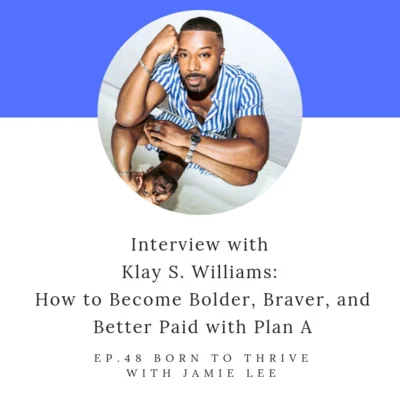
How to Become Bolder, Braver, and Better Paid with Klay S. Williams
How do ambitious people actually become bolder, braver, and better paid?
By making a contribution.
By committing to their life's purpose.
By risking their authenticity, even when there's only $500 in the back pocket and not much else, other than a dream.
This the story of Klay S. Williams, whom I met at a Dress for Success event in 2016.
Klay helps Fortune 500 professionals find their true purpose and satisfaction in four areas of life: Career, Relationships, Spiritual Lives, and Health. He's the founder of Plan A Enterprises, LLC, a full services lifestyle firm. He's also an author, speaker, and host of Plan A Konversations (the podcast) and Bookstr Wellness, a new digital TV show showcasing authors in the mind-body-spirit space.

How do ambitious people actually become bolder, braver, and better paid?
By making a contribution.
By committing to their life's purpose.
By risking their authenticity, even when there's only $500 in the back pocket and not much else, other than a dream.
This the story of Klay S. Williams, whom I met at a Dress for Success event in 2016.
Klay helps Fortune 500 professionals find their true purpose and satisfaction in four areas of life: Career, Relationships, Spiritual Lives, and Health. He's the founder of Plan A Enterprises, LLC, a full services lifestyle firm. He's also an author, speaker, and host of Plan A Konversations (the podcast) and Bookstr Wellness, a new digital TV show showcasing authors in the mind-body-spirit space.
Full Episode Transcript
Hi! Welcome to Episode 48 of Born to Thrive with Jamie Lee. I’m your host and coach, Jamie Lee.
Today, I have a special guest, my friend Klay S. Williams of Plan A Konversations.
You know, you meet one of these people who have become bolder, braver, and really better paid by making a contribution, believing in themselves, and taking courageous action because they are committed to their life vision and their purpose and Klay is one of those people.
And as you will hear when I was listening to his story, even though I’ve heard them before, I was just blown away. And I think it’s really inspiring and he sets a really powerful example of what is possible when we set our sights high and commit to becoming bolder, braver, and better paid.
So, please enjoy and I will talk to you soon. Bye!
Jamie: Hi, Klay!
Klay: Hi, Jamie! How are you?
Jamie: I’m doing great. How are you?
Klay: I am well, thank you.
Jamie: Nice, nice. So, let’s get this conversation started!
Klay: Yeah!
Jamie: I always ask my guests to tell me about a negotiation in your life or career that had the biggest impact on you. And I define negotiation as a conversation with the intention of reaching agreement.
Klay: Interestingly enough, this is a kind of ironic level of negotiation in terms of reaching an agreement, based off of intention. When I was in fourth grade, I grew up in Detroit, Michigan and I don’t know if you are familiar with the big drug boom that happened in LA, Chicago, and Detroit during the 80s but I was a part of that sort of period in time and we lived in a really great neighborhood and, all of a sudden, a drug house appeared on our block.
Jamie: Woah.
Klay: Right? Yeah. And so our next door neighbors, I went over to go get them to play after school, and their grandmother came and said, “Hey, they can’t come out and play because our street’s no longer safe,” and that was foreign to me. And so I asked her why and she said because there was a drug house and I was like, oh, okay.
So I went back home and I said to my mom, “Okay, I need you to get me the white pages, an envelope, a letter, and a stamp,” and she said, “What do you need that for?” I said, “If you give me this, this will help us with the drug house that’s on the block.” She was like, “Oh, okay,” and because I was really an eccentric kind of kid anyway, my mom didn’t think anything of it.
And so I wrote the mayor of Detroit, Mayor Coleman Young, a letter explaining to him the drug house that was on the block and I told him that me and my friends, who can no longer come out and play, we all got very good grades in school and if you want us to continue to get good grades in school and support us, could you do your part in making sure our neighborhood is safe and get rid of this house?
Jamie: Wow.
Klay: Jamie, it was like maybe four weeks later, we were riding our bikes across the street and of course we had a little safe zone because of the house and there was a SWAT team that came on our block, raided the house, and the drug house was no more.
I get a letter, maybe I think three weeks after that, and it was from Mayor Coleman Young thanking me for my tip and asking me if there was any other space that was preventing me and my friends or anyone else I knew from playing who got good grades, so we would make sure we kept our end of the bargain up.
Jamie: Amazing! What did you learn from this experience?
Klay: I learned that, in terms of the negotiation part of it, that there’s a lot of give and take. What is it that I was doing that I could use as leverage as a little kid in terms of the contribution to the world and to the space and what it was that I wanted to get out of this? But also knowing how could this benefit, you know, not only the city but other people around me?
And so that really taught me kind of what it was like to negotiate in the sense of a really roundabout way but it gave me a sense of being able to know that my power and my words and my contribution really matters.
Jamie: Amazing. And that also reminds me of your leadership! How you stepped into your leadership even as a little kid. You realized, I have a voice, I have power, I have the ability to communicate to the people who are in a position of authority. And I define leadership as creating solutions in the best interest of everyone and you created a solution that was a win-win for you, so that you can continue to have good grades and play outside, and for the community.
Klay: Yeah, that really set the basis as I moved on in adulthood and really thought back, wait a minute, let me comb through my past and see where are there other scenarios where I’ve been confronted with a challenge. How did I get myself out of it? And that literally, I think, was the foundation for how I would then approach any level of risk-taking, any level of leadership, and just courage in general.
Jamie: Alright, so let’s fast-forward. How did you apply those lessons in creating Plan A with Klay?
Klay: Well, interestingly enough, I was in grad school at Princeton Theological Seminary and I was working at Polo Ralph Lauren to offset the cost of grad school. I ended up getting a promotion to a manager, I was just a sales associate, and I was also, of course, getting my master of divinity across the street. And people started to come into Ralph Lauren not just to shop but to talk to me about their life issues and problems.
Mind you, I never told anyone that I was obtaining an M.Div. I kept my life very separate. And while I was having these wonderful spiritual awakenings and epiphanies at the door of this luxury brand service and not so much on campus at Princeton, I said to myself, “There has to be a way that I can juxtapose my love for nurturing the interior with image consulting the exterior,” and Plan A was sort of born from that in a Starbucks coffee shop in Princeton, New Jersey.
And while I was toying with idea, okay, how am I actually going to make this happen? And I said to myself at that point, “You’re gonna have to take a risk,” and I remember I had turned down so many wonderful opportunities because it wasn’t the perfect fit after graduate school.
Jamie: Yeah.
Klay: I ended up moving back to Detroit, Michigan where my parents were at the time and was just trying to get my mind together. I literally was a monster all of that summer because I knew what I really wanted to do but I did not tap into that courage that I had or that level of risk-taking, that level of leadership to even just say, “Klay, go ahead and go.” And so….
Jamie: And create this newfangled thing!
Klay: What’s that?
Jamie: And to create this newfangled thing that’s never existed before.
Klay: Yeah! Yeah and after, literally, Jamie, accepting this position over the summer. I had another luxury gig from my old boss at Ralph Lauren. I ended up going to New Jersey, I walked into the store, a sense of claustrophobia came over me, Jamie, and I returned the relocation check.
I went back to Detroit, Michigan. I said, “Sit down, Klay, you know what you want to do in your heart of hearts. You need to muster up all the strength and courage and take a risk,” and I moved to New York City with $500 and began this company.
I couch-surfed for a little bit, maybe close to a year. I called maybe 12 or 14 different friends and said, “Hey, can I crash on your couch maybe once every other week? You know, if there’s a time where I may need a meal, can you support me?” And then you know, asked them again, “How can I support you in exchange?” And so Plan A was born from that experience.
Jamie: Wow. So what helped you become bolder and braver than before? Actually, the question that I really want to ask is what made you decide and commit to that vision?
Klay: Good question. So, during that summer of me just being so incredibly unhappy because I was not living to the vision or the purpose that I had in mind, I knew that I would have to create what I wanted it to be. I was talking to one of my friends, Inger Parker, and I talk about her in all my books and my talks and things like that. And she said to me, you know, I said, “Well, if I just had x amount of dollars, then I can move to New York City. If I just x amount of relationships with this particular company or that network then I could do this.”
And she said, “You know what, Klay? It’ll never be perfect. It’ll never be exactly how you want it to be in order for you to move, so wait, you’re gonna wait until you’re, wait, 30, 45, 50, 60, then the grave?”
And when she said the grave part, there was something inside of me that said, “Oh my gosh, I do not want to be that person. I do not want to be that individual who has spent their whole entire life wishing, shoulda, couldas. I want to live to the highest expression of who I am as a person. I want to expand my mind and I want to really give this a shot. It’s something that I really believe in. I know that I can do it.” And that conversation, literally, was the impetus for me packing up my car and moving to New York.
Jamie: With $500 in your pocket.
Klay: With $500.
Jamie: Yeah. My father did something very similar. He packed up his life in South Korea and he was like, “I’m just gonna go to America. I’m gonna make it work.”
Klay: Yeah. Yeah. I’m gonna make it work. And I think there’s something inside of people who decide to do that where they feel like it’s perhaps a life or death scenario. Where if the vision of what you truly have is what you feel you’ve been called to do, there is no, I mean clearly, there’s no Plan B. I mean, that’s the whole reason why the work I do is called there’s only Plan A because that’s what I feel purpose work is at the core.
Jamie: Wow. So what changed for you as a result of that?
Klay: I’m sorry?
Jamie: What changed for you? What was the transformation you created for yourself when you stepped into that vision and you were like, “I’m gonna execute on this vision, I’m gonna live my purpose?”
Klay: It’s really interesting because I became bolder, I became more authentic. This was also a point where I was forced to face anything that I shoved in the closet and for lack of a better word or expression, I literally came out of the closet. I discovered during this whole period of time that I was gay. And by me deciding to go on this adventure, anything that I compartmentalized, anything that I did not want to face all came running to me like the floodgates had just opened.
Jamie: Mmm.
Klay: And I think I was the Universe’s way of saying if you want to get to the pot of gold at the end of the rainbow, you have to make sure that you are as authentic as the voice that you are speaking out to the world. Can you get beyond just speaking this level of jargon, but can you actually walk the walk?
Jamie: Wow.
Klay: And from that experience, I kid you not, like the sexuality piece came out and made me a better person. Anything, my relationship to money shifted, my relationship to other people shifted, any area that I felt inferior, I was faced with these things all within that first year. Me not wanting to ask for what I need. Me not setting boundaries with other people and then getting mad at them for…
Jamie: I think your story is going to be so inspiring for many people who just wait for the opportunity to be who they really are, who want the circumstances to line up so that they can speak up and stand in their own power.
Klay: Yeah.
Jamie: Yeah. And I love that you mention the money relationship because, as you know, a lot of my listeners, we, including me, we want to become bolder and braver so that we can be better paid.
Klay: Yeah.
Jamie: Yeah. So what, if anything, helped you become better paid? And I’d love to hear a story!
Klay: I have a great story for you. One of my...I had just changed my pricing matrix and I landed my first, one of my first Fortune 500 clients and she had this incredible epiphany, this incredible service and she ended up leaving corporate America and matriculated to her calling and passion and she enrolled the school of midwifery at Yale. She said to me before she left, “Hey, Klay, do you mind if I take you to brunch?” And I was like oh, okay, great!
And so we ended up going to brunch, she goes, “There’s a reason why I wanted so sit down with you,” and I was like, “Oh, okay” and I was like, okay, maybe she’s gonna give me some feedback that I need to hear as a coach or something maybe has transpired in her life and she said, “Take this the best way possible, but your prices are too low,” and I go, “Wait, what?”
She goes, “Klay, you have too many high touch points, you have such great quality and a level of transformation. The things that you gave me, I kind of felt that you gave a lot of things for free that were, could have been add-ons.” And she goes, “I’m glad I got in now, but you need to double your prices.”
Jamie: Woah!
Klay: Yeah!
Jamie: Do you mind sharing what your prices were before and what became after?
Klay: Right, right, so at that point I was charging $3500 for this monthly package that I was offering and after that conversation I literally start, my prices start at $10,000.
Jamie: For like a series of coaching?
Klay: For an extended service.
Jamie: For like how long a package is that?
Klay: Oh, got it, for the monthly Plan A interval package, is what I call it it, it’s a 30-day intensive.
Jamie: You’re charging $10,000 for a 30-day intensive?
Klay: Yeah.
Jamie: Wow.
Klay: Yeah.
Jamie: Nice.
Klay: She said to me at that point…
Jamie: Wait, wait, wait! So that’s almost triple the price!
Klay: Yeah! Yeah. And if I did not have that conversation with her, I would not have been, I don’t know if I would have said to myself, okay, you’re worth this amount of money. Maybe something would have happened later on but hearing it from a client who not only saw the value in it but also would pull me aside and said this is what I really think you need to charge.
And the good thing about it was she was in financial services, so she helped me map out, during that brunch, a pricing matrix that made sense for me and also for the level that I wanted to be at.
Jamie: Amazing. What I love about this story is that it was your client. It was your client who clearly saw the value of your contributions and you obviously had over-delivered many times over, right?
Klay: Mmm-hmm.
Jamie: And so you got the clear signal, you got the permission slip from the person who charges you. That’s really incredible.
Klay: Yeah. And I had never had that kind of experience happen before. I had people who were really satisfied but not to the point where they were like saying, “Let me help you out in this way by telling you that you’re undervaluing yourself.”
Jamie: Yeah. And I just can’t stress it enough that, you know, you first over-delivered and I think that’s so key. I was just reading this quote from Napoleon Hill, Think and Grow Rich…
Klay: I love that book and that quote! Go ahead!
Jamie: Yeah. And I’m gonna paraphrase but, basically, the person who does more than she is paid for will get paid more than she gives…
Klay: Yeah! And it says give more in use value than cash value. And that literally, and Jamie, this is crazy synchronicity, me and my marketing and business officer this morning just used that as a conversation point in our meeting for our 2019 goals. It’s so true, it’s so true.
Jamie: Wow. Amazing. I find this incredibly inspiring and wow, so what has happened since then?
Klay: Let’s see. So, since then, I’ve moved into a new building and, again, just started asking for what I want, utilizing my networks and that kind of thing, but so my offices are down in the Helmsley Building in New York City, one of the oldest historic buildings in all of New York, which has been such an incredible blessing.
Jamie: That’s near Grand Central, right?
Klay: Yeah! Uh-huh. Really, another great opportunity has come, like I’ve now set it up where media informs the business development and business development informs the media and so I’m hosting a show called Bookstr Wellness. I’m a regular guest host on Bold Television, which is a lifestyle brand, and I also have my own podcast as well and so, from that different business opportunities have just really been sort of skyrocketing.
Jamie: Wow and you are living the dream. You’re living the American dream, you know?
Klay: Yeah, it’s interesting that you say that because I was just having this moment before the Thanksgiving holiday and I was just thinking to myself, I have so many more big, big, big goals and big dreams that I really want to, you know, accomplish but at this point in life I was just thinking, “Thank you, Universe, because I am everything that I have always wanted to be at this point.” And that in itself…
Jamie: Can I just interject here and make a plug for that podcast you did? Thank you, More Please. Please everyone go and listen to Klay’s awesome podcast. It’s short, sweet, and so powerful. Thank you, More Please. It’s about your approach to abundance and the grace with which you receive that abundance.
Klay: Yeah. Yeah. You can’t do anything without it. You really can’t. And just being grateful in the muck and mire of the busyness and just wanting someone to see you and understand your value and all your hard work. It literally is just this vehicle that I believe that prepares and propels and just sets you up for continued success.
Jamie: Yeah. So, what advice do you have for ambitious people? And ambitious people are listening to this podcast and they want to live a life like yours, authentic, real, abundant and making their dreams come true. What advice do you have for people like that who want to lead with purpose and authenticity?
Klay: I would say, again, first, to set boundaries with other people. I found out through a lot of trials and tribulations, ups and downs, good and bad times that your relationships and literally the people who surround you can either be your biggest advocates or they can be people who are pulling you down from accomplishing whatever those visions or those goals are. I cannot stress that enough and as Yvonne and Luvvie say from the really cool podcast Jesus and Jollof, they always say on your glow up, when you’re coming up, be cautious of who you spend your time with because that could really be a deterrent.
I would also say ask for what you want, what you need and what you feel that you deserve. And a lot of times, I kid you not, my biggest breaks have come by me being very persistent and also not being afraid for asking people for what I want. My very first spotlight, television, was on Fox 5. I literally, Jamie, I harassed the national news advisor until he literally said to me, “Okay, okay, I have 15 minutes at like 12:00. Can you call then?” And I had my elevator pitch ready and I pitched to him and I had my first spot with a viewership of over 5 million people in New York City, right?
Jamie: Wow.
Klay: And so make sure you’re persistent in your goals. And the third piece of that conversation is you have to be very clear and authentic in who you are as a person. Anybody, no matter if you’re selling a product, if you are the product, people who become your clients or who are your clients, they can see through anybody that’s just completely faking it. If you are not who you say you are, you know.
And last but not least is, one thing I do wish I would have done a little bit more diligently and on purpose with intention was enjoy the journey. I spent so much time working incredibly hard where I missed so many holidays, I missed friends’ weddings, I’ve missed just hanging out with people and it’s been a long, long, long journey to just really be able to be at this point. But I do wish that I would have enjoyed the process a whole lot more and so, if you have that additional 15 minutes to spend with a friend over coffee, if you can get to that holiday with mom, dad, or whomever, be conscious that that time is also important.
Jamie: How long did it take you from that moment when you arrived in New York City with $500 in your pocket...When was that?
Klay: 2007. The whole idea started in 2006 at a Starbucks in Princeton and the day after Christmas is when I arrived. So this Christmas will be 13 years.
Jamie: Wow.
Klay: It has been every bit of a journey and, you know, extreme, extreme hard work and perseverance and faith and risk.
Jamie: Yeah, so, I’m on a similar journey. I’m…
Klay: Of course you are!
Jamie: I want to learn from you, Klay. I want to learn from the book of Klay here, so what do you do when you feel like giving up out of fear, out of the scarcity mindset? I call it the Itty Bitty Shouldy Committee, you know, the voice in your head that says, “Who do you think you are? You’re not good enough.”
Klay: Yeah.
Jamie: What have you done that helps you overcome those moments of doubt and fear and anxiety?
Klay: So there’s two things. The first part is that I’m the kind of person that when I have the vision in mind, I discount every step along the way. So, yeah, I’ve partnered with Deepak Chopra. Yeah, I have all this wealth of media experience. Yeah, I’ve had a desk side with a producer at CBS and all these incredible things. I will discount all those things, well, I haven’t arrived at the vision!
So what I would do is I would literally start to go back in my emails and go back to my vision board that I have and what I do is star everything that I’ve accomplished and all the things along the way. I will go back and give credence and give a special level of gratitude for those things and say, oh, wait a minute, I actually have accomplished a whole lot!
You know, because I think somebody like me who’s very ambitious, who has a very strong Type A personality and who is literally at my core just a hard worker, when I don’t feel that I’ve arrived at that end goal, I forget everything else that I have accomplished. And so going back and remembering those short-term goals and those mid-level goals, it always brings me out of the funk.
And then the second part of it is too, fitness, movement and exercise has become my therapy. When I get into a funk or a space of oh my gosh, I’m starting to panic or I’m starting to get that scarcity mindset, I’m like, okay, Klay, have you moved today? And usually the answer is no. And so after this interview, I have my training session that I go to and I think people have to figure out for themselves, for me, therapy is my gym schedule.
People have to figure out what their outlet is for them. I know a lot of clients that I have, they’ll do, you know, there’s an art project. Some will go for a walk. Some will bake. Some will, you know, do arts and crafts. Some will color, there are adult coloring books and things like that now. Or they’ll reach out to a mentor. But whatever that thing is, that has to be on your schedule and you have to do it daily. It literally will, if not annihilate, it will lessen the burden of resistance that inevitable will creep in.
Jamie: You have to develop yourself physically, emotionally, mentally, and it is a practice for you, a daily practice.
Klay: Yeah. Absolutely.
Jamie: Amazing. So where can people go to learn more about the work that you do, about Plan A with Klay and more?
Klay: Yeah. Okay, great, so I’m on all of your favorite social media by the exact same handle of @planawithklay and they can also go to my website klayswilliams.com and just for your listeners, Klay is with a K.
Jamie: Amazing. I’m so happy to have you share your journey to becoming bolder, braver, and better paid. I appreciate you Klay!
Klay: Thanks so much, Jamie! Thanks for this time.
Jamie: And have a great one!
Klay: Alright, you too. Bye bye!
Jamie: Bye!

Interview with Dr. Maya Borgueta: How Ambitious People Overcome Anxiety and Burnout
Though I believe we are all born to thrive, I know there are days when that truth can feel like a lie, because of anxiety.
We experience anxiety more acutely when we most need our courage to brave a high-stakes conversation like negotiation.
In this valuable conversation with Dr. Maya Borgueta, a clinical psychologist and founder of Stella Nova Psychology, we explored:
- Why it's important to be prepared to know your worth at any time during job interview process
- What purpose anxiety serves
- Why it's not an emotion you need to avoid or push away
- How to manage your anxiety level in a simple, yet powerful way
- What self-compassion has to do with managing our anxiety
- How to recognize burnout
- Steps to take to address burnout
Learn more about Dr. Maya Borgueta on www.stellanovawomen.com
Though I believe we are all born to thrive, I know there are days when that truth can feel like a lie, because of anxiety.
We experience anxiety more acutely when we most need our courage to brave a high-stakes conversation like negotiation.
In this valuable conversation with Dr. Maya Borgueta, a clinical psychologist and founder of Stella Nova Psychology, we explored:
- Why it's important to be prepared to know your worth at any time during job interview process
- What purpose anxiety serves
- Why it's not an emotion you need to avoid or push away
- How to manage your anxiety level in a simple, yet powerful way
- What self-compassion has to do with managing our anxiety
- How to recognize burnout
- Steps to take to address burnout
Learn more about Dr. Maya Borgueta on www.stellanovawomen.com
Full Episode Transcript
Hello! Welcome to Episode 39 of Born to Thrive with Jamie Lee. I’m your host and coach, Jamie Lee.
Usually, I start each podcast episode with a really chipper, “I believe we are all born to thrive!”
I do. I really do.
But I also recognize there are days when that can feel like a lie.
There are days when I wake up filled with a lot of anxiety, self-doubt, guilt, shame, and it doesn’t really feel like I am born to thrive. It feels more like I am born to crawl back to bed.
Ever have one of those days?
I think we all do. I think it’s the human condition. But if I’m wrong, please let me know. And if you never have days like that, I would love to hear about your life! Email me, jamie@jamieleecoach.com.
I think we have days like that and I think that’s only human because our brains are hard-wired to seek out comfort and pleasure and safety. There’s a part of our brain that has never evolved from when we lived in caves and had to seek safety and comfort as if our life depended on it. As if our survival depended on it.
And so, yeah, there are days when it can feel like our brains are working against us, not for us. And I think that’s why mental health is so, so important. And on that topic, I have a very special guest.
My guest is Dr. Maya Borgueta. She is a clinical psychologist and founder of Stella Nova Psychology, a therapy group in downtown San Francisco that specializes in supporting professional women in their careers and in their personal lives.
Her practice focuses on supporting women in their 20s through 40s who work in tech, business and other industries, and the practice also strives to serve the needs of underrepresented groups like women of color. She has previously worked in a variety of settings, including university mental health, veterans’ affairs, rape crisis centers and, most recently, the health tech industry.
This conversation is going to be really useful for all of us who struggle with anxiety. I do. And I’m really interested and looking forward to learning about concrete ways we can help ourselves so that we can show up to brave uncomfortable conversations even when we have anxiety. We can do something to not let anxiety stop us from being courageous and taking the lead so that we can thrive.
So, without further ado, please enjoy this interview with Dr. Maya Borgueta.
Jamie: Hello! Dr. Maya?
Dr. Maya: Hi, Jamie! How are you?
Jamie: I’m doing great! Thanks so much for coming onto the podcast.
Dr. Maya: Thank you for inviting me. I’m glad to be here.
Jamie: Yeah! So, first thing, I’d love to hear about a negotiation in your life or career that had the biggest impact for you.
Dr. Maya: Sure. I was thinking about this recently, because a lot of my clients have been going through a salary negotiation process recently and I actually came to learning these salary negotiations, I think, a little bit late in the game. In my last job, actually. And previously, being a psychologist, I was in school for many years, I was applying for internships and practicum positions which just had a fixed salary. After that, I was working in universities where they had a fixed salary and you just kind of got set on the pay schedule and went up the ladder, kind of step by step, everybody was in the same position and then I transitioned to the private sector. I worked for a role at a mental health tech company, a startup.
So, my first salary negotiation happened at that last job and it happened really out of the blue. I didn’t know I was going into it. I was expecting to go through several steps before we got to the salary negotiation. I thought that I was going to interview and then I’d go home and if they wanted me, they’d call me and, you know, talk to me about salary then. And that’s not at all what happened.
So, I went in for the interview, and on that day I met with a bunch of people and last I met with the CEO of this tech startup and he basically said I had the job if I wanted it and asked what I wanted right then and I was not at all prepared to answer that question. So, I was winging it completely, which maybe was a good thing because I might have been a little anxious had I known I was going into a salary negotiation.
Jamie: So, he basically asked you to name your salary.
Maya: Exactly!
Jamie: Yeah. So, what did you say?
Maya: So, I dove in and I asked him...so, I’d been doing a little bit of contract work with the company before I was interviewing for this job and I asked him to match that hourly rate for my salary, which was a wild ask. It was way more than anything I could have possibly expected for the job. It would have made me probably one of the most high-paid people at the company. And he very quickly did the math in his head and told me that wasn’t gonna happen and he came back to me with, “Okay, well, what is your current salary at your job?” And at that time I was working at a university counseling center, so in college mental health, which is fun work but it is notoriously not paid well. So, he asked me what my current salary was and I answered truthfully, which was about $75,000 at that time and he said they were thinking of offering me something around that number.
Jamie: Quick question.
Maya: Yeah!
Jamie: Was this in California and how long ago was this?
Maya: It was in California and, let’s see, that was around 2015?
Jamie: Oh, okay.
Maya: Yeah, summer of 2015. So, I know that there’s laws now that you can’t ask that question.
Jamie: That’s right, that’s right.
Maya: Yes. But at that time, it was not off the table.
Jamie: Yeah.
May: Yeah, so maybe I started off with a mistake there. I was caught off guard. So he said, “Okay, well, that’s around what we’re looking to offer you.” And so I countered that by telling him, truthfully, that I was also looking at other employment in the private sector at the time. Even thought this job was, by far, my first choice, I was looking at other jobs at that time and I told him that I would be able to make closer to, you know, around $90,000 in other jobs that I was looking at, so that that $75,000 was not a good point of comparison for me as I was thinking about making financial decisions about my next job.
Jamie: Right, yeah. And then, where did you settle?
Maya: So, we settled on that. We settled on $90,000, which I was very happy about at the time. I actually did end up re-negotiating my salary about a year later. I learned that my salary was still below what was considered median for a psychologist in this area here. It can vary quite a bit around the country, as many jobs do, but it was below median, so I was able to re-negotiate that again.
Jamie: Great job! So, what did you take away from that experience? What was your lesson?
Maya: So, my lesson was that it is a valuable thing, always, to be prepared to know and discuss your financial worth confidently. Even though I wasn’t expecting to have that conversation that day, I think I could have set myself up for a better discussion. It ended up turning out well for me in the end but I think about it actually a lot like another concept that I discuss with my therapy clients a lot, which is setting boundaries. I tell them, you can’t set boundaries with other people until you have a clear idea of what you yourself need. And I think it’s similar with your salary. You can’t negotiate your salary without having a firm understanding going into it of what you need and what you can accept.
Jamie: I couldn’t agree more. I think how you negotiate one thing is how you negotiate other things in your life and, you know, salary negotiation is just an extreme example of setting those boundaries. Like you’re saying, “This is the work I will do for x amount of money,” right? Yeah. Great lesson and great story! Earlier this week, I gave a webinar about how to anchor and basically, you ended up anchoring at an extremely high place and your to-be employer set a new anchor and then you effectively broke the extremely low anchor by countering, saying, “I am also looking at other jobs and I’m looking to make $90,000,” so, well done! This is a great story and a great lesson to take away.
So, as a psychologist, I’d love to hear about how you approach and explain anxiety. You know, for me, anxiety is something that I deal with on a daily basis, and I think anxiety is something that comes up when everyone, like a lot of people, when they think about negotiating, there’s just anxiety there in the top of their mind. So, I’d love to hear, in your expert point of view, what we can do to manage it.
Maya: Sure, absolutely. So, anxiety, as you’ve already said, it’s a really common concern for people. It’s actually, I think, the number one issue that my clients in my practice come to talk to me about. And we don’t all experience anxiety disorders but virtually everybody experiences anxiety that comes up in certain situations. And experiencing anxiety says nothing, actually, about your ability or about your competence. The clients that I work with, in particular, are really high-functioning, intelligent women. They’re accomplished and ambitious professional people, so I just want to point that out to bust a little bit of the stigma around there.
Jamie: Yeah, and it can feel like the truth when your anxiety is saying things like oh, you can’t do it, blah blah blah.
Maya: Oh my goodness, yes!
Jamie: And I call my voice the Itty Bitty Shouldy Committee.
Maya: I love that, yes. That’s exactly true. And we tend to think of anxiety as an emotion, which it absolutely is, but it’s also a really complex series of physiological responses that we have in our bodies whenever we are anticipating something to be potentially threatening or potentially dangerous. And our body doesn’t really distinguish between threats like messing up an interview and being embarrassed or something that’s actually physically dangerous, like you’re getting mugged, right?
So, when we’re headed into a scary-feeling negotiation, we’re actually, in our bodies, experiencing a low-level or sometimes a full-blown fight or flight response. And actually, we now know that that fight or flight response that most people are familiar with is actually fight, flight or freeze. So, if you’ve ever experienced freezing up when you’re in a moment of anxiety, feeling like you can’t think or you can’t talk or your brain is just on pause…
Jamie: Or crawling back to bed.
Maya: Absolutely, absolutely. Yeah, so, in your body, when you’re anxious, what types of feelings do you usually have?
Jamie: When I’m feeling anxious, I feel nervous. I feel shame in advance.
Maya: Mmm, yeah, absolutely. That anticipation.
Jamie: Yeah, yeah. I have this anxiety around public speaking. Even though I do it all the time, the anxiety still comes up every single time. And I would say it’s that the heart is beating really fast, like you talked about, the flight or fight response. There’s a temptation to be like, “Uhhhh, I don’t know if I can do it,” you know?
Maya: Yeah, yeah, so your heart races, you get that, maybe, sometimes when I feel really anxious I feel a little bit short of breath. Especially when I’m talking, like I can’t really catch my breath. A lot of people feel it as stomach upset, so, you know, nausea or just cramps in your stomach or, you know, that butterfly feeling.
Jamie: That’s right.
Maya: It’s really, really common. And I like to point out, you’re saying you get a little bit of anxiety every time you go to speak. A little bit of anxiety is not necessarily a bad thing in and of itself. A little bit of anxiety can actually be helpful for performance. If we’re not at all anxious, maybe we don’t prepare as well, right? You know, a little bit of anxiety can make you go the extra mile as you’re getting ready. In the moment, it can improve your alertness and it can give you a boost of energy, too. So, a little bit of anxiety is not necessarily a bad thing. Too high anxiety in the moment can really be paralyzing and particularly if you’ve ever had a panic attack, that’s a really acute high level of anxiety. You really can’t function at all. So there’s a wide range of what anxiety can look like, right?
Jamie: Right.
Maya: So, when I’m working with a client, my goal, I always tell them at the beginning, to kind of set expectations around this and normalize that anxiety is an okay emotion to have. My goal is never to eliminate anxiety completely or make anxiety the enemy. It’s to turn the volume down so that your anxiety’s not up at a 10. You want your anxiety maybe to be at a 3 or even a 4. That’s a level that most of us can still function perfectly well at.
Jamie: Yeah, yeah, that’s a really interesting point. In an earlier episode, I was having a conversation with a career coach and she made the distinction between confidence and courage and I think there’s this kind of a myth about the very confident person who shows up with zero anxiety, zero fear but in reality there’s always gonna be a little bit of anxiety and, in fact, what I’m hearing is that it actually can serve a really great purpose in helping you to prepare, be alert, do your best.
Maya: Yeah. Anxiety is, like all of our emotions, actually, it’s an evolved response and it’s evolved in humans because it helps us. If you think about your health, if you had zero anxiety you probably wouldn’t do routine things like getting your pap smear or your physical. I’m out in California, so the example that always comes to mind is a little bit of anxiety is going to get you to build your earthquake kit so that you’re prepared, right?
Jamie: Yeah. What if you feel like you’re teetering on the edge of like 8 or 9 right before you engage in a high-stakes conversation like salary negotiation?
Maya: Yeah, absolutely. And I think salary negotiation is definitely one of those situations that can trigger that level of anxiety for a lot of people. So, in that moment, I think doing something to ground yourself can be really helpful. I really love, one thing that works for me and that I actually pull out as a tool when I’m finding my anxiety creeping up, anywhere from, I get a little nervous on planes when there’s turbulence, I do it when I’m on a turbulent airplane ride, I do it before I go to the dentist, and I do it before I get on stage or go up to do speaking as well. It’s something called box breathing. Have you heard of it before?
Jamie: Yes, I have heard of it before.
Maya: Yeah, so the idea behind it is that when you’re in a state of anxiety, your nervous system is really overactivated, so it’s a way to calm down your nervous system. And it’s really simple and the idea is just that you are taking some nice, slow breaths but you’re doing it in a really specific way. It’s called box breathing because you are going to inhale to a count of four, hold that breath for a count of four, exhale for a count of four, and hold the breath out for a count of four. And when I do it, I find that even doing that for like four or five cycles of breath can be enough to really, dramatically change how I’m feeling. It sounds simple and it is simple, actually, but it’s really effective and so I love having a tool like that for going into something that I know will be challenging.
Jamie: I read about it in Brene Brown’s book and I remember doing it, doing the box breathing as I was walking to work because the thought of going into work, into the office was creating anxiety for me, yeah.
Maya: Yeah, definitely, and that’s one of the nicest things about it is it’s a tool that you can literally do anytime, anywhere. I’ve done it during meetings before. Nobody has to know you’re doing this thing to manage your anxiety. It’s really kind of a stealth anxiety management tool.
Jamie: Yeah, and I love that it’s something that is so easy and it’s just breathing, but breathing in a very conscious and deep way, intentional way. Yeah, that’s very powerful.
Maya: Yeah, and I remember hearing Brene Brown actually talking about that. She learned about it from people in the military. They actually are trained, they don’t call it box breathing, they call it tactical breathing, but they do it as a way to center themselves, even in a combat situation. So, it’s used really everywhere from the military to yoga studios.
Jamie: Wow. And I know you recently gave a talk at Bullish Conference about self-compassion for ambitious people and I would love to hear from you, what is the connection there?
Maya: Sure, sure. So, I have become a little bit of an evangelist about self-compassion with the ambitious professional women that I work with and before I get into the anxiety connection, just to tell you a little bit about self-compassion and what it is and how I think about it: the reason that I ended up developing this talk which I’ve had the opportunity to give in a few different places at this point is that I was noticing this thread coming up again and again with my clients and also myself, for that matter, the tendency to be really hard on ourselves. And even really accomplished, competent, ambitious women were struggling with really impossibly standards for themselves, harsh self-criticism, stuff that we [audio drops] goes on with people in our lives that we care about.
So, to give an example of this, you could imagine watching your best friend just blow a presentation that she’s worked really hard on for the past week, for past six weeks. Everything’s gone wrong. She’s tripped up, she’s forgotten things, she’s given misinformation. Most of us, in that situation, we would really, deeply cringe for her, right? It would be painful to watch. But we’d also comfort her. We’d remind her that she’s still awesome, that she’ll get the next one. We might actually even also help her figure out what actions she needs to take to move forward, right? Maybe she needs more practice, maybe she needs to talk to a therapist about her performance anxiety that might be getting in the way, right? What we generally don’t do with our best friend who’s messed up in this way is we generally don’t call her a loser. We generally don’t tell her she’s never gonna amount to anything or that she’s worthless or that she’s nothing but an embarrassment.
Jamie: Ooh! Good one! Yes! You hit it on the head right there.
Maya: But the thing is that when the tables are turned, when it’s us that’s made the mistake, it’s exactly what we do. We tell ourselves we’re idiots, we’re losers, we’re stupid, we obsess over the situation and we can play it over and over again in our heads.
Jamie: Yep. Been there. Done that.
Maya: Yeah. I think it’s really relatable. When I did this talk for the first time in San Francisco, I was actually just like kind of putting it out there. I put some tickets up on EventBrite. I was like, I don’t know if people will come to this, but worth giving it a try. I was just starting to build my practice. It sold out in three days. I didn’t do any paid marketing, I just posted in a few Facebook groups. And it resonated so deeply because it’s something that I think is so, so very common.
So, basically, self-compassion is the practice of treating ourselves with the same care and kindness that we would treat somebody we loved. It doesn’t mean that we’re coddling but we are supporting and encouraging and offering empathy and kindness to ourselves. Even and especially when we’ve messed up.
Jamie: Yes. So powerful.
Maya: Yeah, so bringing it back to your original question about anxiety, what does this all have to do with anxiety? Well, one thing is that you can imagine that your self-critic can cause a ton of anxiety. It’s obviously anxiety-provoking to be hearing you’re not smart enough for this, you absolutely can’t mess this up, or everybody thinks you’re an idiot, right? Anybody would be anxious hearing somebody telling us that, whether it was somebody outside or ourselves telling us that same message. So, when we learn how to calm that inner critic and quiet that inner critic it can really be helpful for soothing our anxiety.
Jamie: And I think the first step is just recognize that this is the voice of the inner critic. It’s not me. We tend to over-identify with our own thoughts, so being able to make that distinction, oh that’s just the inner critic. That’s just the part of my brain that talks to me like that. Nothing’s actually gone wrong.
Maya: Yeah, exactly. You know, you were saying before about anxiety how when you’re in the middle of it it just feels true. It feels like all your anxious thoughts are true. I think we can have that same kind of distortion around our inner critic that because it’s being harsh, it’s the unblemished, objective truth and that if we think anything else, we’re just deluding ourselves. But really, having a negative bias on how we look at ourselves is just as harmful, if not more harmful, than having an overly positive filter.
Jamie: Yeah, and I love the self-compassionate way, because compassion just means to be with, right? And so it takes being able to recognize and acknowledge it, not push it away or reject it, but like, okay, I have these thoughts in my head. These are just thoughts. For that reason, I always advise my clients, what I do all the time is write down the stressful thoughts, the anxious thoughts, like you’re not gonna amount to anything, you didn’t do a good job, or whatever. You’re a loser.
Maya: Exactly! So, you know, if you were noticing that you were anxious, either, you know, some people are more tuned in with their body, it’s easier for them to kind of first recognize that they’re feeling anxious, because they notice that their heart’s racing and their palms are sweating and they’re feeling a little shaky. Other people are really heady and might notice that they’re really just ruminating on an anxious thought. Whatever your personal kind of red flags are that, ooh, this sounds like anxiety, this sounds like my self-critic, it’s a signal to yourself to check in and take a pause and see what you need in that moment. Self-compassion is figuring out what is good and helpful for you in the moment.
Jamie: Excellent. Yeah, so I have one more question about this.
Maya: Sure!
Jamie: So, I know that anxious people, anxious people who are very ambitious, we also tend to burn ourselves out because we listen to that inner critic that says you gotta do and do and do and do more.
Maya: Right.
Jamie: So, I’m curious to hear, what are some ways, some strategies that you advise your clients take to avoid burnout?
Maya: Yeah, so burnout is a really specific type of exhaustion. It’s one that we get, mental and physical exhaustion, when we’re under chronic stress and it seems to be a theme in our conversation today but we don’t always realize that we’re in the middle of it. So, the first step is to be able to recognize that that’s happening for you. It’s something for me, as a psychologist, that I’ve had to work at because I think, you know, those of us that are in caregiving types of professions can burnout and experience compassion fatigue at really high rates.
So, you know, signs that I look for to recognize when I’m burnt out is if I’m feeling tired all the time. Even when I’m getting enough sleep, I still have that bone-deep exhaustion. Another sign that can come up is feeling cynical or pessimistic or maybe even resentful about some kind of project that you really care about, something that you’re working on. If I find myself getting unusually annoyed at my clients, that’s a sign to me that I’m burnt out. And another one that is, I think, particularly relevant to those of us who identify as being ambitious, professional women is we can lose confidence in ourselves and also find it really hard to enjoy our success and kind of discounting that.
So, that’s step one. Recognizing that you’re in the middle of it. And the next step is figuring out what needs to change in the structure of your day-to-day life. A lot of people kind of jump from oh, I’m burned out, I need to take a vacation. And a vacation can be a wonderful first step, but just taking a vacation does not solve burnout. I think we’ve all had the experience of going on vacation and it is lovely and it’s heavenly for a week and you think, “Ugh, I’m gonna go back to work and I’m never gonna be stressed again. I’m just gonna imagine myself back on this beach.” And you get back to work and your emails have piled up and maybe your boss is still a jerk, or maybe there’s still too much work to get through in your work day and you’re there until 9PM. And nothing has changed and you’re right back to square one and maybe even more underwater now that you’re back from a vacation. So, take a vacation, I am not anti-vacation, but you need to think about what needs to change in a bigger way in your life.
Jamie: Oooh.
Maya: Yeah. Are you making space for your self-care basics? Do you have enough time for food? Are you getting routine medical care? Are you making time to get enough sleep to be fully rested? Not just enough to function, but to be rested. Are you exercising? Are you getting social time? All of those things are non-negotiables. And maybe we need to set boundaries in our life or delegate some of our responsibilities if we’re not able to make time for that.
Jamie: You’re giving me a lot to think about here.
Maya: Sure. What stands out for you?
Jamie: It’s thinking bigger. It’s not just about quick fixes but structurally, how are you designing your career? How are you operating in your life? I think those are the bigger questions that you’re helping to raise for me. Thank you!
Maya: Absolutely. And I think it can be helpful to think about what is your personal mission statement. Or what are your core values? What really matters to you in your life and are you getting to engage with that stuff in your normal day-to-day?
Jamie: Yeah.
Maya: If the answer is you’re not doing that much, then if you want to reduce your burnout, you also need to find a way to fit things you’re passionate about into your life. And it seems a little counterintuitive, right? Add something new in when you’re already burnt out? But those are the things that energize us. We need rest for energy but we also need kind of emotional energy that we get from doing things that are really meaningful.
Jamie: I think for me it’s the constant thinking about work.
Maya: Mmm-hmm. Yeah, yeah. I’m a psychologist but I’m also an entrepreneur and building a new business and I’m in the process of hiring employees and we’re getting ready to move into a new office and there’s always something new on the table and that has been something that’s a struggle. Putting work down at the end of the day.
Jamie: Yeah. It’s mental hygiene.
Maya: Exactly. We need to take care of our mental health as much as our physical health.
Jamie: I love that even those of us who work with people and help other people, like you and me, we still gotta do our own work.
Maya: Absolutely. You know, I think it can even be harder sometimes. One of the downsides to being a person who loves to help other people and who really gets joy out of being able to help people reach their goals is we can lose sight of our own and there has to be that balance. Because, you know the saying, you can’t pour from an empty cup.
Jamie: Exactly. This has been such a valuable conversation and I’m really getting a lot of insights for me. Thank you. Where can people go to learn more about you and the work that you do?
Maya: Absolutely. So, you can go to my private practice website, which is stellanovawomen.com and that is the website for my therapy practice in downtown San Francisco where I focus on serving the needs of professional women to care for their own mental and emotional health. And you can also follow us on Facebook and Instagram and Twitter @stellanovawomen.
Jamie: Okay! Dr. Maya, thanks again for your valuable time. I have some things to follow up now after this conversation and I look forward to hearing more about the wonderful work that you do at stellanovawomen.com.
Maya: Okay! Thank you so much, Jamie. It was really wonderful talking to you.
Jamie: Bye bye!
Maya: Bye bye!

Interview with Eric Kohler: How to Take a Stand #MeToo
Eric Kohner is an ally who taught me how to coach -- which I love not only because it's a grand way to make a living, but also because coaching skills are at the intersection of leadership and negotiation skills.
Eric is also an internationally recognized executive coach and keynote speaker. He founded eKCosystem, a global corporate training company dedicated to bringing HUMAN BEING into business, because “in today’s highly competitive world, the new hard skills are the heart skills.”
In this interview, Eric shared personal stories of:
- How he negotiated a conflict with his employer, from anger and resistance to connection and vulnerability
- How he encountered unconscious bias in the most unlikely of places and gained empathy for the marginalized
- How he took a stand for himself and you can, too, in the era of #MeToo so we can press for progress.
Learn more about Eric's work here: www.ekcosystem.com
Or reach him directly via email here: eric.kohner@icloud.com

Eric Kohner is an ally who taught me how to coach -- which I love not only because it's a grand way to make a living, but also because coaching skills are at the intersection of leadership and negotiation skills.
Eric is also an internationally recognized executive coach and keynote speaker. He founded eKCosystem, a global corporate training company dedicated to bringing HUMAN BEING into business, because “in today’s highly competitive world, the new hard skills are the heart skills.”
In this interview, Eric shared personal stories of:
- How he negotiated a conflict with his employer, from anger and resistance to connection and vulnerability
- How he encountered unconscious bias in the most unlikely of places and gained empathy for the marginalized
- How he took a stand for himself and you can, too, in the era of #MeToo so we can press for progress.
Learn more about Eric's work here: www.ekcosystem.com
Or reach him directly via email here: eric.kohner@icloud.com
Full Episode Transcript
Hello, Hello! Welcome to Episode 32 of Born to Thrive with Jamie Lee. I’m your host and coach, Jamie Lee.
My mission is to help people like you - ambitious people like you - become bolder, braver and better paid.
My guess is that, if you’re like me, you may not fit the bill, you may not fit the description of most people in high positions of power in corporations, law firms, and organizations. They happen to be mostly white men.
And I want to help you break through that glass ceiling and so, today, we’re going to brave that uncomfortable and hot topic: white male privilege.
And we’re also going to talk about bias. We’re going to talk about Me Too. We’re going to talk about the hot-button issues of today and I have very special guest. His name is Eric Kohner.
He is a white dude. But he’s an ally. He’s my ally. He’s someone who has taught me everything, almost everything, all the really, really good and juicy things that I know and that I practice in my coaching.
Eric is an internationally recognized executive coach and keynote speaker. He founded EKCOsystem, which is a global corporate training company dedicated to bringing HUMAN BEING into business because in today’s highly competitive world, the new hard skills are the heart skills. I love that.
EKCOsystem is successfully bringing the heart skills to high-level executives in global organizations such as the US Navy, Capgemini, and ING, just to name a few. So, without further ado, here’s the interview with Eric Kohner.
Eric: Hello?
Jamie: Hi, Eric. How are you?
Eric: I’m good. How are you?
Jamie: I’m doing awesome. So happy to have you on the Born to Thrive podcast!
Eric: Well, I’m excited to be here.
Jamie: Amazing. So, I’m really honored because you were my coach trainer. You taught me how to coach and coaching is really important to me, not only because I do it and I feel like it’s my life calling, but at the same time, what I recognize is that coaching is at the intersection of negotiation and leadership, which is what this is all about.
And so, I’d love to hear from you, what are some of the key learnings in your life around negotiating?
Eric: Great question. You know, interestingly enough, one of my biggest learnings came about when I was working for a coaching company. And one of the things that I was doing with them, they were licensing their IP to me, and it was a very generous agreement and I was bringing this into a corporation, the trainings.
And then overnight they decided that it wasn’t working for them and they basically decided that they were gonna take back their agreement and then centralize it and take all the clients that were licensing material from, take it away from us. And, needless to say, this really upset me. But I was also an employee of that company and so it made it very difficult for me to really take a stand and one by one, each of us kind of folded and allowed this to happen.
And, literally, I know this sounds like a cliche, but literally, I looked in the mirror and I couldn’t look at myself in the mirror, doing that.
And so I decided to take a stand and it took about a year and a half but it was a very long, drawn out negotiation and ultimately me and the CEO of this company had a huge fight. And, ironically, it was when both of us kind of allowed our emotions to really cut loose, something magical happened. And it was a real lesson for me around allowing yourself to take a stand for yourself.
Something magical happened. Intimacy got created between us and both of us kind of realized in that moment of anger that we needed to kind of, both of us needed to reinvent the conversation. And from there, I mean, it still took some time, but from there, we were able to, I believe, come up with a win-win situation for both of us.
Jamie: This is so fascinating, because so many of us...I mean, I’ll just speak for myself, you know? I’m afraid of conflict. There’s a part of me that does not want to get into an argument with people because I’m afraid that it is going to ruin the relationship and they’ll never work with me again. There’s a lot of my own ego involved in that…
Eric: Right.
Jamie: ...wanting to protect my ego. And so, I’m so fascinated to hear that, for you, having those emotions come to the surface and allowing that conflict, to just have that conflict, confront it, was the pivotal point that made things better not worse.
Eric: Yeah, it was really counterintuitive because, I mean, I really thought, you know, when this was happening in the moment, I thought I saw my career flash through my eyes. And I really want to give this CEO a lot of credit because he was the one that actually, he got very, very angry with me and I said, “Be angry!” Right?
Jamie: What did you say?
Eric: He said, “I’m really, really angry with you right now!” And I just said, it was funny because there was a part of me that went into coach mode and wanted to allow him to, I don’t know, there was this split second where I thought, “Maybe I should coach him right now.” And then I thought, “NO! I’m negotiating, I’m not coaching right now. I have to take a stand for myself!”
And so I just said to him, “Be angry! If you’re angry, fine! I’m angry, too!” And then there was this long silence and he just said, “I’m so frustrated,” and I didn’t respond. I just listened to him and then he said, “You know, maybe there are some things that I got wrong on this.”
Jamie: Wow.
Eric: Yeah, and like I said, I mean, he’s the one that actually got vulnerable with me. And once he, the second he got vulnerable then I was able to then also see his side of things. And we were able to then kind of relook at the whole thing and find a way for both of us to come out of this in a way that worked for both of us.
Jamie: So, my negotiation hat tells me - my hat is talking to me right now - that there were three amazing things that happened. First is that you took a stand and you didn’t fold when the emotions were getting heated. And then second is that you created this space where you allowed for anger to just be. You said you kind of vacillated whether to coach or not, but you’ve taught me that in coaching we all get to be, so you did that!
Eric: In that way, yes, but let’s put it this way: As you learned in coaching, it’s always about holding the other person’s agenda. I had an agenda.
Jamie: Okay, I see. Got it.
Eric: So, in that way, I wasn’t coaching him, but you’re right. I allowed him to have his feelings. I gave him space. And I also gave myself space to have my emotions. And for some reason, as I said before, if somebody would have told me this beforehand, that this was the way that we were gonna break the impasse, I would have told them they’re nuts! But that’s what happened.
Jamie: That’s so beautiful because, like I said, there’s a part of me that is afraid of conflict and that’s because there’s a part of me that does not want to feel negative emotion and what your story illustrates is that allowing us to feel all the feels, even the bad ones, is sometimes exactly what you need to do to get through.
Eric: Right, and I would even push it a little further and say anger isn’t necessarily a negative emotion. It’s just an emotion. And when we give ourselves permission to have all of our emotions and at the same time be responsible with them. So, I’m not talking about being angry and hitting somebody or being angry and manipulating with that anger, but really allowing oneself to have their emotions in a clean way, it’s healthy in negotiations, it’s healthy in relationships. It’s healthy.
Jamie: Yeah, that’s really rich and powerful. Thank you for that. I just want to add one thing which is, you did a third thing that was really amazing, which is you held silence.
Eric: Yeah.
Jamie: Yeah, and that became the space in which the CEO was able to introspect and then allow himself to be vulnerable. That changed everything.
Eric: Yeah, I mean, a lot went on in that timeline, so that’s all I can say. And as always, silence doesn’t mean nothing’s going on, when we allow for that silence.
Jamie: Yeah, which is a great coaching skill as well as a negotiation skill. One thing that comes to my mind is that some people might hear your story, some of my audience who are mostly women, and they’ll be like, “Yeah, but that’s because it was a guy and guy conversation,” you know what I mean? Like, “Of course he was able to get there because it’s a man talking to a man.”
I’ve been asked recently to address white male privilege and for women, professional women who tend to be in like the junior or mid-ranks of corporations and organization, how do they get through to men who are at the upper echelons of these organizations? How do we get through to the old white guys?
Eric: So, what’s the question? How do you get through to people like me?
Jamie: So, we’ve addressed the elephant, we’re getting closer to the elephant in the room.
Eric: No, I love that you’re bringing this up. [Inaudible]
Jamie: So I’m wondering if you would share with us, what do you notice, what do you see about women in leadership? And I think you have a great story to share, an instructive story to share. I’d love to hear from your perspective.
Eric: Well, two things are popping up: something that happened in the past, maybe eight years ago, and then also I kind of want to address what’s happening now.
Jamie: Yeah.
Eric: You know, because now we’re in the Me Too, Time’s Up kind of movement and so I think that my perspective has shifted a lot since eight years ago. But, you know, I was once invited to facilitate a leadership program in a global bank.
Jamie: Hmm. Where?
Eric: It was in Singapore. The bank itself, their headquarters is in the Netherlands, but, like I said, it was global so they had people all over the world. And, if I remember correctly, it was called the Leadership Inclusion Program, and what they meant at that time, inclusion meant specifically including women. You know, that was their main focus.
So, these were some of the top women leaders in the company that were going through this program. And I was delivering like one piece of a much bigger program. So, I flew in. There were about forty women, twenty went in one room with me and my co-facilitator and the other twenty went in another room with two other facilitators. We finished the first day and for whatever reasons - it was all women, my co-facilitator was a woman also, so it was all women - and for whatever reasons there were a few women in the class that I just rubbed the wrong way. I just walked in and I don’t know what I did. To this day, I know when I mess up. In this particular case, I didn’t know what I did.
Jamie: Could it be, Eric, that you were a white dude?
Eric: You know, I don’t know if I was a white dude, but I think what I represented to some of the women were arrogant executives that they had to deal with.
Jamie: Mmm, so they were projecting that onto you.
Eric: Yeah, because I can be very direct, you know. That’s just a part of who I am and that can be perceived as arrogant at times. So, I have to be honest, I don’t know. I don't’t know what I did. But I get this phone call at 1:00 in the morning, that evening, from the lady that was in charge of the program and basically said, “I’ve heard some real negative comments from a few of the women in the group. They don’t like you and we’ve decided…” She said it much nicer. She said, “I don’t want to do this, but I’ve decided I’m gonna replace you.”
Jamie: Ouch!
Eric: Yeah. And I just said, “No.” I kind of…
Jamie: You took a stand again.
Eric: I took a stand again. Yeah, I said, you know, this happens and I said to her, “This isn’t about me. This is about what happens inside organizations. Whenever there’s a problem, people don’t go directly to the person that they have the problem with. They go around. They’ll go to HR or they’ll go their manager. They won’t go directly speak to the person that they have the problem with.”
I said, “You know, if they don’t want me in the class, I’m happy, well, not happy, but I’ll accept it. But they’re gonna have to fire me.” And so, the lady was taken aback but she said, “Okay. We’ll do it that way then.”
And the next morning, I felt like I was walking into the lion’s den and my co-leader was very supportive and she basically said, “You need to stand up for yourself. We’re not gonna walk in here and just allow them to railroad you like this.” So, she did something brilliant, okay? Before we started on all that other stuff, she just talked about how she’s really excited to be in Singapore because once she’s done with this thing, she’s gonna go shoe shopping and she’s gonna just go shopping, right? And somehow, that, she met the group in a way that they could relate to, right? And so the first ten minutes they were talking about clothing, basically. And I was just sitting there waiting for the inevitable.
And finally, I just said it. I said, “Look, I heard from the person that’s in charge last night that there’s some people that have a problem with me. I want to give you the space to say whatever it is that you need to say.” And basically the class just said, “Oh, no, we don’t have a problem with you,” or “We’re past all that,” which kind of, you know, I knew that not to be true, right?
And then finally there was one woman in the group that said, “I know that this is an inclusion program but I just have to tell you, there’s something about you I don’t like.”
Jamie: Hmm. Can I just pause you right there and say that’s the kind of feedback that so many of my negotiation workshop share with me. That’s the kind of feedback they get. Vague. Subjective. You know, there’s no concrete basis for this. They get told by their mostly male, sometimes female supervisors that they just don’t have the chops. There’s just something lacking and they don’t know what it is. They’re too aggressive. They’re too whatever, too shy or too aggressive.
Eric: Yeah, I get it.
Jamie: You’re getting a taste of what they get.
Eric: Exactly. And that was the upshot of that whole program because after that, I mean, I said to the lady, “Thank you very much, I really appreciate you telling me this and I’m facilitating this workshop and part of my job is actually to make you uncomfortable. Because leadership is about stretching you. And I’ll do the best I can. Let’s talk during the break if there’s something I can do to make it easier for you.”
And then we moved on and the rest of the workshop was magical. The rest of the workshop was a huge success, and one of the women, in the feedback said, “You know, we really got a lot out of the workshop, actually, by it not working at the beginning because it allowed us to go through this journey. Like, there was a struggle at the beginning but the end result gave us a lot of learning.”
So, yeah, that’s number one and when we finished the workshop, exactly what you’re talking about, Jamie, I said to them, “Thank you.” I thanked the group. I said, “I now know what it’s like to be the only woman in the room by experiencing some of the feelings that you had about me. I can see what’s it’s like to be the only of your gender in the room. So it was a great learning for me.”
Jamie: And thank you, I appreciate you sharing this story because it shows again that we’re all biased.
Eric: Yeah, we are.
Jamie: It’s not restricted by gender or by position, by class. Bias is in all of us and if we’re not conscious and if we’re not willing to brave that discomfort which you have demonstrated over and over again is the critical thing that can help people get past impasse and create that fulfilling connection where something really magical happens.
Eric: Yeah, exactly, and, I mean, here’s the thing: I also consider myself a feminist. And what I mean by that is when I was growing up, you know, my mother, she read Anais Nin, I don’t know if you know who she is but my mother was at the beginning of the whole feminist movement, so I was influenced by her.
And I am a product of a white, patriarchal society, so as much as I want to see women as equal, I’ve still been impacted by the environment that I was grown up in. So I said to you the other piece is the Me Too movement, when I look at the Me Too movement, when I look at all the women, I mean almost everybody I meet now has a story. I have to take responsibility as a man and say not all these women can have these stories without men being guilty as charged.
And so, what it’s done is it’s made me take a real deeper look at where have I been responsible for some of this? Where have I personally not seen women or objectified women or been impacted by mob mentality, the mob male mentality, I’m talking about, and allowed myself to not be the best that I can possibly be? And so, I think it’s a good time and it’s a very vulnerable time, also.
Jamie: Yeah. I appreciate your vulnerability. I can relate to you. I’m an Asian immigrant woman and I am also a product of both Korean patriarchy, white patriarchy, I mean, I think what I learned is that this bias, yes, it’s systemic, yes, it’s embedded in our society and companies, organizations, but it’s also embedded inside of us. And it’s so hard.
Eric: Insidious.
Jamie: Yes, it’s insidious and it’s so easy to miss that unless you’re really consciously thinking about what you’re thinking about. And so it’s really uplifting to hear from a male ally who is going through this journey and it’s not easy. It’s not easy.
Do you have a personal story? Do you have another personal story that you can share with us about Me Too?
Eric: Yeah, actually, this happened right before the Me Too movement. I was leading a workshop and once again, I can honestly say that the accusations that were made against me were not true. And I also would like to say that probably at other times in my life, I’ve been guilty as charged, okay? But in this particular moment, I wasn’t.
And there was a woman in the class that...I was working with, my co-facilitator was a woman of South Asian descent and for whatever reasons, there was a woman in the class that felt that I was both being sexist and racist. And she reported me to the company that I worked for and I was thoroughly investigated because that’s what happens and it was really, it was hard. It was very, very hard.
Jamie: Do you mind my asking, what do you think triggered this response?
Eric: Well, the only thing I can think of, I mean, you know what I look like, okay?
Jamie: Because I’ve met you, yes.
Eric: So, to the audience, I’m a New York...I look like a tough guy, okay? I’m not saying I am a tough guy but I just look like a tough guy. I look like I could belong to the mob, okay? And I think that just happens a lot. I’ll walk into a room and sometimes that’s worked in my favor, but other times it hasn't. And I think that goes for everybody. What we look like sometimes can work for us or against us.
And I have a condition where my hands shake, so during the class, she did all the flip-chart stuff and at certain points, I would say, “Hey, could you put this up?” You know, I would just tell her. And I think the lady in the class kind of saw me bossing her around. Or she thought I was bossing her around.
Jamie: She saw your co-leader do all the flip-charts and her mind that meant that she was being bossed around by you.
Eric: Yeah, like I was telling her to do all the menial work, I guess. And that’s the only thing I can think of. And, as I said, I’m a pretty direct person and sometimes that directness can get interpreted as bossy or arrogant or I don’t know. That’s the only thing I can think of. She was the only one who had that feedback in the class, so I don’t know. But the point, for me, was that it was horrifying to be accused of that and it was really, really difficult.
And the upshot of it, though, was I suddenly got what it’s like to be profiled. And I suddenly realized, wow, this happens all the time with women of color or people of color, period. And women constantly in the workplace are getting profiled and it really sent me in this journey of not only personal introspection about this but learning systemically what’s going on.
And I really feel like I’m just a beginner in this. I don’t feel like I really know, yet, what this all means but it’s taken me on a really rich, new journey around Me Too, around Black Lives matter, around white privilege. All of that, you know, before this incident, it wasn’t that much on my radar, to be honest with you. And now it’s something on a daily basis that I look at and it’s taken me in directions that’s very fulfilling, let’s just put it that way.
Jamie: Yeah, and thank you for that. And, you know, I’m really encouraged by what is happening in our culture, in our popular culture and social media culture. You know, we’re raising awareness. The conversations, the tone is changing and the media is...last night I saw Crazy Rich Asians and…
Eric: I was gonna ask you about that! I’m gonna see that this weekend.
Jamie: Oh, it was amazing!
Eric: With my daughter, actually, and my wife’s a Filipina so my daughter really kind of identifies with being Asian, so I look forward to that.
Jamie: Yeah. I cried and it didn’t dawn on me how much I had yearned for this kind of representation, seeing people who look like me, people who have a similar background as me on the big screen. And it’s a fantasy, but still, the dream is so meaningful because it touches us emotionally.
Eric: Right. I get it.
Jamie: And so, on that note, I want to wrap this conversation up with a question to you: What is a vision that you hold for equality, for gender equality, where we’re not so systemically held back by these old stories about what it means to be a man, what it means to be a woman, what it means to be of color, like, what’s possible for us in the future? What do you think, Eric?
Eric: Hmm. Wow. Do we have four hours? I think that - and I’m hope I’m not ruffling any feathers to your audience when I say this - but, you know, politically, right this second, we’re in a very, I don’t know, the only way I can put it is constrictive period where the government is, how do I say this...
Jamie: But take us into the future!
Eric: Well, this is what I’m about to say. So, politically, right this second, we’re in a period of...it’s dark, okay? But, culturally, I think we’re in an amazing period right now. Like you just said, Crazy Rich Asians, Blackklansman just came out. I don’t know if you saw the TV Show Pose. Have you ever heard of Pose? It’s completely cast, it’s about Black and Latino transvestites in the 1980s, and it’s completely cast with real transgender actresses.
Jamie: Wow.
Eric: And both in front of and behind the camera, the LGBTQ community is totally represented in that TV show. I think a lot of groundbreaking stuff is happening right now, so I think the future is very bright. And demographically, I think that it’s very colored, that the United States is moving towards an era where, hopefully, a lot of the issues that we’re talking about today won’t be issues anymore.
Jamie: Thank you.
Eric: I’m very optimistic.
Jamie: Yeah. So, what’s gonna be one thing that we can all do to help bring us closer to that vision?
Eric: You know, I mean, it’s paradoxical because, you know, I mentioned that this is systemic, so change is going to be systemic and it’s personal. So, I think that we all have to find what’s important for us. Like, obviously, what you’ve chosen is to empower women in the area of negotiation.
Jamie: Yeah.
Eric: That’s specifically your thing. For me, I’m just newly embarking on doing work in the social justice field around training people in underserved communities, training them in coaching skills. So, I guess what I’m saying is that, you know, I think all of us have to individually look into ourselves now and see what is the area that we want to carve out that can make the world a better place. And then do something about it.
Jamie: Beautiful. Yeah, and I’d love for you to come back and I’d love for us to have one more conversation about how to use these amazing coaching skills and the tools to do exactly what you said. How to enhance, how to bring us closer to that compelling vision of a more equal, more just world. So, please share with us, how can our audience learn more about you and the work that you do? Where can they go?
Eric: Okay, so you can go to my website which is ekcosystem.com or you can just email me at eric.kohner@icloud.com.
Jamie: And I’ll make sure to include your website link as well as your email in the podcast notes and for those who are curious, you can also reach me at jamieleecoach.com. My email is jamie@jamieleecoach.com and Eric, thank you so much for your bravery, for your vulnerability and for these really great stories. I hope you have a wonderful day!
Eric: Hey, it’s been a pleasure.
Jamie: Yes. Same here. I’ll talk to you soon!
Eric: I love the work you’re up to!
Jamie: Thank you.
Eric: Bye bye!
Jamie: Bye!
Hey, before you go, I just want to let you know that I will be doing a free webinar. The series will be called Bolder, Braver and Better Paid because, after all, that’s the mission I’m serving, and the first webinar is going to be next Wednesday, August 29th on How to Win Over Difficult People and I’d love for you to join. The link to register is on my site, www.jamieleecoach.com.
Hope to see you there. Bye!

Interview with Leadership and Negotiation Expert Selena Rezvani: How to Negotiate Meeting Culture
Selena Rezvani is a highly sought-after expert on leadership and negotiation who promotes a more female-friendly workplace culture through her award-winning writing and speaking engagements.
If you've ever been told no, if you've ever been cut off at a work meeting, and if you want to close the gender and racial wage gap, you won't want to miss this podcast interview.
We discussed:
- How you can leverage the power of cognitive dissonance to flip a “No” around
- How tiny, everyday way of negotiating meeting culture can have a huge impact on your career
- What remains the biggest barrier for women to be heard and respected at meetings
...and so much more.

Selena Rezvani is a highly sought-after expert on leadership and negotiation who promotes a more female-friendly workplace culture through her award-winning writing and speaking engagements.
If you've ever been told no, if you've ever been cut off at a work meeting, and if you want to close the gender and racial wage gap, you won't want to miss this podcast interview.
We discussed:
- How you can leverage the power of cognitive dissonance to flip a “No” around
- How tiny, everyday way of negotiating meeting culture can have a huge impact on your career
- What remains the biggest barrier for women to be heard and respected at meetings
...and so much more.
Full Episode Transcript
Jamie: Hello, Selena!
Selena: Hi, Jamie. How are you?
Jamie: I’m doing awesome. How are you doing?
Selena: Great, great! Are you having a good week?
Jamie: Yes, I’m having a really wonderful week. How about you?
Selena: Good! Yeah, we haven’t spoken since you’ve kind of branched off on your own, so congratulations!
Jamie: Thank you so much. I just want to say thank you for taking the time to share your wisdom and your expertise on my podcast.
Selena: My pleasure.
Jamie: I’m all about leadership, I’m all about negotiation and you’ve been doing this longer and you’ve written an award-winning book called Pushback that I and many of my peers have read, so again I really appreciate you taking the time on this beautiful day.
Selena: It is beautiful, isn’t it? Finally!
Jamie: Yeah, finally it is. Well, let’s get started.
Selena: Sure.
Jamie: I’d love to hear your personal experience. I’d love to hear about a negotiation in your life or career that had the biggest impact on you.
Selena: For sure. I’ll tell you about one that happened to me in early days. As a teenager, like a lot of kids, I dreamed about going to college, but I knew that was going to be kind of a hardship for my parents. I’m the youngest of four, after all, so I knew that was not gonna be an easy process, but I bounced along, optimistic that that would happen and life kind of had other plans.
I lost my father very suddenly in my teenage years, and aside from just the devastation of that, financially, it became really hard for us as a family and when it came time for college, my wonderful mom who made miracles happen, she said, “Honey, I can just swing everything with the financial aid package you’re getting this year,” (my first year), and I loved that year at college, that first year.
I received my financial aid package for the second year, and to my very shocked upset, it was almost like half as much, despite having a really strong year at school and my mom sat me down and she said, “Selena, I just can’t swing it this time.” And I knew in that moment that the only thing that was going to drive an outcome that might change the situation was gonna be me.
And so I wrote a very long, rambling appeal to the financial aid office at NYU and I was so delighted when they changed my financial aid package to make it doable for my family, not just for that sophomore year, but for the next three years, so that I could finish.
Jamie: Yeah, you asked. You made a bold and vulnerable ask, it sounds like.
Selena: Yeah, you know, so often I find with my clients and in my own life learning to become a more bold negotiator, you get even a whiff of no or here’s how it is, here’s what we can do, and it’s so, so easy to kind of slink away feeling like, well, that must be how it is. That is the final limit. That is the bottom line. And it’s so rare that it actually is the bottom line or the final word.
Jamie: That’s a really inspiring story and I love that you started with a no, right? They were like, “No, this is how much you’re gonna get,” and you were like, “Wait, no! Let’s negotiate. Let me ask you something.”
Selena: Yeah, and I mean there are so many nos you’re going to get in life, and that’s a lesson I wish I had learned earlier as a young person. It’s not if you’re gonna get the no, it’s when. So what are you gonna do? How will you be ready? How will you pivot or who will you engage? What will you do when that happens, not if it happens?
Jamie: Right, right. And what you shared with us is that there’s still room for conversation. You can still ask again.
Selena: Yeah, in fact, I would actually say that the odds are stacked in your favor. Often when you’ve been told no, there’s a cognitive dissonance, a psychological factor that makes it hard to say no to the same person over and over again. So, I would actually say when you’ve been told no, you can almost see it as A) corrective information to change your pitch a little bit or do something slightly different, but B) ask again. It’s very uncomfortable to say no to somebody three times in a row.
Jamie: That’s interesting. That leads me to my next question. I know that a lot of your work is centered around research, and I’m curious to know what are some of the most interesting research findings that you’ve come across on women’s leadership.
Selena: Yeah, well there are so many. This is one of my favorite arenas, I think you know, just to really see the future when it comes to the experience of working women. I’ll tell you one thing I’m really interested in right now, and it’s a tiny, everyday way that we negotiate at work, and it’s negotiating meeting culture.
So, this is an area I’m particularly interested in because you’re an expert at this Jamie, you know that so often people focus on the kind of major pitch or the once a year professional development meeting, but it really is this everyday skill, and you know, you think about meetings, many of us spend hours on end in meetings.
They signal what’s important to a company, what we meet about. Once we’re there, we’re negotiating to make a point in a meeting, we’re negotiating to stand up for our point or somebody else’s when it’s being attacked. We negotiate to try to change the minds of folks if there’s a popular direction we don’t agree with. I think one of the major things that’s almost rampant in workplace culture is around interrupting and I think women need to negotiate that. I think that is an everyday negotiation.
Jamie: Absolutely.
Selena: Yeah. You look at that research, and it almost, it really pains me to say this, but one research point that came out of Journal of Language and Social Psychology - that’s the kind of premier journal - said men and women are both likelier to interrupt when they’re talking to a woman than when they’re talking to a man, so the sex of the interrupter is less of a strong force on interruptions but it’s more the sex of who’s being interrupted.
We are all more likely to interrupt a woman and that’s really a shame because there’s other data that when it comes to groups being most productive and strong, they are most likely to share airtime equally. This is kind of the kindergarten lesson all of us learned, which is take your turn, you know, wait your turn. So, that conversational turn-taking serves teams better and yet interruptions happen to the point where there’s multiple apps, things like Gender Timer.
Jamie: Really?
Selena: Yeah, just to promote this awareness in workplaces. It shows who’s speaking the most, who’s dominating the airspace. There’s even an app, a newer one, called Woman Interrupted. Really! There’s an app for that. It shows that it happens more than we think.
Jamie: It’s almost painful, because it brings back, for me, memories of being an analyst at this financial firm and my manager would ask me to prepare documents to present at the meeting and whenever I would get one word in, I would say, “Okay, this shows…” and then he would immediately cut me off and he would just run the meeting. And I remember it was like that every single time. I would put together the documents, I would say, “Okay, this is…” and then he would cut me off every single time.
Selena: Wow. At least you can say he’s predictable, but wow. I would go so far as to say it can feel dehumanizing, it can feel almost humiliating to be cut off. And it’s even worse, I think when you find your own self saying by default, “Oh, please, go ahead,” without even thinking. I know I’ve done that myself without even noticing I’m doing it. I yield at points and will say, “Oh, please, go ahead.”
Jamie: Yeah. I’ve done it many times.
Selena: Right. And there’s solutions to this and I talk to women about it and men alike because I think they’re part of this just as much, but I think one of the first things is, first of all, having allies in the room who will say something like, “So and so just said that,” or, “The way you’re speaking is making me uncomfortable.” Or encouraging women to say, “Stop interrupting me.” If you are the woman interrupted, I think negotiating that is quite an art. You can keep talking. So one method is keep talking as if you didn’t hear the interruption.
Jamie: Right.
Selena: Truly. Another is to do what I do with my 5-year-old twins, which is just as you would with a child, say to the interrupter “One moment,” while you continue talking or, “I’m not done,” and continue the point you were making. You can kind of shift in your chair. I have done this and seen it have an effect. You’re kind of making your body bigger or showing some physical discomfort and a change and continue speaking a little bit louder. Whatever you do, don’t ask, “Can I finish speaking?”
Jamie: Yeah. So don’t look for permission. Don’t yield. Have your say.
Selena: Have your say. Absolutely. I mean, there is something so programmed and so deep in many of us that women should really accommodate and avoid things that feel escalating or somehow less communal behaviors and it’s up to each of us to kind of change that programming by disrupting it. I think that’s one of the best ways.
Jamie. Yeah, my mentor, Lisa Gates, she says you have to interrupt interruption.
Selena: Absolutely. That’s a perfect way to think of it. Because what will keep it going is that polite dance, the polite but frustrated dance of, “Sure, go ahead,” “Sure, jump in here. What I was saying wasn’t that important anyway.”
Jamie: Yeah. That’s really important and I’m kind of pained to self-reflect and think about have there been times where I’ve thoughtlessly interrupted other women? And probably so, because I did have women reporting to me in my career and I probably did it unconsciously.
Selena: Yeah, I mean, listen, I think it takes a big person, to say that, first of all, and to do that kind of reflection but I think we all do it to an extent. I mentioned that I had twins earlier, they’re a boy and a girl and I’m in this line of work of trying to improve workplaces, to make them more gender equal, to empower women and I correct myself sometimes, too. I correct myself.
I notice if I say, “Can somebody come help me set the dinner table,” if my son kind of is dismissive or distracted, I’ve noticed in the past that I’m a little bit more lenient with that then when my daughter is like, “Well, I want to play more.” As though she should, for some reason, be more communal and be more helpful. I mean, we all have this programming to overcome and it’s so deep it’s almost invisible.
Jamie: Yes. So it takes a lot of mindfulness and practice.
Selena: It does, and sadly I think a lot of organizations today, like you can do the once a year training or the once a year town hall to raise awareness, but it’s not enough for any of us. None of us can have biases continually disrupted and to be reminded consistently if we’re just doing something very, very occasionally to interrupt it. So I think how you weave it into your culture, how you weave it into your life so that it’s an ongoing discussion item.
Jamie: Like a meeting, which happens on a recurring basis every week and so every week you have that opportunity to initiate a brief conversation, to have your say, to speak up, to ask for what you want. I think that’s what you’re saying and I think it’s so important.
Selena: If it’s not part of the company’s operating norms to divvy airtime, to not interrupt, it’s one of the most basic things all organizations can do, that all meeting organizers can do to change the status quo.
Jamie: Yeah. And I can see how that will have a spillover effect into how you are evaluated, how you are perceived by the leaders and the decision makers when they go to think about okay, who’s gonna get promoted, who’s gonna get that plum assignment. The person who speaks up, the person who takes up as much airtime during meetings is probably going to be top of mind, just because they’ve been seen and heard more often than the people who have not.
Selena: You’re a hundred percent right, and I’ll never forget a story that a CEO shared on a panel that I was on, and she said, “We were interviewing for a position. We had one candidate who we knew of but had a reservation or two about and another candidate who looked great on paper but that nobody knew, nobody had really heard them speak.” Who do you think got the job? The flawed but known person. Not the possibly incredible but quiet person and that’s very illustrative I think of the workplace today.
Jamie: Yeah. So, moving on, I’m curious to know what three pieces of advice you have for women who do want to close their wage gaps.
Selena: Yeah, that’s so important, and thank you for asking that question and the first thing I would say is talk to people who don’t look like you about what you make. At one of my first consulting jobs - I grew up in management consulting - I did this. I talked about what I made with my peers, but guess who I talked to. I talked to my two best friends, and they were an African American woman and a Chinese American woman. So, do you think that what the three of us made was really representative of the entire band or level where we sat? Heck no!
According to research, all three of us were probably underpaid, but I used their information as my anchors and to inform what I should be making. I shouldn’t have done that. I needed to talk to white men and men of color. I needed to really get out there, to diversify who I was seeking information from, and I think that’s so important.
I often will say to women, if you feel uncomfortable doing this, bring along a little give. So you can diffuse some of the tension by saying like, “Oh, I have an industry salary report. I’d love to send it to you and share what I learned.” Bring some sort of third party gift if you feel funny asking out of the blue.
You can also ask people things like, “Where do you hope to be?” You don’t even have to ask the question of, “What did you come in at when you joined the company?” but “Where do you hope to be at performance review time or bonus time?” A second thing I think is really important, and I just ran a workshop where some of the women said this made a difference, is shift your mindset from taker in a negotiation to giver.
Jamie: I like that. Tell me more.
Selena: So, this is kind of remembering the oxygen mask phenomenon in the plane. It’s realizing that the more you negotiate for yourself, the more responsibility you have, the more money you make, the more license you have to drive decisions within your organization, the more you can give opportunities to other people, for example. The more you can nominate that very worthy person to lead a division or lead a department. The more you can give to charity. There’s so many ways you can think about this. The more you can do for your family.
And I think that’s important. I think that resonates with a lot of women, that I’m not just like taking for the heck of it when I negotiate. I’m actually looking to make a bigger impact in the world and wow, I can do that if I have more say-so and more money in the bank.
A third thing I would say is, we all kind of know that if you make your ask more communal, it will help you in a negotiation and that’s certainly in line with gender stereotypes that we know.
But I would add one more thing that I think a lot of women have success with and it’s counterintuitive. It’s bringing some humor into negotiations. And I say that because I think a lot of the blowback we get is because of this trope of you’re a strident, demanding woman asking for whatever it is. I think when you have a sense of humor, even one playful, funny comment like, “Research shows that when I ask you for what I’m about to ask you, you’re gonna like me less.” I mean, really, like, diffuse the tension, even call out the absurdity that a woman asking is gonna make her a little less likable.
Jamie: It’s also calling out the elephant in the room at the same time. It kind of makes them step back and think, “Oh, hmm, interesting.”
Selena: Exactly! It does kind of undress and humanize the conversation a little bit and people have even done this in funny ways with contentious group negotiations.
I read one example where somebody started the meeting knowing this group had a kind of negative history by saying, “Look, I’m gonna be part Oprah, part Dr. Phil, part Jerry Springer today and I hope none of you throw any chairs.” It was a way to diffuse the tension, it was a way to inject some levity and maybe even remind people, is it worth it to get so carried away or so combative? So I think that was really effective. I do think it can help.
There’s also some newer research that shows humor is seen as a form of intelligence by people when they use it “appropriately” so not too extreme in form.
Jamie: Yeah, I love it, because it’s a way of strengthening the bond between you and the other side. We do know when there is a strong bond, you’re, I read, about four times more likely to get what you want.
Selena: Yeah, it makes complete sense that the same reasons you would do small talk or rapport build, you know that you would also have the occasional laugh.
Jamie: Right, and that makes people relax and just be at ease. If you’re more at ease, you’re being creative, you’re being more forthcoming and that will help you negotiate better, absolutely.
I want to add to your idea of coming to the negotiation table as a giver. I also think it’s helpful to think about how you can give more creative solutions, more value. If you are negotiating for a raise or a promotion, I think you do want to say, “I am committed to bringing more value, and this is how: X, Y, and Z.” So that way, you’re giving.
Selena: Yeah, I think that’s really smart. It’s really almost like reframing from “Can I have this?” to “Here’s a value proposition.”
Jamie: That’s right, yeah.
Selena: I like your point a lot. You know that that leads to more yes answers than just the “Can I have…?” for my own sake.
Jamie: Yeah, instead of “Can I have…?” be like, “Alright. I want to do more for you, how can we make this work?”
Selena: Exactly.
Jamie: Yeah.
Selena: You stole my line!
Jamie: It’s everyone’s line. So, I’m curious to know from you, you are an expert on negotiation, leadership, on creating more female-friendly workplaces and from that place, what does the word thrive mean to you? What does it look like?
Selena: You know I think it’s very simple. For me, it’s about having a voice. And maybe that’s why I’m so interested in meeting culture, what I was bringing up earlier about interruptions and being talked over or feeling shushed in life. I think a lot of women have felt shushed in their life in some way or another. I have.
And so, I feel incredibly lucky to have been able to write columns about the experience of working women, to write books, to have the agency to say my say-so, to have that self-expression. I tell my kids the same thing. I encourage them, “You can do whatever you want as a grown-up in your career but make sure you have a voice. Have a say in what matters to you. Steer the conversation. Use your articulation to shine a light on something that people aren’t seeing.” That is such a gift, and it’s one I will never stop appreciating.
I had a job early in my career and it was at the kind of firm where anything you said outside of the firm in a blog or in an interview like this needed to be checked by about twelve PR people and sometimes massaged before it could be put out there in the world. I could not stand that and I couldn’t live that way and so I think that’s really important to have a voice and use it.
Jamie: I love it. I have to say throughout all this time I’ve just been nodding my head. You just can’t see me, but I’m like, “Yep. Exactly!”
Selena: I love it. The vigorous nodding. I’m feeling it, Jamie, I’m feeling it.
Jamie: Yeah. So, just one quick personal question: What’s your favorite color and why?
Selena: Yeah. This has not changed in my entire life, but purple. And I really love the dark, kind of almost the color of an eggplant. That’s my favorite kind. Mysterious.
Jamie. Nice. Okay, cool. So where can people learn more about what you do and your work with Be Leaderly?
Selena: Yeah. Beleaderly.com is a great place to find us and we’re also on Facebook and Twitter, on Instagram, we have lots of lively dialogue and share as many super usable tips as we can, so please join us on those and we can continue the conversation!
Jamie: Yeah, this was a really valuable conversation. I love the tips about how to interrupt interruptions at a meeting so you can have your say and use your voice so you can thrive! I love that!
Selena: Well, thank you so much. I hope we get to do this again, Jamie, it was awesome.
Jamie: Same here. Thank you so much for your time, your expertise and your voice.
Selena: Thank you.
Jamie: Okay. Bye-bye.
Selena: Bye.

Katrina Jones: Negotiation Secrets from HR, Diversity & Inclusion Expert
Katrina Jones is an accomplished HR executive and fierce champion for diversity, equality and inclusion. She currently serves as the Director of People & Inclusion at Vimeo and is also an adjunct faculty at NYU Wagner.
In this interview, Katrina shares: What do employers think about when they put together an offer to a candidate? What are some of the best salary benchmarking resources? What should women who want to close their wage gaps do? What sets apart the people who excel at negotiating and leading at work? She shares insider's insights, scripts, and timeless strategies for getting what you want and getting ahead at work.
Follow Katrina on Twitter: @Katrina_HRM

Katrina Jones is an accomplished HR executive and fierce champion for diversity, equality and inclusion. She currently serves as the Director of People & Inclusion at Vimeo and is also an adjunct faculty at NYU Wagner.
In this interview, Katrina shares: What do employers think about when they put together an offer to a candidate? What are some of the best salary benchmarking resources? What should women who want to close their wage gaps do? What sets apart the people who excel at negotiating and leading at work? She shares insider's insights, scripts, and timeless strategies for getting what you want and getting ahead at work.
Follow Katrina on Twitter: @Katrina_HRM
Full Episode Transcript
Jamie: Hello! Welcome to the eighteenth episode of Born to Thrive with Jamie Lee. I am your host, Jamie Lee. I believe that negotiation skills are leadership skills and that we’re all born to thrive.
And we can thrive when we learn from each other and when we brave that uncomfortable ask. And it’s often about salary, isn’t it?
So, today I have a very special guest. My guest is Katrina Jones, who is an accomplished HR executive and fierce champion for diversity, equality, and inclusion. She currently serves as the Director of People and Inclusion at Vimeo, and she is also an adjunct faculty at NYU Wagner.
She is an expert on pay negotiation because she is the person who puts together these offer packages for candidates that she hires at companies like Vimeo and I thought it would be really great to hear about salary negotiation from the perspective of somebody who works in HR, somebody who is an advocate for diversity, equality, and inclusion.
Both of us being women of color, I think this is going to be a really great conversation. So, I hope that you gain valuable insight and that it helps you get bolder, braver and better paid. Enjoy.
Katrina: Hi, Jamie.
Jamie: Hi, Katrina! How are you?
Katrina: I’m well, how are you?
Jamie: I’m doing excellent. Thanks so much for joining us on this podcast. I’ve not had an HR expert on the podcast to talk about negotiation, so this is really interesting for me, and I think it will be really interesting and helpful for our listeners.
So, would you share some insights as an HR expert on how employers like Vimeo put together a compensation package? I’m really interested in learning about the thought process that goes into putting together an offer.
Katrina: Absolutely! I’m really grateful for the opportunity to join your podcast and to be part of it and have this conversation - an important conversation - about compensation.
For Vimeo, we first set by defining our compensation philosophy, which is something that happens outside of the recruiting process and extending an offer. We aim to be competitive with what the market is paying out across roles, and we know that we’re recruiting against the likes of a Facebook, a Google and other local tech companies in Silicon Alley, so we do need to be competitive.
So, we will conduct market research to know what a particular role pays for or what the median range, what the pay range is for a particular role. So we’ll do that research. We have a budget, of course, that salaries are built into, and so at that point, we’ll get into negotiations as part of an offer, potentially.
And we do make the best offer possible. So, our goal is not to put people into a position where there’s a ton of negotiation, but the goal is to make sure that it’s a really great offer that will close the deal because ultimately when you’ve gotten to the point of offer, we just want to hire you. We really want to bring you on board, and we will work to get to the yes. So, that’s something that’s important to think about.
And of course, as part of our offer - and offers vary - so, offers can include equity, they can include, of course, we have great benefits, our health benefits, as well as other insurance benefits and what we offer, our unlimited vacation, which is a fantastic benefit and really cool company and great company culture as well, with an amazing CEO who’s a woman of color. So, these are all things that - there’s the salary piece, and there are the intangibles as well. I should say salary and overall compensation.
Jamie: Yeah. So, it’s really good to know that from the HR perspective, you really want to get that yes.
Katrina: Yes, absolutely!
Jamie: And also, that you’re not just thinking about the salary component, you’re thinking about making a really compelling offer with the intangibles and the benefits and the culture. So, I guess for people who are getting prepared or thinking about, oh, how do I negotiate an offer, you have to really think about the whole picture.
Katrina: Yeah. Absolutely. And for a lot of companies, tech companies, in particular, depending upon the level of the role, there is often an option for equity, which is incredibly important and I would encourage people to ask for that or negotiate for that. At the minimum, ask whether or not equity is a part of the package, but that can certainly sweeten the deal.
But for anybody who’s going through a recruiting process, know that once you get to the offer, the employer, the organization, the hiring manager on the other side really just wants you to say yes.
Jamie: Yeah. So, in a sense, people do have leverage when they’ve been offered a job.
Katrina: Yes! Yeah, you definitely do have leverage. And I can say this from personal experience, where I’ve been able to negotiate my base salary based on what I brought to the table, what I bring to the table as an HR and diversity and inclusion practitioner, and say “That figure is great, I appreciate the offer,” or “Thank you for the offer. I’m really excited about the opportunity. In terms of base salary, this is what I had in mind based on these reasons why.”
Jamie: Yeah. And I appreciate that, because that’s the same script I offer to people and it almost always starts with that appreciation and enthusiasm, because it might sound like just soft language, but it’s really important to communicate that no, you really are excited, and you do feel enthusiasm for what the company is doing. Otherwise, you don’t really have a reason to be talking.
Katrina: Right. I was just going to say, I am totally, wholeheartedly in agreement with you that that language is important to say thank you and to be enthusiastic about the offer that you’ve been presented with, and then pivot to that next part of the conversation, which is “This is what I was thinking of,” or “This is the number I would like us to get to, that I’m hopeful we can get to.”
Jamie: Right. Speaking of numbers, I’m really fascinated by the research that practitioners like yourself would do to put together an offer, because a lot of my clients, they go to Payscale.com, Salary.com, Glassdoor.com, and depending on what they type into that search box, they might get a completely different number.
You just change the title or change the geographic data, and the range can be really astronomical, and that can lead to confusion as to what is the going market rate. So, what is the level of research that you do when you put together an offer?
Katrina: Yeah, so we are, and most companies have access to research, so there are companies out there, compensation companies and other compensation consulting companies and other talent consulting companies that what they do is they benchmark salary data. So, we have a compendium of annual data that we have access to with salary ranges for certain positions.
And this is fairly common, I would say, across industries. I’ve worked in the law firm industry before, and we similarly had research from a company called Towers Watson that we would access when evaluating compensation. So, there are companies like Towers Watson, other companies out there, that they solicit data from companies, they benchmark and then they turn around and then sell that data to a broad range of companies.
Jamie: Yeah. So, in your opinion, do Glassdoor, Payscale, Salary.com, do they even come close?
Katrina: It’s very mixed. My recommendation is those are great resources at least to access and to get a sense of what the range would be.
I would also encourage people to reach out to recruiters if they have any recruiters that they have personal or professional connections to, and just ask them about what the salary range is and salary ranges are for roles that they’re recruiting for. That can be a great predictor of what’s the range, what should you ask for, and will get you closer to what is the range for a company of x size, versus a company of y size, or in this sector versus another sector.
And I think that’s what makes it difficult to really accurately pull data. What you’re getting from Salary.com or from Payscale can be across a multitude of industries, including, for example, the hospital and health industries, other industries and so that is definitely not an apples to apples comparison.
Jamie: Yeah.
Katrina: Another site that’s really great that I also encourage people to visit is Fairygodboss.com. So, Fairygodboss is designed for women, specifically, that aggregates and publishes reviews and information on company salaries offered to the site, and it’s aggregated by company, so you can actually look for a specific company and start just looking at some of the ranges, and it’s all pulled from real reviews that are out there by women working at these different companies.
Jamie: Thank you for sharing that. I also know that Fairygodboss, they have data on company culture, work-life balance, as well as maternity leave policies. Like, which companies actually have paid maternity leave, etc. Information that’s really helpful for women in particular.
Katrina: Yes. I find it to be helpful, I think, for people in that they have a comprehensive - and some of this actually vetted with the companies directly, so that they have given their permission to publish what they offer across their benefits from maternity or parental leave and beyond, and I find that those are pieces of information that are really hard to get during that process to understand, in addition to salary, because you should think about that as well, what will you be paying for health insurance, for instance, or what kind of leave is offered? If you are asking for one salary, but your health insurance premium is $30,000 annually, that can make a dent into your salary and may or may not change what you negotiate for.
Jamie: Okay. There’s a lot to think about. It’s always good to know that these are specific things you can look out for and that there are great resources available. So what advice do you have for women who want to close their wage gaps?
Katrina: So, that’s a great question, and the advice that I would give to women is to ask for more, to always ask for more. When you are negotiating a salary for an initial offer, always ask for more money. The worst that the organization will do is hold firm and say no, but chances are it may be that you’re able to negotiate for more money, it could be for more benefits, it could be for increased equity. Everything is on the table when you’re at that final offer.
Jamie: Because they want your yes!
Katrina: Yeah. They want your yes. They want to close the deal. By the time you’ve gotten to final offer stage, they are just waiting to send you that welcome packet and they are eager to welcome you into the company. So, you do have real leverage there.
I would also encourage women to ask for and to meet with their managers to meet at least a couple of times a year to talk about their career path and talk about what opportunities are out there for them. So, internally, just being very intentional about how you grow your career within a company, looking for those other opportunities. If you’ve had a really great quarter or a great couple of quarters, asking for perhaps a spot bonus, and I think what comes with that is also doing some research to understand what compensation opportunities are out there, and what does the company offer.
Do they provide spot bonuses? Are bonuses purely on a year-end basis or part of the review process? But you never know until you ask, and once the ask is out there, again, the worst thing that they can do is say no. But, what they might do, and what often happens is they come back with at least a timeline of when you could have your salary reviewed for an increase or really advocate for yourself for that year-end bonus.
Jamie: I love that you’re tying in the fact that you have to be strategic about the development of your career. It’s not just about money, but what kind of assignments are you asking for, and then from there, once you have contributed value, then you have an even better case for the money that you want.
Katrina: Absolutely. That is incredibly important, that you are able to - I always encourage people to be specific and to share some data about what have you done. Have you increased market value? Have you increased page views or site clicks or whatever you’re working on? Have you decreased a budget or filled a budget gap? Being able to translate that into, this is what I’ve saved the company in terms of money that I’ve saved the company or this is how I have increased the company’s value.
Jamie: Right, right. That’s something that I discussed in this earlier webinar I gave about how it’s really important to quantify your value. Yes, you are valuable and you need to be able to express it in quantified terms, right? The x percentage in increase in revenue, number of clients served, customer satisfaction rating went up, that’s quantifiable. So, thank you for reminding us of that very important career strategy.
Katrina: Absolutely. And if I can just share one more piece of advice, I know there are some people who are kind of journeywomen and who will move around to different companies, different organizations, and some people who might stay in one spot and they have tremendous career opportunities and great visibility and great relationships and lots of other things that make them stay on with a company for quite some time, and that is great.
And I would also encourage you to even write out, periodically, for what else is out there in the market (in relation to your position). That can also be a great way to benchmark against the desired skills in the market. Also, if you can find out information that way about salary or other benefits that are being offered so you can continue to remain competitive in your career as a professional and of course from a compensation standpoint. You have access to that information.
Jamie: Thank you. Thank you for sharing that. So, I’m curious to know, since I imagine you do deal with a lot of salary negotiation, do you see a pattern between people who are vocal, people who are proactive about asking for more money, more hot jobs, great opportunities and those who actually lead?
Katrina: That’s such a great question! I can’t generalize, but I do see some people forcefully advocating for themselves and really holding firm, and I don’t know that it’s explicitly split by gender, say, that men advocate more forcefully for themselves versus women, or personality type, but where I find that people are successful is people that really understand the business, understand how the business makes their money and can speak to that, understand the value that they bring to the organization and can tie all of those things together.
Jamie: Oh, wow, that’s a really good point. You really need to understand how the business operates, how the business makes money, and what is the impact of your work on the operations.
Katrina: Yeah, how does your work contribute to that?
Jamie: Yeah, tie it all together so you can paint the full picture. Okay, thank you, yeah, that’s a really good one. And so do you see that those who can see the full picture of how the business operates and how their contribution impacts the business, do you see that those people tend to be leaders?
Katrina: I do. Because they have a holistic view of the business versus just looking at their part, and I think what is challenging sometimes is we get very heads down and can be siloed in these roles, but to look up and to understand what products do we produce, or what services, or who are our huge clients, how long have they been clients?
But really just understanding more deeply about the business, and that is something I think is something that everybody should do, and I have seen incredibly brilliant women who are business-minded and think about organizational health in that way and think about the business in that way, and then think about their careers in that way in terms of let me think about where I sit in this big picture.
Jamie: Nice, nice. So, one more question for you. As you know, my podcast is called Born to Thrive because I believe we are all born to thrive, no matter our gender, creed, sexual orientation. What does the word thrive mean to you?
Katrina: You know, it’s so funny that you ask. So, thrive is one of my absolute favorite words, and I’m always positioning things in terms of how can we thrive? How can we help, especially as an HR practitioner and diversity practitioner, how can I help people thrive? And it has so many meanings for me. For me, it means just traveling along joyously on that journey of life. That there are peaks and there are valleys, and it’s how do I maintain during those moments where I’ve hit a valley. How do I persist through?
Because the journey is a mix of overwhelming, incredibly joyous moments and it’s a mix of moments of sadness and tough times, right? But it is about how do you get through? So, when I think about thrive and what that word means to me, I think about grit and resiliency and how you push through til you get to the next mountaintop. The next high peak.
Jamie: Love it. Where can people learn more about you and what you do?
Katrina: So, I have a Twitter account and I’m incredibly active on Twitter. I share lots of news within the HR and diversity and inclusion discipline, and also speak about a lot of the current stuff that’s happening across businesses. So, you can find me on Twitter, my hashtag is @Katrina_HRM and then of course on LinkedIn. You can find me on LinkedIn and click my profile and definitely connect with me on LinkedIn. I love connecting with new people and follow me on Twitter as well and you can read all of my musings on a variety of things.
Jamie: That’s how we met! I met you on Twitter and then we connected on LinkedIn.
Katrina: Yes! Yeah, social media, that’s a whole other conversation, but I am a huge proponent of social media and the value of connecting virtually and what those connections can bring. It really does expand your network tremendously, and I’ve been able to connect with so many amazing people including yourself, and so many other people and I learn so much, so it’s just fantastic.
Jamie: Thank you. So, Katrina, what I’m taking away from this conversation is that when somebody gets an offer from a great company like Vimeo, they really do have leverage, because they want your yes, and you don’t have to be afraid to ask for more, of course, within reason, right?
Another thing is that it really helps to be able to see the full picture. That was a really good takeaway for me. So, thank you so much, Katrina for your valuable time, for sharing your great insights from within the trenches and I’ll be sure to let everyone know where they can find you on Twitter and LinkedIn.
Katrina: Okay, awesome! Thank you. And thank you again for having me. I’ve really enjoyed being a part of the podcast and look forward to connecting with your audience.
Jamie: Awesome. Have a great day, Katrina! Thank you.
Katrina: You too.

Interview with Kathlyn Hart: Desire More. Earn More. Give More.
My special guest Kathlyn Hart is creator of Be Brave Get Paid, a salary negotiation bootcamp for women. In addition, she hosts The Big Leap Show podcast where she interviews badass women about the journey from dreaming to doing.
In this episode, she shares the biggest lesson she learned as an "aftermath of a terrible negotiation" in her freelance career and how the biggest hurdle to negotiation success is often our money beliefs.

My special guest Kathlyn Hart is creator of Be Brave Get Paid, a salary negotiation bootcamp for women. In addition, she hosts The Big Leap Show podcast where she interviews badass women about the journey from dreaming to doing.
In this episode, she shares the biggest lesson she learned as an "aftermath of a terrible negotiation" in her freelance career and how the biggest hurdle to negotiation success is often our money beliefs.
Episode Highlights:
Why do we hold ourselves back?
Kathlyn shares what she learned from "an aftermath of a terrible negotiation." As a business owner she was once reluctant to raise her rates from $150/hour to $300/hour. When her business partner suggested they negotiate with their clients for a rate increase, she wasn't on board at first. She later realized it was her money beliefs holding her back from feeling confident that she could earn more.
In the interview, she shares how doubling her consulting rate led to an "ah-ha" moment that eventually inspired her to start teaching women how to negotiate for what they want.
Why it's all about reframing
Why do women excel at negotiating on behalf of others, but not for themselves?
Kathlyn suggests reframing negotiation as simply a conversation, where two people with different agendas come together to try to make it work.
Negotiation is simply:
- Understanding what you want
- Having a conversation to find out what the other side wants
- Finding compromise or middle ground so you can work together with the other side
Leaders negotiate
Leading is not about commanding or controlling people without listening to their needs. Kathlyn says,
When we're being good human beings, we can become better negotiators, and better leaders, along the way.
Negotiation Advice for Women Who Want to Close Their Wage Gaps
1. Get clear on your money beliefs.
Do you believe that you have "enough money to get by" or that money won't make you happy? Kathlyn shares how this belief once held her back from desiring more and asking for more.
Truth is money itself won't make you happy. But when you don't have money, you may experience stress, anxiety, fear, and anger because of the money you don't have. When you do have money, you can experience freedom, happiness, growth, and contribution. Money can free you to make a bigger contribution towards the causes, nonprofits, or projects that you stand for.
2. Desire more.
You can desire more from a place of abundance. You can feel grateful for what you have and desire more at the same time. It's not gross or nasty or greedy or bad to desire more.
When you desire more, you'll be motivated to negotiate and ask for what you want. When you ask for what you want, you're 100% more likely to get what you want than when you don't ask.
3. Embrace your ambition.
Regardless of your culture or background, ultimately there's no shame in having ambition.
So embrace your ambition. Get clear on what your ambition is, and take action on your desires by asking for what you want.
4. Don't negotiate against yourself before you negotiate.
Sometimes we negotiate against ourselves by letting fear talk us out of applying for hot jobs, or stretch assignments that pay better. Kathlyn says,
What's the harm in reaching for the better paying job? The only risk is a bruised ego.
Remember that 80% of success is psychology. 20% is tactics.
Be Brave Get Paid
To learn more about Kathlyn's bootcamp, go to bebravegetpaid.com
To learn more about working with Kathlyn one-on-one, go to kathlynhart.com

Interview with Minda Harts: Advancing the Next Generation of Women of Color
My special guest Minda Harts is a social impact entrepreneur and founder of My Weekly Memo, a digital career education platform. Her mission is to advance the next generation of women of color. She drops negotiation and leadership wisdom, and shares how she successfully negotiated a $30K salary increase.

My special guest Minda Harts is a social impact entrepreneur and founder of My Weekly Memo, a digital career education platform. Her mission is to advance the next generation of women of color.
In this quick interview, she drops negotiation and leadership wisdom and shares how she successfully negotiated a $30K salary increase.
Here are some highlights:
Know Your BATNA
BATNA stands for Best Alternative to Negotiated Agreement. It refers to the next best option that's available to you, should the negotiation you're in fail to reach an agreement.
In the interview, Minda shares how having a strong BATNA helped her make a career decision that led to $30K increase in salary and bigger title.
Advocate for Yourself, Lead Others
Negotiating and leading go hand in hand. Whether you're negotiating your salary or negotiating a contract, developing your negotiation skills is a lifelong process, and these skills are part of your leadership skills.
Advocating for yourself - whether for money, places or things - that's leadership.
If you lead, you also have to advocate for others on your team. But first you'll have to learn how to advocate for yourself, so you can do it for others that you lead.
Negotiation Advice for Women of Color
The gender wage gap is more severe for Latinas and black women. As a leader who advocates for women of color, Minda says that the best advice is to start asking.
No one's going to tap you on the shoulder and say, "Hey girl, I heard there's a wage gap. Let me give you some more money to fill it."
If you don't ask, then it's always a no, and the wage gap will only widen. Minda says she advises other women of color, "Even if you shake through that ask, make the ask."
Don't Wait Until the Annual Review
There's no need to wait until the annual review to advocate for the value you bring or to make the ask.
There is no magical time to advocate for your value.
In fact, Minda says, you make your ask whenever and set it up for success by consistently highlighting the value you bring throughout the year.
Check out the Weekly Memo here.