Podcast Archives
Prior to Risky Conversations, previous iterations of Jamie Lee’s podcast were hosted elsewhere; those early episodes have been preserved here in an archive for public access. If you want to subscribe to Jamie Lee’s current podcast, you can do that by visiting the Risky Conversations homepage.

Interview with She Negotiates' Lisa Gates: How to Name the Elephant and Lead Negotiation Conversation
Lisa Gates is my good friend and mentor who taught me nearly everything I know about teaching negotiation to professional women. She's also the co-founder and chief inspiration officer of She Negotiates, a leading negotiation consulting and leadership coaching company for women. In this interview, she shares timeless tips and pearls of wisdom on how women can cut through unconscious bias in the workplace, lead the conversation, and signal their potential for career advancement through storytelling. Learn more about She Negotiates at www.shenegotiates.com

Lisa Gates is my good friend and mentor who taught me nearly everything I know about teaching negotiation to professional women. She's also the co-founder and chief inspiration officer of She Negotiates, a leading negotiation consulting and leadership coaching company for women. In this interview, she shares timeless tips and pearls of wisdom on how women can cut through unconscious bias in the workplace, lead the conversation, and signal their potential for career advancement through storytelling. Learn more about She Negotiates at www.shenegotiates.com
Full Episode Transcript
Hello! Welcome to Episode 30 of Born to Thrive with Jamie Lee. I’m your host and coach, Jamie Lee.
This episode is being published late because I had a last-minute business trip this week. I was in Huntsville, Alabama to deliver a keynote speech for the U.S. Women in Nuclear Conference as well as a day-long workshop on everyday workplace negotiation skills.
It was a phenomenal event and I got this gig through Lisa Gates, She Negotiates co-founder and negotiation and leadership coach who also happens to be my good friend and mentor. She was booked to deliver the keynote and the workshop at U.S. Women in Nuclear Conference this year. Due to an unforeseen circumstance, she couldn’t make it and so I replaced her. She called me last Thursday morning and on this Monday, so four days later, I was on a flight to Huntsville, Alabama!
It was a phenomenal opportunity for me and it just goes to show how awesome it is to have people in your network who know you, who know the caliber of your work, who trust you to even fill in for them. And it was a tremendous opportunity for me to connect with some really amazing women who are doing cutting-edge work in the forefront of clean energy.
Today, I have a special treat for you. Lisa couldn’t make the conference but before the event she and I recorded this interview and in this interview, she shares some really timeless tips and pearls of wisdom on how women can cut through workplace biases and get heard and lead the conversation and signal their potential for career advancement within the context of a workplace negotiation.
Lisa is a negotiation and leadership coach and she sees her role as Chief Inspiration Officer. She operates under the radical philosophy that there is nothing wrong with women, which I love. In fact, she likes to ask, “What would the world look like if everyone negotiated like a woman?”
Hmm.
I like that question.
She combines storytelling, career development strategies, and collaborative negotiation best practices and then she nests them in women’s lived experiences to come up with solutions that help them become daily askers and confident actors in work and life. Lisa is amazing. So, without further ado, here’s the interview with Lisa Gates, co-founder of She Negotiates.
Jamie: Hi, Lisa.
Lisa: Hey, Jamie Lee, how are you?
Jamie: I’m doing well. Thanks so much for joining me on the podcast today.
Lisa: I’m really glad you invited me. Thank you.
Jamie: I’m really glad you made it. So, I want to hear from you about a negotiation that had the biggest impact in your life or career.
Lisa: In my life or career...probably both. You know this story because we’ve talked about it, but this is a really the story where I learned that I was actually in a negotiation and then how to duplicate it later on with great mentoring by a boss of mine.
Jamie: Okay.
Lisa: Yeah, so I was working in a public relations firm as the Coordinator of New Business, working for the VP of New Business. I was kind of a glorified secretary and I had a commute. I was living in LA. I had this really long commute. It was actually only about 18 miles but it would take me an hour, an hour and a half, and by the time I got to work I was always frustrated and angry from the drive.
And this went on for several weeks, about six weeks, when I went into my boss’s office really in a kind of breakdown. I was crying, which is really a great way to start a negotiation, had I known I was in one. And you know, I’m whining and I’m crying and I’m saying, “I hate this job. I just can’t stand the commute and it’s just really difficult to land and do anything of value for about an hour. So it’s just this huge waste of time.”
And he looked at me and I’m babbling and he says, “Do you have a question in there?” And I was just sort of dumbfounded. I thought I was just gonna get to complain and he was gonna wave the magic wand. And I said, “No,” and he said, “No. Think about it. What kind of a question do you need to ask me?” And it took me a minute to think and finally I said, “How about if I come in at say 10 or 11 o’clock and leave at, say, oh, I don’t know, 6 or 7?”
His answer was, “Okay.” I was completely shocked that he would even consider that. I thought I was being funny. And then he added this little piece where he said, “Tell me why that would be of benefit to me? Why would that be of value to me?”
Jamie: Oh!
Lisa: And I said, “Well, I can be your closer, right? I can make sure everything’s buttoned up at the end of the day, all the straggler pieces are kind of nailed down for a presentation that might be happening the next day.” And he said, “There you go.” He said, “You gotta ask and your ask always has to have a benefit to your conversation partner.”
Jamie: Mmm, that’s a good lesson.
Lisa: It was a huge lesson and I can’t say that in the moment I was completely aware that oh, this is a negotiation strategy but as I went through my career and started to learn more, I always harken back to that experience because it had so much value in so many ways. Just asking, period. Noticing that there’s something wrong and that you might have a solution. So, that was the other piece of it, he would always tell us, “Turn your complaints into solutions.”
Jamie: And benefit, offers of benefit.
Lisa: Offer a benefit and you and I both know that’s the key to a good ask.
Jamie: Right. I mean, now we know it because you and I both work as negotiation coaches.
Lisa: Right.
Jamie: You are the mentor who really taught me everything I know about how to teach negotiation skills, especially to women professionals, so it’s my deep privilege to have you and share your awesome insights and wisdom with us.
So, I’m curious. For the benefit of our listeners, would you share with us what your journey was that led you to become a negotiation coach for women?
Lisa: Thanks for that question, and I just have to back up a little. I really appreciate that you say that I was your mentor. You had so many chops when I met you, so don’t undersell yourself. You’re pretty amazing in your own right.
Jamie: Thank you.
Lisa: I trained and certified to be a coach around 2005, 2006 and after a few years of coaching mostly women I started to notice this pattern. Women were super fabulous at designing a career strategy and creating accountabilities and plans and they knew where they were going. That was the work that we did. But when it came to asking for promotions or raises or workplace kinds of things that were important to them to achieve, they just kind of stumbled.
They resisted, they avoided, they said, “I really can’t do this. It makes me nervous.” So, I decided to learn myself, what is this negotiation thing and why are women so afraid of it? And the first book I read was Women Don’t Ask and Victoria, my business partner and I had this similar reaction to it. We got about seven pages in and threw it across the room because it was so annoying to read all the statistics about how we behave and what was stopping us.
Jamie: And was it maddening because it was true or because it’s not true?
Lisa: Oh, because it was true. And also because we couldn’t believe it was true. These things are hindering and hampering me and everyone else? Really?! So a piece of self-awareness started to just percolate and we started to just rewind through your whole life, your whole career and look at all those places where, oh yeah, I didn’t even know that I could ask. I didn’t even think to ask.
So, there was that piece and then Victoria and I had been friends for a while. As writers, we followed each other around the planet, on the internet planet, and I called her up one day and said, “Why don’t we build a workshop for my clients and whoever else we want to invite from social media, people we know out there in the world?”
So we built this six week, online workshop and after the first session, we hung up and I called her back and said, “Oh my God, this is not a workshop, this is a business.” Because just in that first meeting, women were so hungry, it was like a sponge, they were like sponges devouring the water, you know, the negotiation water. There was a lot of desperation and confusion, so that’s our birth story.
Jamie: Now I’m curious. What was the biggest confusion around negotiation?
Lisa: Part of it was, it’s a thing that happens in two parts, even still with clients today and when I teach and train and do workshops, it’s apparently sort of confidence issues, self-awareness about your capacities, your strengths, all of the things that you bring to your role that you might not have your arms wrapped around well enough, right?
And then the other piece is actually the actual strategies and tactics, you know, getting super pragmatic about when do I anchor and how do I frame this in a way that helps them see a possibility for themselves or helps them see me in the light that I want to be seen in? So those are very tactical things that we have to learn how to do and as you know from working together, we like to simplify and make it as easy as possible to learn these things and not make it so complex that it feels like you’re in a hostage negotiation, right?
Jamie: It can definitely feel like one.
Lisa: Yeah! Help me out of this! I’m gonna lose my family! They’re gonna kill me! They’re gonna kick me out! I know. So, it’s those two places, the emotional place, the self-awareness, the self-acceptance, all of that, yeah.
Jamie: So on that note, what top three pieces of advice do you have for women who want to close their wage gaps and sidestep gender blowback?
Lisa: Ohhh, sidestep gender blowback, let me tackle that one. I don’t think you can sidestep bias. I think you have to be willing to walk through it, right?
Jamie: Interesting.
Lisa: Because you become aware of bias doesn’t mean it’s not gonna happen, right? So you can’t tiptoe around it and get where you need to go. You need to name that elephant as it happens. So if you’ve been passed over two and three times for a promotion, are you just gonna take it? Or are you actually gonna be transparent and talk about, look I’ve been passed over a few times and each time, Joe and Dave and Don get the role? I can’t help but think this is gender-based, help me walk through this. How do you see it? What would you do if you were me?
So, I just feel that especially now with the Me Too movement, in a way corporate America has sort of co-opted the initial meaning of the Me Too movement. There’s this other leg of it, which is economic disempowerment. The biases creating roadblocks to our financial well-being, so we have to talk about it. We have to bring it up when it happens. You know, somebody is mansplaining or talking over you or interrupting you in a presentation, you need to deal with those things as they happen or soon after they happen.
Jamie: So instead of sidestepping it, step right through it!
Lisa: Like a cow patty!
Jamie: Right, because bias is something that we all struggle with, isn’t it? I mean, who among us is not, I mean, people will say, “I’m not biased,” but…
Lisa: Oh, right! I mean, you walk out your door and you have an opinion about the person who just walked in front of you. You’re making judgments about what they’re wearing and where they’re going and who they think they are and why they’re walking so fast. We have all these opinions, we’re human, it’s not something that we can change, but as our awareness ratchets up and especially collective awareness in our workplaces due to the work we do on gender bias training and implicit bias, all of that, anything we can do to ratchet up our ability to see it as it happens is great.
Jamie: So first, walk through it. I like that.
Lisa: Yep, walk through it. Name the elephant. And then the other thing, I think, is to take a leadership role in your interview process and what I mean by that, I wrote about this recently, that I think there are two questions we need to ask our prospective employers, or even if it’s a promotion conversation, asking: What is the company’s commitment to gender balance? Not only in leadership roles, but all along the path to promotion? What is your commitment? And let them explain who they are and what their vision is. And sometimes that might be kind of a stumping question, they might be stumped by it and not be able to answer it terribly well and that should be a red flag. Or you might hear some corporate speak that sounds okay, good, but it doesn’t have a lot of substance so you really have to perk up your ears for that answer.
And the other question I would ask is, what assurances can you give me that your offer will be in alignment with what men in similar roles are making? You just come out ahead of those questions.
Jamie: That’s a really good one.
Lisa: You kind of signal to them, hey, I’m expecting a market value offer. I’m expecting something in alignment with my experience, education, contributions, all of that. It’s similar to the first one, a lot of transparency and a lot of self-leadership.
Jamie: I know it’s, I’m going to be mixing up the metaphors here, but it also shows a lot of balls.
Lisa: Yeah, exactly! It does demonstrate, your directness demonstrates who you are as a leader and how you’ll be for the future in that company. Now, if somebody kind of gets squirmy about that and feels like oh, wow, she’s kind of ballsy. She’s kind of bitchy/bossy/demanding. Well, maybe you just don’t want to work there. There are other fish in the sea and move on. Move on. It’s time for you to take care of yourself, to put yourself first.
Jamie: This reminds me, I have clients who are disheartened. People who work in technology, women who work in technology and they see management is all dudes, no women. And they want to work for companies that have gender diversity. They want to see that, not only are they saying they’re going to honor diversity, they’re actually doing it.
Lisa: Yeah and it’s kind of invisible, right? In many tech companies. So, bro culture is so on steroids that it’s hard to kind of push your way through by yourself, which is hard. This might lead into another tip, which is to really, really be building alliances and building your influence so that when it comes time for project x or new project y or a promotion or a raise conversation, that you have people in your back pocket that will back you up and echo your value. And that, I know, is difficult when there isn’t anybody who looks like you, right? So, it is not an easy task in many companies and instances to develop that kind of influence, but it still needs to be a part of your plan.
Jamie: This happened to me in the last tech company I worked at. I was the manager and I did have a person reporting to me who looked like me. She was a young, Asian woman in her 30s and she wanted a raise and she asked me to pitch on her behalf for management because I met with them every day as part of the daily management meeting. So I did, and I remember when I brought up that she wanted a raise, they looked at me and they said, “You’re sure this is what she wants?” I’m like “Yes, this is what she wants!”
Lisa: Oh, interesting little turn there. Curious how they turned it on you, or was it more about, “What do you mean she’s asking for a raise?”
Jamie: You know, it’s possible that I may have asked for a little bit more than…
Lisa: Oh, what a great manager to have!
Jamie: Yeah, I went to bat for her and then I just, I don’t know, I fattened the ball? It’s a terrible metaphor. And then they were like, “Wait, is that what she wants?” I’m like, “Yeah! That’s what she wants! Of course, she wants more!”
Lisa: First of all, that’s a great use of influence and I’m curious, when she asked you that, did you have any little bias hackles going up? Did you have a perception about her?
Jamie: It’s possible that my perception, you know, it’s true, my bias may have been that she’s asking for too little.
Lisa: Oh, wow, okay! How interesting. You were really protecting her. You were a good manager. And that’s what we’re talking about, how great it is to learn these skills, it’s not just about advocating for yourself, although put your oxygen mask on first, right? But advocating for others and having the, not just the chops to do it, but the understanding that thereby you build engagement and longevity in your employees.
Jamie: Right. And you know, she did end up taking over for me when I left and she did...for three, two more years, I think? So, yeah, just as you mentioned, longevity, engagement, it did happen.
Lisa: There you go. That’s awesome.
Jamie: Yeah, yeah.
Lisa: I love that story. I don’t remember you telling me that one. That was great. You know, okay there’s another point... The third point then, or the third tip is to learn how to tell great stories. So you’ve told me two stories, I’ve told you the birth story and the negotiation story. These are critical to people buying what you sell, loving what you offer, getting to know who you are. And I’m talking about a story that has a beginning, middle, and end. Crisis, drama, and resolution.
So, it’s one thing for somebody to say, “Tell me about yourself,” and you say, you know, give them your career credentials, but if you can back up your credentials...usually if you do that, you sort of say who you are, people will say, “Well, give me an example of when blah blah blah,” and that is an opportunity for a real, live story. Think of Cinderella is a rags to riches story and she’s forced to go live with her mean old stepsisters, and then, lucky her, she gets this invitation, she gets to go to the ball and complications set it. The crisis and drama starts to happen where she doesn’t make it in time because of the pumpkin, she loses her slipper and everything works out in the end because the prince saves her.
Well, that’s not a great, feminist story to tell, but we can turn it on its head to look at how you want to have those kind of elements in your story so that people can see how things were working, how they broke down and what kind of strategies you employed to turn things around. And lessons learned from that process.
Jamie: Yeah, that’s a good point because I’ve been reading this book, Conflict Management, and in it, it says that MIT researchers found that feelings is the most influential factor in negotiation outcomes. People are influenced by how they feel about their partner, how they feel about the negotiation outcome, how they feel about themselves and how they’re doing in the negotiation. And stories is the best way to get people to feel.
Lisa: That’s right! You know you think about the old, what is it? Logos, ethos, pathos? Right? You use logic but logic with emotion is, human beings connect with that kind of thing, we need it to make decisions. And it’s part and parcel of all the work I pretty much do with every single client is to really get at all the accomplishments and contributions and the history of your work and what those accomplishments reveal as your strengths, your capacities, your skills. And those accomplishments have a story behind them. The better ones have stories and it’s about identifying those so you can tell them in the interview process but also as part of your ask when you actually get to the point of saying, here’s what I really want.
Jamie: That’s really interesting because I know you have an acting background and when I watch emotionally gripping dramas on Netflix or whatever, there’s always a story that the hero tells as they’re coming to a critical decision or they’re reaching this shocking agreement with the enemy. Basically, they’re negotiating!
Lisa: That’s exactly right and we have come to expect it. We want logic and feels. How many times have we read, maybe it’s in old literature, but you know, do not be emotional, do not… you know, feeling is different than being emotional. Inducing feeling through story causes the other person to...it’s one thing for me to say, “Hey, I’m really good at building Lego sculptures,” but if I tell the story about the last time I built a Lego sculpture and how many times it broke before I actually got it right, the other person is making all kinds of judgments and assessments and they’re making up their own story about your value. They’re seeing things that you might not even be meaning to convey. It’s like how somebody will read a piece of poetry and one person will say, “You know what I got out of that?” and they’ll talk about it and it will be completely different than what the author might have intended.
Jamie: Right, right.
Lisa: So it just allows people to...it’s show versus tell.
Jamie: Show versus tell.
Lisa: Demonstrate versus just the facts, ma’am. Yeah, it’s super powerful.
Jamie: Yeah. You do powerful work with your clients. So, I’m sure people who are listening to this podcast are saying wow, this is really great stuff. I want to learn how to tell better stories. So, where can they go to learn more about you, your work at She Negotiates?
Lisa: They can knock on my door in California and say hi. They can take a train from New York to L.A., no, you can find me at SheNegotiates.com and right from the homepage, leadership coaching and negotiation coaching are the two things we provide. And the occasional workshop, public workshop, so come on by. Sign up for the newsletter. Read the blog. See what you can learn. Lots of resources are downloadable on the website and come say hello!
Jamie: Alright, excellent. Well, Lisa, this has been really valuable and I really appreciate you taking the time again, and I will talk to you soon!
Lisa: Thank you so much, and great job on a really fun podcast.
Jamie: Thank you!

Big Embarrassing Mistake and Pitfalls of Assumptions
Last month I was in Japan to give a workshop and I made a terrible mistake that had me feeling mortified and embarrassed.
In this podcast I share the dirt: what happened, how I recovered, and what I learned from the experience.
Assumptions have the power to undermine our communication, negotiation, and leadership.
What are three dangerous assumptions that bully us silent and compromise our results? How can we shine light on our cognitive blindspots so that we show up powerfully without making assumptions?
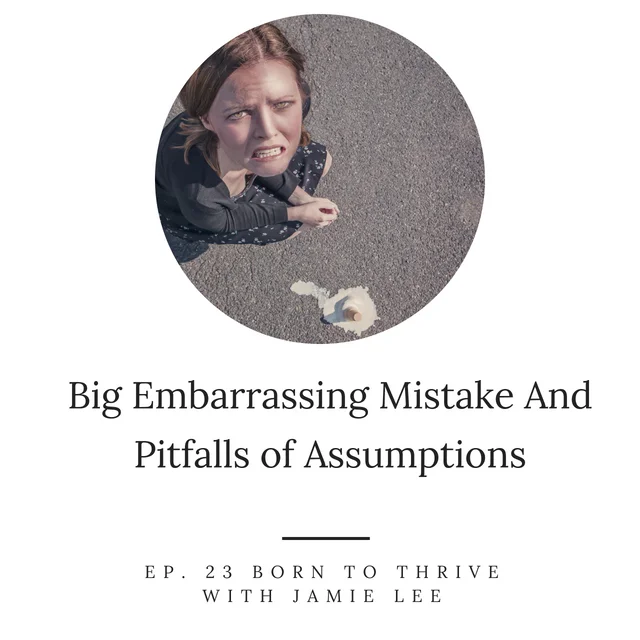
Last month I was in Japan to give a workshop and I made a terrible mistake that had me feeling mortified and embarrassed.
In this podcast I share the dirt: what happened, how I recovered, and what I learned from the experience.
Assumptions have the power to undermine our communication, negotiation, and leadership.
What are three dangerous assumptions that bully us silent and compromise our results? How can we shine light on our cognitive blindspots so that we show up powerfully without making assumptions?
Full Episode Transcript
Hello! Welcome to episode number 23. This is Born to Thrive with Jamie Lee. I’m your host and coach, Jamie Lee.
Yep! You’re born to thrive.
Yes, you are.
And in order to thrive, you need to ask for what you desire. That requires leadership. That requires negotiation. And that’s what we talk about here on this podcast.
Today, I am going to eat some humble pie.
What I mean by that is I have a rather embarrassing mistake that I recently made that I would like to share with you. And I made this embarrassing mistake due to some assumptions and so let’s also have a chat about some assumptions we make and how those assumptions may be undermining our negotiation and leadership success.
Finally, I want to invite you to a powerful coaching experience with me because I want to dispel some of the assumptions, I want to question the assumptions and also help you shine some light on some potential blind spots that you may have so that you can have a breakthrough.
So, it’s been awhile since I’ve been on this podcast. It’s been about two weeks, and it’s because I was traveling in Singapore where I have family now. I’m not originally from Singapore, I’m actually from South Korea, but now that we live in a global age, I now have a family in Singapore.
It’s great! It was really hot but it was also beautiful. And Japan, I visited, I lived in Japan 15 years ago as a junior year abroad student and so I speak a little bit of Japanese, I’m familiar with Japanese culture and it was so wonderful to be back and be immersed in it and eat delicious food and see the beautiful sights. Highly, highly recommend.
And I gave a workshop, but I made a mistake. I made what you would call a classic facepalm mistake.
So, here’s what happened. It’s Sunday. It’s May 20th. It’s 4:30 in the afternoon. It’s warm, it’s bright, it’s a beautiful day in Tokyo and I’m on my way to facilitate a workshop for the Japan Smith College Alumnae club.
I’m feeling really great.
I’m feeling really awesome.
I had just landed in Tokyo that morning after a red-eye flight from Singapore and I had intentionally booked a hotel that was within walking distance of the workshop venue because I intended to get there on time and to my surprise, once you download a Google Maps app while you have wi-fi connectivity on your iPhone, the app will store a local cache version of that route.
So that means the blue dot that you follow when you try to navigate using Google Maps App? It will still work when you have your phone on airplane mode, which I did to save money. I didn’t want to spend an exorbitant amount of money on international roaming charges while I was traveling in Asia.
And so, I’m feeling great. I just checked into the hotel at 3:00 in the afternoon after a red-eye flight, showered, got dressed, I’m walking in this beautiful Tokyo city and my Google Maps app is working! I’m following the blue dot to my venue by foot.
It’s 4:30. I’m thinking I’m gonna get there half an hour early because I’m thinking the workshop starts at 5:00.
And when I get there, to the venue, much to my surprise, everyone - everyone who signed up, everyone who organized - they’re there.
They’re waiting for me.
It turned out they had been waiting a very long time.
And no, it’s not because the Japanese are hyper-punctual, it’s because I had made a terrible mistake. The workshop was scheduled to start at hour 1500 in military time, which is 3:00 in civil or what we use here in the United States.
And I misread it. I misread 1500 military time for 5:00 pm.
It’s so embarrassing. Without realizing it, I had acted from an assumption of false consensus. It’s just a fancy word that means that I was acting out of bias. Cognitive bias. I’m thinking that my interpretation or misinterpretation of time is how everyone else has interpreted the schedule.
And based on this unquestioned thinking, my brain overlooked the obvious and the explicit, because hour 15 was communicated to me in email and yeah, I read it and I thought it was 5:00 pm.
It’s inexcusable. It’s my brain being lazy, thinking out of convenience and habit and I acted out of that blind spot.
I was mortified. I get there and everyone is there. So graciously, still waiting after an hour and a half in delay.
I was shocked.
I apologized.
I know some Japanese, so I apologized in Japanese to these gracious, patient, amazing women who are also bilingual. I said, “Moshi wake arimasen!” It’s the polite way of saying “I’m sorry.”
And standing in front of my audience and organizers, I now had a choice. I could indulge in my feelings of shame and ineptitude. Oh my God, Oh my God, how stupid can I be?!
Or I could do my best given the circumstances and given the last 30 minutes remaining out of two hours that were allotted for this workshop.
So I just dove right in.
I didn’t have a choice.
I went straight into the key points.
I tried to manage, just put down the feelings of shame and ineptitude. I’ll deal with it later when I get back to my hotel room.
And you know what? In spite of my blunder, my huge embarrassing blunder, the event went well and I think that really speaks to the caliber of the women who came to this workshop.
And we had a rich, hour-long discussion because the organizer so graciously allowed us to extend the workshop by another half-hour and we had a discussion on communication best practices for leaders. How do we show up as leaders in our day to day communication? How do we engage with curiosity, with genuine curiosity? How do we really listen, not just passive-aggressively listen, not just listen for our turn to speak, but really listen and hear our counterparts? And how do we give acknowledgment for who people are and not just what people do?
Thinking back on this experience, I’m back home in New York City, I’m very grateful. I feel very humbled. Very humbled. I had made a terrible assumption and I didn’t even know it.
Assumptions have the power to sabotage our results. And I think I gave you a very vivid example of how that’s possible. But it’s especially the case when we communicate with other people, when we negotiate, when we lead other people.
We all have our blind spots. We make wrong assumptions and there are holes in our research, holes in our knowledge, and sometimes these are the unknown unknowns that we don’t know until we find out through something going wrong.
If you aren’t aware of these assumptions, they have the potential to derail your negotiation outcomes. At Wharton, which is a business school at the University of Pennsylvania, there is a professor there, Richard Shell who says there are three types of assumptions that can really negatively impact your negotiation.
So, I wanted to share those three negative assumptions with you and share how I see examples of that in my client work and in my interactions with workshop attendees and then I want to tell you about some positive assumptions I make and then finally, invite you to a powerful coaching experience.
So the three types of assumptions that can negatively impact your negotiations according to Wharton professor Richard Shell are:
Number one: Assuming that a high level of conflict exists where there necessarily is not one in the negotiation.
Number two: Assuming that everybody thinks the same way. I made this mistake. I assumed that everybody thinks - or to be more precise, doesn’t think - the way I didn’t think.
Number three: Overestimating the other party’s power and/or underestimating your own.
Oof. Yeah. That’s a big one.
So, how do I see this in my work? I often see that these dangerous assumptions hold us back from speaking up, from engaging, from braving difficult conversations.
Take, for example, number one: assuming that a high level of conflict exists where there necessarily is not one. Let me give you an example. Earlier this week, I conducted a short and informal survey of women attorneys whom I will be speaking to next week about negotiation and I asked them some simple questions.
How do you engage in negotiation? What’s holding you back?
And 65% of the women who answered this survey said that they manage to negotiate, they don’t really like it, but they do it when they absolutely have to. About the same number of people said that the biggest barrier to their desired negotiation outcome is the fear of gender blowback.
The fear of negative feedback.
The fear of being rejected.
The fear of being judged as aggressive, as greedy.
It was very interesting to me that people didn’t say limited resources, people didn’t say I don’t have an open channel with people who make those decisions, people didn’t say I don’t know what to ask for.
So many people - about 65% of the people - said that it’s the fear of being judged, of being called something that is deemed unfeminine and therefore undesirable. It’s unfortunate that we still struggle with this gender stereotype and yet, we do.
What this informed me, what I make out of this data, is that probably the same amount of people who manage to negotiate when they absolutely have to, they are missing out on opportunities to speak up. They are not recognizing that they do have a voice and that they can ask for what they want because they are waiting until they absolutely have to.
And why? Because they assume that there is going to be conflict and this assumption of conflict creates fear that creates resistance that creates avoidance.
We often assume the worst in people when we are anxious about a high stakes conversation. And I am including myself. I am also working through this myself. But why don’t we assume the best? Why don’t we assume that people do want to hear from us, people do want to help us, and that people do want to see us happy, succeeding and thriving and have an open, honest conversation with us?
Why not?
Why not?
Number two: assuming that everybody thinks the same way. A lot of people I know, a lot of high-achieving, high-performing people that I know and talk with and consult and coach have assumptions that people should behave, that people should react, that people should speak in ways that they would.
But not everyone does. In fact, hardly anyone does because, let’s face it, other people are out of our control. The only thing that we can control is ourselves, our own behaviors, our own actions, our own words.
And also, since we’re talking about gender stereotypes and gender bias, I think it’s so dangerous when we have internalized negative opinions about women who compete, about women who promote themselves, women who speak with a loud voice and advocate for what they want and then assume that everyone else thinks the same way.
We project our gender bias on other people thereby perpetuating the bias. I’m going to quote my negotiation mentor, Lisa Gates, who’s co-founder of She Negotiates, who has said that “The place where gender bias is most deeply and secretly lodged is inside ourselves.”
And so when we fear that other people have negative opinions of self-advocating women, we get even more afraid. We get even more silent. Less brave.
So, the next one kind of feeds right into this, the third dangerous assumption is overestimating people’s power and/or underestimating our own power.
All these assumptions, they go hand in hand, right? When you assume that a high level of conflict exists, when you assume that everybody thinks the same way and when you let these assumptions hold you back from taking a stand, being courageous, taking action, we can easily overestimate that other people have more power.
Power that exists outside of us.
Power that we don’t have.
And when we think we don’t have power, we feel small, we feel like victims.
We feel miserable.
The thing about power, however, is that there is more than just one type of power. A lot of people mistake power as simply dominant power or power that you may exert over other people when you are in a sort of commanding control type of situation, and you exert control and authority over a group of people.
And almost always, we associate masculine qualities. If you look up the word commander or leader it’ll say oh, he is the kind of man who will lead this team to this success that we want! And that’s unfortunate, but that’s not the only kind of power that exists.
I think the real power is in ourselves because we have the power to choose our thinking. We have the power to influence our own emotions and that means we have the power to take inspired action and when we take inspired action we generate positive results, not just for us, but for the world.
And that is the kind of power that I want to ignite in the people that I coach. That is the kind of power that I am interested in helping to develop and grow.
I also make positive assumptions, so I’m not going to make an a-s-s out of m-e. I will state my assumptions about the kind of people who are interested in this specific type of power that I’m talking about which is your autonomy.
I think the people who are interested in my content, I think people who are interested in working with me are the kind of people who want to make a positive impact in the world.
And for this type of people, it’s not just about money. It’s not just about more dominant type of power. Although you love money and you love exerting influence, you love money and you love influence because it can be used to fuel the positive change that you want to create.
Yeah, I’m talking about you!
I think you want to negotiate a bigger life that’s defined by purpose, meaning, and joy.
And if that is true, then I make another assumption: that you want to brave the discomfort of advocating for your value so you can take ownership of your dreams. So you can step into the leadership that you dream of and speak up for what you believe in and that’s because that’s how change starts.
And so if that is true, then I also assume that you want to make a conscious and empowered choice in your thoughts and actions. That’s where the magic is because as I said earlier, thoughts generate feelings that generate action that generate results.
And so if that is you, I want to invite you to a powerful coaching experience with me.
I am making some time available in my schedule to speak with my audience one-on-one, for free, for 90 minutes.
Why? Because I am grateful to have this privilege to reach you. Because I am looking to connect with my audience in a deeper way. And I think the best way to dispel any negative assumptions that are holding us back is to really listen and to be engaged in one long conversation at a time.
And in 90 minutes, we can address whatever challenge you’re facing right now that’s holding you back from showing up, communicating with authenticity, and negotiating as a leader.
So, if you are interested, email me at jamie@jamieleecoach.com and let me know who you are, what you do, what you’d like to talk about. It’s jamie@jamieleecoach.com and once I read your email and I feel that there is a fit for your needs and that I can support you, I will reply with a calendar link for you to book a 90-minute, powerful coaching experience with me.
All I ask is that you show up, on time, to the call once it’s scheduled, and be open to a life-changing experience.
This might sound too good to be true, but it’s not a gimmick. I don’t have any gotchas. I’m not gonna sell you on a program. And no, you don’t have to have a salary negotiation for us to talk about.
This is real. I am already doing this and I’d like to offer this to my valued podcast listeners because I am growing small but with a lot of intention and a deep desire to contribute real value.
So, this week I coached a feminist leader, one of the women who came to my workshop in Japan. I coached her, and she is working to empower young high school girls so that they can make informed decisions about how they want to live their lives and she wants them to be happier and more fulfilled as a result. I love that.
This morning, I coached a UX designer and she’s helping to realize the visions of mission-driven organizations by improving their websites so that these mission-driven organizations can serve people and in this process the designer, the UX designer, she is creating joy.
So, I’m seeking to connect with people like that.
People who value excellence. People who value service. People who desire to make a positive impact. People who tend to lean on the introverted side and tend to think really deep. Those are my people.
And so if that is you, if you are listening to this and you’re like, yeah, that is me! If you are interested in talking with me, I’m giving you an open invitation to have a really long, deep, powerful conversation with me.
Email me at jamie@jamieleecoach.com. My intention is to demonstrate that I can help by helping you. So, I look forward to hearing from you and talk to you soon!