Podcast Archives
Prior to Risky Conversations, previous iterations of Jamie Lee’s podcast were hosted elsewhere; those early episodes have been preserved here in an archive for public access. If you want to subscribe to Jamie Lee’s current podcast, you can do that by visiting the Risky Conversations homepage.

On Money, Family, and Passion: Eric Kohner Coaches Jamie Lee Using the Five Knowledge Centers
According to Ivy Business Journal, “Executives and HR managers know that coaching is the most potent tool for creating lasting personal change.”
I think coaching is something everyone should get to test drive and experience first hand to really understand the impact of it.
But if you can't hire a coach (or find a coach-in-training who will coach you for free) the second best thing might be for you to sit in on a coaching session.
That’s why earlier this week, I invited leadership coach Eric Kohner, who trained me to coach at the Coaches Training Institute to coach me on my own money beliefs using his leadership framework called the Five Knowledge Centers.
The Five Knowledge Centers reflect:
1. Head - reason
2. Heart - love
3. Gut - intuition and vision
4. Groin - passion and drive
5. Hands - action
Eric Kohner is an internationally recognized executive coach and keynote speaker. He founded eKCosystem, a global corporate training company dedicated to bringing HUMAN BEING into business, because “in today’s highly competitive world, the new hard skills are the heart skills.”
Learn more about Eric's work here: www.ekcosystem.com
Or reach him directly via email here: eric.kohner@icloud.com
You can reach me directly via email too: jamie@jamieleecoach.com

According to Ivy Business Journal, “Executives and HR managers know that coaching is the most potent tool for creating lasting personal change.”
I think coaching is something everyone should get to test drive and experience first hand to really understand the impact of it.
But if you can't hire a coach (or find a coach-in-training who will coach you for free) the second best thing might be for you to sit in on a coaching session.
That’s why earlier this week, I invited leadership coach Eric Kohner, who trained me to coach at the Coaches Training Institute to coach me on my own money beliefs using his leadership framework called the Five Knowledge Centers.
The Five Knowledge Centers reflect:
1. Head - reason
2. Heart - love
3. Gut - intuition and vision
4. Groin - passion and drive
5. Hands - action
Eric Kohner is an internationally recognized executive coach and keynote speaker. He founded EKCosystem, a global corporate training company dedicated to bringing HUMAN BEING into business, because “in today’s highly competitive world, the new hard skills are the heart skills.”
Learn more about Eric's work here: www.ekcosystem.com
Or reach him directly via email here: eric.kohner@icloud.com
You can reach me directly via email too: jamie@jamieleecoach.com
Full Episode Transcript
Hello! Welcome to Episode 59 of Born to Thrive with Jamie Lee. I’m your coach and host, Jamie Lee.
How are you?
I say it every episode and that’s because I really believe it: I believe we’re all born to thrive. Not just survive but thrive. And as a leadership and negotiation coach, I believe that asking for what we want or negotiating or engaging in collaborative value-creating conversations is the conscious practice of leadership that will enable you to thrive and be fulfilled.
The leadership I’m talking about and that I coach people on is not about how many people you manage or what title you have but rather how you consciously choose to grow yourself so you can be of greater value and be of greater service to the world.
And that’s why I love coaching because that is the mission of coaching, to enable people to become of greater value and to become of greater service to the world. I love coaching and I love being coached by other coaches and this is a special episode where you will hear me get coached by a master leadership coach, Eric Kohner, who trained me to become a coach with the Coaches Institute a couple of years ago.
But you know what? I want to be really honest because before I started training as a coach, before I experienced coaching for myself first-hand, I didn’t really get what coaching was about. I thought coaching was a hoax or, worse yet, a privileged way for somebody who’s got money to get somebody to listen to them and to get a paid friend or a pretend therapist.
I didn’t get it.
Once I experienced coaching for myself, that’s when the scales fell from my eyes and Eric really helped me do that and he was the first person I met who called himself a leadership coach and I was like Oh! I can do that too!
He showed me a powerful example of what is possible.
And since then, my life has never been the same. Coaching has changed how I think, how I feel, and how I show up to my life and career. Coaching has changed my mindset and because I changed my mindset, my results changed and so my life changed.
Coaching has enabled me to live the life of my dreams, to negotiate, to lead, and to thrive.
But, you know, I don’t want you to take my word for it. I think coaching really is a gift that everyone should experience first-hand but if you can’t afford it or if you don’t know any coaches who are in training who might be able to coach you for free, the second-best thing is for you to sit in on a coaching call.
And that’s why, earlier this week, I invited leadership coach Eric Kohner to coach me.
And I asked him to coach me on my money beliefs and if you’ve been listening to my podcast, you know that my mission is to help ambitious people like you become bolder, braver, and better paid. And unless I work on my money beliefs so that they’re not limiting beliefs, how can I coach other people? How can I be of service to others?
And that’s the reason why I am very open, transparent, and vulnerable in this episode. You’ll hear about what I think and believe, some of my own limiting beliefs, how I feel about them, and you’ll find out how Eric uses his five knowledge centers, his own leadership framework, to help me rise above it, to overcome, and to shift my mindset around it.
So, Eric was on this podcast last year. You might want to check out Episode 32 where we did a really cool discussion about #MeToo and what it means to be a male ally in these times. Eric is also an internationally recognized executive coach and keynote speaker and coach trainer. He founded EKCOsystem, a global corporate training company dedicated to bringing HUMAN BEING into business because in quotes, “in today’s highly competitive world, the new hard skills are the heart skills.”
You can learn more about Eric’s work on www.ekcosystem.com or you can reach him directly via email at eric.kohner@icloud.com. And if you have any feedback for me, feel free to email me directly: jamie@jamieleecoach.com
So I hope you enjoy this special episode where you get to experience me getting coached by Eric. Without further ado, here it is:
Jamie: I am down for some coaching. Yeah!
Eric: What do you want to get coached on?
Jamie: You know, one of the things that I coach people on is money because my goal is to help ambitious people become bolder, braver, and better paid. And that’s either through mindset shifting, going for their dreams, negotiating for more money and I would loved to be coached by you on my own money beliefs.
I’ll be more specific. I want to create abundance and wealth for myself and I also want to do it for my family but there’s like this little part of me that’s still kind of...I don’t know how to describe it, it’s like...you know, when I think about abundance and think about being able to make big donations like I feel like a lot of uplift but when I think about the obligation that I have to give back to my family, I feel like it’s like a speedbump. It’s like I feel a little resentful, you know?
For a bit of background, I am from an immigrant family and as a lot of immigrant families do, we give back to our parents because...yeah, I know it’s not only the immigrant families, but…
Eric: No, no. Just to reveal a little bit, my wife is from the Philippines so I was actually relating to you.
Jamie: Got it. Yeah.
Eric: That that is part of the culture in the Philippines, so that’s where I was coming from.
Jamie: Great. Yeah, I’m Korean but yeah, I think it’s very similar and my family, they tell me there is an expectation that I will share my wealth and I want to be able to come from real abundance and real generosity, you know what I mean? I don’t want to come from this place of obligation and guilt.
Eric: Right, got it.
Jamie: So that’s where I’m at.
Eric: First of all, to me, it’s inspiring that you’re getting so vulnerable in a webinar. I know personally and from studies that speaking about money is probably one of the most vulnerable topics to talk about. So I just want to acknowledge the courage that it’s taking for you to actually even talk about it in public.
Jamie: Thank you. My intention is to walk the talk I give and I think it’s important to talk about money. I think it’s really important to change what we think and believe and feel about money. Yeah.
Eric: Right.
Jamie: So it’s important to me.
Eric: So, I’m actually hearing, there’s already a few knowledge centers that you’re already tapping into. And, by the way, my dog just broke into the office so she’s very interested in this also, so I just want to include her. If she makes any noise, I apologize in advance. It seems like you’re getting a bit weighed down in your head about this.
Jamie: Oh yeah. Absolutely.
Eric: Tell me about what’s happening in your head, like the rational, reasonable part.
Jamie: Yeah, the rational, reasonable part is like, it starts calculating. It starts, you know, expenses and doing the P&L analysis. Like how much money am I gonna make? Am I gonna have enough? And can I afford this? How much are they gonna ask for?
Eric: Yeah, exactly and how is this gonna impact my relationship with them and all that kind of stuff.
Jamie: Yeah. What are they gonna say? How are they gonna judge me? My mom’s gonna say I’m being cheap.
Eric: Yeah, being stingy, got it. And so that, it almost feels like there’s a weight in your head about that.
Jamie: Mmmm.
Eric: Yeah, yeah. Let’s go down to your heart.
Jamie: Mm-hmm.
Eric: I actually kind of want to...well, go to your heart first before I say what I wanna do. Go to your heart. What is your heart telling you about the relationship of money and family?
Jamie: Wow. You know, I’m kind of surprised...I feel a bit of sadness, like…
Eric: Okay.
Jamie: Yeah, there’s like a bit of...in my heart, in my chest I feel a bit of heaviness. Yeah.
Eric: So just be with that sadness for a second.
Jamie: Mm-hmm.
Eric: Just allow that sadness to be there. Because it’s giving you some information.
Jamie: Yeah.
Eric: What’s there now?
Jamie: Uhh...wow. I feel emotional thinking about the sacrifice...the sacrifice that my parents made coming to America, working so hard. I thought about the sacrifice my grandmothers made, living through some really difficult times like the Korean War and poverty. And I think the sadness comes from feeling that struggle and the lack that they had to go through for me to experience so much abundance and so there’s sadness, there’s like a ton of emotion and a lot of gratitude.
Eric: Gratitude. Yeah, I can see that. I can see that and there’s something pure there. It’s not attached to any solutions or what are you gonna do but that in itself has a really powerful effect on you. Yeah. So are you ready to actually sink down into your gut for a second?
Jamie: Okay.
Eric: Unless you want to stay there because sometimes clients, you know, we hit on something and to get all five knowledge centers, I really want this to work for you.
Jamie: [laughs] When you said, “Let’s go to your gut,” the first thing that came to my head was “Oh, I’m hungry!”
Eric: Your gut tells you that too!
Jamie: My gut tells me I’m gonna have lunch after this webinar.
Eric: And the gut is kind of the place where intuition and vision also resides. Like what is your gut telling you about abundance and family?
Jamie: You know, my gut feels this like so strongly. I feel this..I feel so certain that it is possible that I can create abundance in my life, that I can give away abundance and...I feel really strongly in my gut that what I dream for my clients, for myself, for us to actually become bolder, braver and a heck of a lot better paid, I really do believe it’s possible and I feel it like very strongly in my gut.
Eric: And, only because you also brought up family, what is your gut telling you about abundance and giving back to your family?
Jamie: Wow. The words that just popped into my head surprised me. The words that popped into my head were “It’s not too late. It’s never too late.”
Eric: Never too late.
Jamie: Yeah.
Eric: Never too late for what?
Jamie: It’s never too late to create abundance, to give abundance. I guess my head was thinking about oh, you know, they already struggled so much and yeah…
Eric: Yeah. Yeah, yeah, yeah.
Jamie: And my gut said it’s not too late. It’s never too late.
Eric: Never too late to come from abundance.
Jamie: Yeah. It’s never too late.
Eric: Right. Fantastic. So I see this big smile on your face.
Jamie: Yeah. I’m really surprised by what came to the surface.
Eric: Mmm, cool. You know, it’s almost like the smile on your face, it’s almost like an ageless smile. Like you could be five or you could be sixty five and I don’t know what that means but that’s what’s coming up over here. Yeah.
Jamie: That’s really funny. My life partner sometimes makes fun of me and he tells me I’m sixty-five years old. [laughs]
Eric: [Laughing] Well, being sixty-six, it ain’t that bad, okay?
Jamie: Nice.
Eric: Yeah. So, let’s now...and I’m gonna actually ask you to stand up, okay?
Jamie: Alright.
Eric: Because we’re gonna be now going to the groin area and the thing that I like to get my clients really in touch with that part of their body is….because it really is about being grounded and in touch with what are you passionate about?
Jamie: What am I passionate about?
Eric: What are you passionate about? What is it that you wanna create? Yeah.
Jamie: I’m really passionate about...I’m really passionate about helping people understand their own minds.
Eric: Mmm.
Jamie: Yeah. And I’m really passionate about helping people see their own potential and that nothing is too good to be true. That with the power of their minds that they really can accomplish and create anything that they desire. And I’m really passionate about believing that for myself as well.
Eric: Cool. Cool. And what about...I’m taking a little bit of a risk here, okay?
Jamie: It’s okay! Eric, can I just give a technical note? We would love to see your face. Is it possible for you to lift up your camera angle so we can see you?
Eric: That’s as far as it goes, so I’ll sit down.
Jamie: Okay.
Eric: Okay. So, can you see me now?
Jamie: I can see you really well.
Eric: Okay, great. So, what...and I wanna get back to what you were saying. You were talking about having people see what’s possible, having people really step into their greatness, all of that. And how about your family?
Jamie: Hmm.
Eric: What about seeing them from that perspective? What pops up when I ask that?
Jamie: Oh, wow. Wow. Hmmm. That’s a tricky one. Yeah.
Eric: Yeah, like I said. I knew that was a bit edgy, so…
Jamie: Yeah because my mind, my head immediately pops up and it says things like, oh, they don’t get what you’re doing, you know?
Eric: Right. Exactly.
Jamie: Why didn’t you become a lawyer? Why aren’t you climbing the corporate ladder?
Eric: Why aren’t you doing a nice corporate job? Right.
Jamie: Yeah. Why are you doing this coaching stuff? We don’t get it but as long as you make money, we get it, you know?
Eric: They don’t have to get it. This is not about them getting it. It’s about you getting it. About them. It’s about you seeing them from a place of possibility. So that’s kind of where I’m taking you. And I also notice that when I asked that question, you automatically went to your head.
Jamie: Yeah.
Eric: Yeah.
Jamie: And all the reasons why they wouldn’t get it, they wouldn’t accept it, they wouldn’t approve of it.
Eric: Exactly. And they don’t have to! Because it’s not about them. This is about you.
Jamie: Yeah. So, wow. To see them from a place of possibility. You know, I went to...my mind went to my nephew and it’s really exciting to think that my nephew is going to have a life that is just so completely different from my parents’, from mine…
Eric: Right. So that’s what’s possible. Perhaps the next generation, then.
Jamie: Yeah.
Eric: Yeah, yeah. And I’m gonna keep challenging you. I’m gonna challenge...so, your mother.
Jamie: Mm-hmm.
Eric: What is something that is so fantastic about her?
Jamie: What is so fantastic about her is her optimism, her drive, her work ethic, her love. Her love for her grandchild is just...it’s just so beautiful. I mean, she just has this overflowing love for my nephew and it makes me feel warm-hearted to see her be so happy holding this baby. She’s got this tremendous energy that I’ve always looked up to, you know? She’s a workhorse. And I also...what’s so fantastic about her is her belief in me, her belief in her own children, to do amazing thing that she hasn’t but for good reasons because she doesn’t speak English well and all that stuff but yeah, I think of her...I see her smiling, I see her as this incredible source of strength.
Eric: Yeah and if we had more time, we would go to your dad but [inaudible] the time also, but this is actually, what I’m seeing is, this is my intuition here, my gut is telling me the answer to everything here is around your passion.
Jamie: Mmm.
Eric: But before we go to that, there’s one other knowledge center I want to explore just for the sake of everybody getting the model here and that’s the hands.
Jamie: Okay.
Eric: What are your hands telling you about this?
Jamie: What are my hands telling me about this?
Eric: Yeah. About abundance and family?
Jamie: What do my hands tell me about this?
Eric: And you can sit down if you want. I just wanted to, on the passion part have you stand up, yeah.
Jamie: Yeah. Huh. My hands tell me that...I don’t know if it’s my hands saying this or it’s my mind saying this but what I want to believe is that I can build it.
Eric: Yes. Well we talked about the hands are what make things. What is it you want to build?
Jamie: I wanna build a really successful coaching practice. I wanna build a company that employs people and transforms lives. I wanna build something that really helps women double their income and their impact. Funny you say that, asking about the hand because I was thinking how it’s so easy because all I have to do is type into a computer [laughing].
Eric: Yeah, the hands actually...you need your hands. At least still today, we need our hands to work with technology.
Jamie: Yeah.
Eric: Yes, yeah. So, I’m gonna ask you now to go back to your head.
Jamie: Okay.
Eric: But with that, all the knowledge that you just explored.
Jamie: Mm-hmm.
Eric: And I’m noticing you’ve got this very warm smile on your face right now.
Jamie: Mm-hmm.
Eric: What are you taking away from this, now we’ve been coaching for about twenty minutes? What are you gonna take away from this exploration around abundance and family?
Jamie: I don’t need to worry so much.
Eric: Yeah.
Jamie: Yeah.
Eric: Wow.
Jamie: Yeah.
Eric: Yeah.
Jamie: You know I also coach with the Life Coach School by Brooke Castillo and she says worry pretends to be necessary and so that’s what came to my mind, I’m like why am I worried, you know? I think I’m gonna answer my own question. I think I’m worried because I’m feeling impatient. I want it now, I want the millions of dollars to give away like Oprah, like now!
Eric: You wanna give everybody a car.
Jamie: Yeah, yeah. You get a Mercedes! And what’s coming to me now is how I think it was when we went to the gut, my gut says it’s never too late.
Eric: Yeah, it’s never too late. And that seems to be a really powerful...it’s almost like a mantra or something. I don’t know. What do you want to do with that? Because that actually seems to ground you.
Jamie: Mmm. Yeah, that’s really interesting because when I sit down and write down my self-limiting thoughts, the one that comes up over and over again is that I’m running behind.
Eric: Right, right.
Jamie: And so it’s kind of like my gut telling me, “You’re not behind!”
Eric: You’re not falling behind. You’re right on time.
Jamie: There’s no rush.
Eric: There’s time, there’s no rush. Exactly. Yeah.
Jamie: Yeah.
Eric: So I wanna end this by just saying you are so up to this. You are so ready to step into this.
Jamie: Thank you! Thank you.
Eric: And my whole body is actually telling me that.
Jamie: Nice.
Eric: Yeah.

Big Embarrassing Mistake and Pitfalls of Assumptions
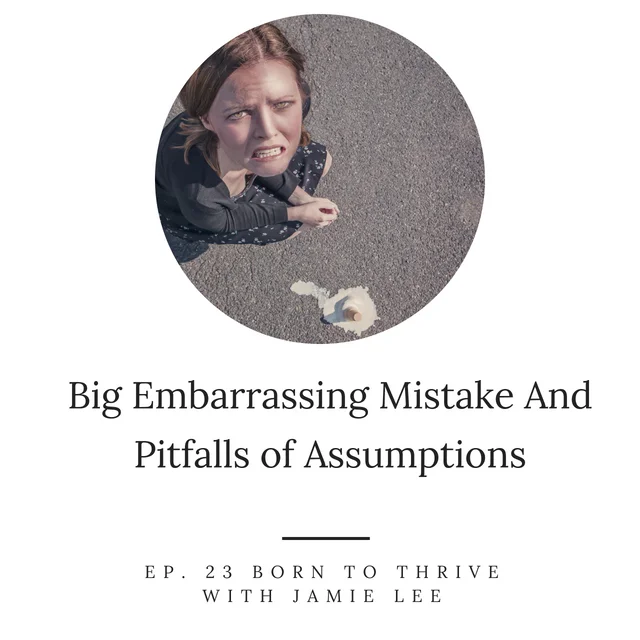
Last month I was in Japan to give a workshop and I made a terrible mistake that had me feeling mortified and embarrassed.
In this podcast I share the dirt: what happened, how I recovered, and what I learned from the experience.
Assumptions have the power to undermine our communication, negotiation, and leadership.
What are three dangerous assumptions that bully us silent and compromise our results? How can we shine light on our cognitive blindspots so that we show up powerfully without making assumptions?
Last month I was in Japan to give a workshop and I made a terrible mistake that had me feeling mortified and embarrassed.
In this podcast I share the dirt: what happened, how I recovered, and what I learned from the experience.
Assumptions have the power to undermine our communication, negotiation, and leadership.
What are three dangerous assumptions that bully us silent and compromise our results? How can we shine light on our cognitive blindspots so that we show up powerfully without making assumptions?
Full Episode Transcript
Hello! Welcome to episode number 23. This is Born to Thrive with Jamie Lee. I’m your host and coach, Jamie Lee.
Yep! You’re born to thrive.
Yes, you are.
And in order to thrive, you need to ask for what you desire. That requires leadership. That requires negotiation. And that’s what we talk about here on this podcast.
Today, I am going to eat some humble pie.
What I mean by that is I have a rather embarrassing mistake that I recently made that I would like to share with you. And I made this embarrassing mistake due to some assumptions and so let’s also have a chat about some assumptions we make and how those assumptions may be undermining our negotiation and leadership success.
Finally, I want to invite you to a powerful coaching experience with me because I want to dispel some of the assumptions, I want to question the assumptions and also help you shine some light on some potential blind spots that you may have so that you can have a breakthrough.
So, it’s been awhile since I’ve been on this podcast. It’s been about two weeks, and it’s because I was traveling in Singapore where I have family now. I’m not originally from Singapore, I’m actually from South Korea, but now that we live in a global age, I now have a family in Singapore.
It’s great! It was really hot but it was also beautiful. And Japan, I visited, I lived in Japan 15 years ago as a junior year abroad student and so I speak a little bit of Japanese, I’m familiar with Japanese culture and it was so wonderful to be back and be immersed in it and eat delicious food and see the beautiful sights. Highly, highly recommend.
And I gave a workshop, but I made a mistake. I made what you would call a classic facepalm mistake.
So, here’s what happened. It’s Sunday. It’s May 20th. It’s 4:30 in the afternoon. It’s warm, it’s bright, it’s a beautiful day in Tokyo and I’m on my way to facilitate a workshop for the Japan Smith College Alumnae club.
I’m feeling really great.
I’m feeling really awesome.
I had just landed in Tokyo that morning after a red-eye flight from Singapore and I had intentionally booked a hotel that was within walking distance of the workshop venue because I intended to get there on time and to my surprise, once you download a Google Maps app while you have wi-fi connectivity on your iPhone, the app will store a local cache version of that route.
So that means the blue dot that you follow when you try to navigate using Google Maps App? It will still work when you have your phone on airplane mode, which I did to save money. I didn’t want to spend an exorbitant amount of money on international roaming charges while I was traveling in Asia.
And so, I’m feeling great. I just checked into the hotel at 3:00 in the afternoon after a red-eye flight, showered, got dressed, I’m walking in this beautiful Tokyo city and my Google Maps app is working! I’m following the blue dot to my venue by foot.
It’s 4:30. I’m thinking I’m gonna get there half an hour early because I’m thinking the workshop starts at 5:00.
And when I get there, to the venue, much to my surprise, everyone - everyone who signed up, everyone who organized - they’re there.
They’re waiting for me.
It turned out they had been waiting a very long time.
And no, it’s not because the Japanese are hyper-punctual, it’s because I had made a terrible mistake. The workshop was scheduled to start at hour 1500 in military time, which is 3:00 in civil or what we use here in the United States.
And I misread it. I misread 1500 military time for 5:00 pm.
It’s so embarrassing. Without realizing it, I had acted from an assumption of false consensus. It’s just a fancy word that means that I was acting out of bias. Cognitive bias. I’m thinking that my interpretation or misinterpretation of time is how everyone else has interpreted the schedule.
And based on this unquestioned thinking, my brain overlooked the obvious and the explicit, because hour 15 was communicated to me in email and yeah, I read it and I thought it was 5:00 pm.
It’s inexcusable. It’s my brain being lazy, thinking out of convenience and habit and I acted out of that blind spot.
I was mortified. I get there and everyone is there. So graciously, still waiting after an hour and a half in delay.
I was shocked.
I apologized.
I know some Japanese, so I apologized in Japanese to these gracious, patient, amazing women who are also bilingual. I said, “Moshi wake arimasen!” It’s the polite way of saying “I’m sorry.”
And standing in front of my audience and organizers, I now had a choice. I could indulge in my feelings of shame and ineptitude. Oh my God, Oh my God, how stupid can I be?!
Or I could do my best given the circumstances and given the last 30 minutes remaining out of two hours that were allotted for this workshop.
So I just dove right in.
I didn’t have a choice.
I went straight into the key points.
I tried to manage, just put down the feelings of shame and ineptitude. I’ll deal with it later when I get back to my hotel room.
And you know what? In spite of my blunder, my huge embarrassing blunder, the event went well and I think that really speaks to the caliber of the women who came to this workshop.
And we had a rich, hour-long discussion because the organizer so graciously allowed us to extend the workshop by another half-hour and we had a discussion on communication best practices for leaders. How do we show up as leaders in our day to day communication? How do we engage with curiosity, with genuine curiosity? How do we really listen, not just passive-aggressively listen, not just listen for our turn to speak, but really listen and hear our counterparts? And how do we give acknowledgment for who people are and not just what people do?
Thinking back on this experience, I’m back home in New York City, I’m very grateful. I feel very humbled. Very humbled. I had made a terrible assumption and I didn’t even know it.
Assumptions have the power to sabotage our results. And I think I gave you a very vivid example of how that’s possible. But it’s especially the case when we communicate with other people, when we negotiate, when we lead other people.
We all have our blind spots. We make wrong assumptions and there are holes in our research, holes in our knowledge, and sometimes these are the unknown unknowns that we don’t know until we find out through something going wrong.
If you aren’t aware of these assumptions, they have the potential to derail your negotiation outcomes. At Wharton, which is a business school at the University of Pennsylvania, there is a professor there, Richard Shell who says there are three types of assumptions that can really negatively impact your negotiation.
So, I wanted to share those three negative assumptions with you and share how I see examples of that in my client work and in my interactions with workshop attendees and then I want to tell you about some positive assumptions I make and then finally, invite you to a powerful coaching experience.
So the three types of assumptions that can negatively impact your negotiations according to Wharton professor Richard Shell are:
Number one: Assuming that a high level of conflict exists where there necessarily is not one in the negotiation.
Number two: Assuming that everybody thinks the same way. I made this mistake. I assumed that everybody thinks - or to be more precise, doesn’t think - the way I didn’t think.
Number three: Overestimating the other party’s power and/or underestimating your own.
Oof. Yeah. That’s a big one.
So, how do I see this in my work? I often see that these dangerous assumptions hold us back from speaking up, from engaging, from braving difficult conversations.
Take, for example, number one: assuming that a high level of conflict exists where there necessarily is not one. Let me give you an example. Earlier this week, I conducted a short and informal survey of women attorneys whom I will be speaking to next week about negotiation and I asked them some simple questions.
How do you engage in negotiation? What’s holding you back?
And 65% of the women who answered this survey said that they manage to negotiate, they don’t really like it, but they do it when they absolutely have to. About the same number of people said that the biggest barrier to their desired negotiation outcome is the fear of gender blowback.
The fear of negative feedback.
The fear of being rejected.
The fear of being judged as aggressive, as greedy.
It was very interesting to me that people didn’t say limited resources, people didn’t say I don’t have an open channel with people who make those decisions, people didn’t say I don’t know what to ask for.
So many people - about 65% of the people - said that it’s the fear of being judged, of being called something that is deemed unfeminine and therefore undesirable. It’s unfortunate that we still struggle with this gender stereotype and yet, we do.
What this informed me, what I make out of this data, is that probably the same amount of people who manage to negotiate when they absolutely have to, they are missing out on opportunities to speak up. They are not recognizing that they do have a voice and that they can ask for what they want because they are waiting until they absolutely have to.
And why? Because they assume that there is going to be conflict and this assumption of conflict creates fear that creates resistance that creates avoidance.
We often assume the worst in people when we are anxious about a high stakes conversation. And I am including myself. I am also working through this myself. But why don’t we assume the best? Why don’t we assume that people do want to hear from us, people do want to help us, and that people do want to see us happy, succeeding and thriving and have an open, honest conversation with us?
Why not?
Why not?
Number two: assuming that everybody thinks the same way. A lot of people I know, a lot of high-achieving, high-performing people that I know and talk with and consult and coach have assumptions that people should behave, that people should react, that people should speak in ways that they would.
But not everyone does. In fact, hardly anyone does because, let’s face it, other people are out of our control. The only thing that we can control is ourselves, our own behaviors, our own actions, our own words.
And also, since we’re talking about gender stereotypes and gender bias, I think it’s so dangerous when we have internalized negative opinions about women who compete, about women who promote themselves, women who speak with a loud voice and advocate for what they want and then assume that everyone else thinks the same way.
We project our gender bias on other people thereby perpetuating the bias. I’m going to quote my negotiation mentor, Lisa Gates, who’s co-founder of She Negotiates, who has said that “The place where gender bias is most deeply and secretly lodged is inside ourselves.”
And so when we fear that other people have negative opinions of self-advocating women, we get even more afraid. We get even more silent. Less brave.
So, the next one kind of feeds right into this, the third dangerous assumption is overestimating people’s power and/or underestimating our own power.
All these assumptions, they go hand in hand, right? When you assume that a high level of conflict exists, when you assume that everybody thinks the same way and when you let these assumptions hold you back from taking a stand, being courageous, taking action, we can easily overestimate that other people have more power.
Power that exists outside of us.
Power that we don’t have.
And when we think we don’t have power, we feel small, we feel like victims.
We feel miserable.
The thing about power, however, is that there is more than just one type of power. A lot of people mistake power as simply dominant power or power that you may exert over other people when you are in a sort of commanding control type of situation, and you exert control and authority over a group of people.
And almost always, we associate masculine qualities. If you look up the word commander or leader it’ll say oh, he is the kind of man who will lead this team to this success that we want! And that’s unfortunate, but that’s not the only kind of power that exists.
I think the real power is in ourselves because we have the power to choose our thinking. We have the power to influence our own emotions and that means we have the power to take inspired action and when we take inspired action we generate positive results, not just for us, but for the world.
And that is the kind of power that I want to ignite in the people that I coach. That is the kind of power that I am interested in helping to develop and grow.
I also make positive assumptions, so I’m not going to make an a-s-s out of m-e. I will state my assumptions about the kind of people who are interested in this specific type of power that I’m talking about which is your autonomy.
I think the people who are interested in my content, I think people who are interested in working with me are the kind of people who want to make a positive impact in the world.
And for this type of people, it’s not just about money. It’s not just about more dominant type of power. Although you love money and you love exerting influence, you love money and you love influence because it can be used to fuel the positive change that you want to create.
Yeah, I’m talking about you!
I think you want to negotiate a bigger life that’s defined by purpose, meaning, and joy.
And if that is true, then I make another assumption: that you want to brave the discomfort of advocating for your value so you can take ownership of your dreams. So you can step into the leadership that you dream of and speak up for what you believe in and that’s because that’s how change starts.
And so if that is true, then I also assume that you want to make a conscious and empowered choice in your thoughts and actions. That’s where the magic is because as I said earlier, thoughts generate feelings that generate action that generate results.
And so if that is you, I want to invite you to a powerful coaching experience with me.
I am making some time available in my schedule to speak with my audience one-on-one, for free, for 90 minutes.
Why? Because I am grateful to have this privilege to reach you. Because I am looking to connect with my audience in a deeper way. And I think the best way to dispel any negative assumptions that are holding us back is to really listen and to be engaged in one long conversation at a time.
And in 90 minutes, we can address whatever challenge you’re facing right now that’s holding you back from showing up, communicating with authenticity, and negotiating as a leader.
So, if you are interested, email me at jamie@jamieleecoach.com and let me know who you are, what you do, what you’d like to talk about. It’s jamie@jamieleecoach.com and once I read your email and I feel that there is a fit for your needs and that I can support you, I will reply with a calendar link for you to book a 90-minute, powerful coaching experience with me.
All I ask is that you show up, on time, to the call once it’s scheduled, and be open to a life-changing experience.
This might sound too good to be true, but it’s not a gimmick. I don’t have any gotchas. I’m not gonna sell you on a program. And no, you don’t have to have a salary negotiation for us to talk about.
This is real. I am already doing this and I’d like to offer this to my valued podcast listeners because I am growing small but with a lot of intention and a deep desire to contribute real value.
So, this week I coached a feminist leader, one of the women who came to my workshop in Japan. I coached her, and she is working to empower young high school girls so that they can make informed decisions about how they want to live their lives and she wants them to be happier and more fulfilled as a result. I love that.
This morning, I coached a UX designer and she’s helping to realize the visions of mission-driven organizations by improving their websites so that these mission-driven organizations can serve people and in this process the designer, the UX designer, she is creating joy.
So, I’m seeking to connect with people like that.
People who value excellence. People who value service. People who desire to make a positive impact. People who tend to lean on the introverted side and tend to think really deep. Those are my people.
And so if that is you, if you are listening to this and you’re like, yeah, that is me! If you are interested in talking with me, I’m giving you an open invitation to have a really long, deep, powerful conversation with me.
Email me at jamie@jamieleecoach.com. My intention is to demonstrate that I can help by helping you. So, I look forward to hearing from you and talk to you soon!