Zen of the Misplaced Ferrari
You're good at your job — genuinely, measurably good.
But are you white-knuckling the status quo — one in which you're underestimated, undervalued, or stifled — while quietly wondering if this is just how it is?
Maybe you can relate to my client Maya — a former director at what I'd describe as a well-paid, perfectly beige role at a large financial firm — stable, respectable, and slowly suffocating her.
Like you, at her best Maya is sharp, fast-moving, and attuned to where the world is going. Her company wasn't. She could feel, in her bones, that staying wasn't safe — not because anything dramatic was happening, but because nothing was.
She was interviewing for more exciting roles. Getting to the final round, again and again. And then, nothing. Close, but no cigar. Over and over.
She came to me stuck, anxious, and starting to wonder if something was wrong with her.
Nothing was wrong with her. What was missing was detachment, the healthy kind.
In one of our early sessions, a metaphor surfaced the way the best ones do, when you stop elbowing your way through something and let something truer come forward.
Maya realized she was a Ferrari that had been placed on a golf range. Not broken. Not wrong. Just misplaced — and performing accordingly.

That image unlocked something. We followed it into the deeper work: visualizations that worked directly with her subconscious to build what Maya herself named a healthy sense of detachment — a groundedness so secure that the outcome of any single interview, conversation, or decision simply couldn't shake her sense of who she was.
Within four sessions, she walked into an interview at a fast-growing AI company and aced it.
Shortly after that, she secured the role and negotiated full remote flexibility and, even with a modest pay cut on paper, ended up keeping more of her earnings.
The morning after our session, before she'd even heard back, she sent me this:
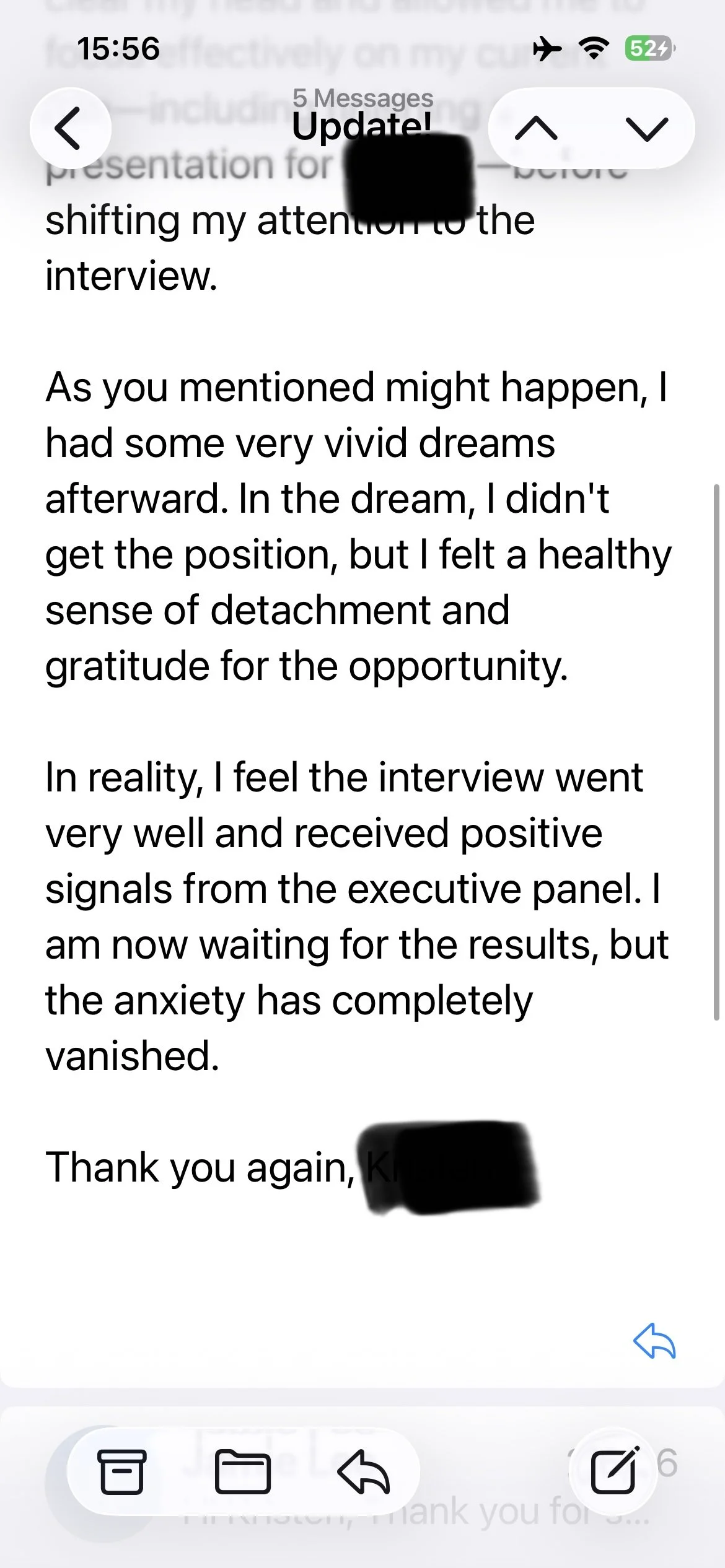
The anxiety has completely vanished. Before she even knew the outcome.
That's the whole thing, right there.
Now here's what I want you to understand about what Maya coined — because it has implications far beyond job interviews.
Office politics: When you're not rattled by the chaos, you become the calmest, clearest voice in the room. That's not just pleasant; it's power.
Getting paid more: Negotiating from detachment means walking in with matter-of-fact energy, no guilt, no silent apology for asking. Just a clear, grounded human stating what they're worth. That calm is contagious. It changes the room.
Leadership presence: Leaned back. Sitting tall. Calm and unhurried while everyone else is reactive. That's what healthy detachment looks like in a room, and it's magnetic precisely because it's so rare.
This is the counterintuitive heart of the work. Detachment doesn't make you passive or checked out.
It makes you more effective — because you're finally operating from your actual capacity, not from fear.
If you're a high-achiever who's genuinely excellent at her job and exhausted by how much that still isn't enough, this is the work.
Let's do the work. I'll help you.
My full coaching engagement is six months — enough time to do what Maya did and more: shift your mindset, rewire your defaults, and compound the results you create in your career.
We start with a free, hour-long consult where we do something most coaching conversations skip: we co-design a custom plan built around your unique situation, goals, and how your particular brain works.
No cookie-cutter frameworks. No homework you'll dread. Just a clear, tailored path — and someone in your corner who knows how to get you there.
If you're ready to stop white-knuckling and start playing a bigger game, let's talk.